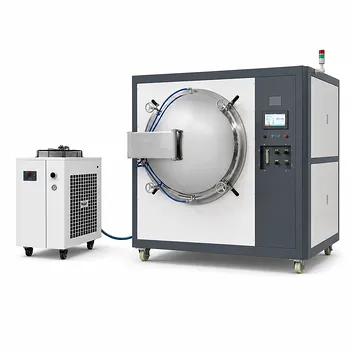
A vacuum hot press sintering furnace acts as the definitive processing tool for fabricating high thermal conductivity graphite and copper composites by simultaneously applying heat and mechanical pressure within a protected environment. This equipment integrates three distinct physical mechanisms—thermal fusion, uniaxial densification, and vacuum protection—to transform loose powders into a solid, highly oriented material.
Core Takeaway: The furnace’s primary contribution is the synergy of uniaxial pressure and vacuum protection. While heat softens the copper matrix, the pressure forces the graphite fillers to align directionally—a requirement for high thermal conductivity—while the vacuum ensures the interface remains free of oxidation and impurities.
The Mechanism of Induced Alignment and Densification
The most critical function of the vacuum hot press in this application is not just sintering (heating), but the application of force during the heating process.
Forcing Graphite Orientation
Graphite fillers often exist in flaky or fibrous forms. To achieve high thermal conductivity, these fillers must be aligned in a specific direction (typically the X-Y plane).
The furnace applies synchronized axial pressure (e.g., 40 MPa) during the sintering phase. This physical force mechanically reorients the graphite, forcing the flakes to lay flat perpendicular to the pressing direction. This alignment creates a continuous conductive path, which is the decisive factor in enhancing thermal performance.
Eliminating Internal Defects
Achieving a dense composite is difficult due to the non-wetting nature of graphite and copper. The furnace overcomes this by forcing the softened or liquid copper matrix into microscopic gaps.
The continuous pressure drives the metal into the voids between graphite flakes, significantly reducing porosity. By mechanically suppressing the expansion of copper and filling interlaminar gaps, the equipment ensures maximum material density and structural integrity.
The Critical Role of the Vacuum Environment
High temperatures are necessary to fuse copper (often around 980°C), but these temperatures would destroy the material in standard air.
Preventing Oxidation
Copper oxidizes rapidly at high temperatures, and graphite can degrade. The furnace creates a high-vacuum environment (e.g., 1x10^-2 Pa) that completely removes oxygen from the chamber.
This protection preserves the chemical purity of the copper matrix and the graphite fillers, ensuring that the final composite retains the intrinsic thermal properties of its constituent materials.
Enhancing Interfacial Bonding
Beyond simple oxidation prevention, the vacuum actively cleans the material precursors. It discharges adsorbed gases and volatiles trapped within the powder gaps.
By removing these impurities, the furnace ensures a "clean" interface between the copper and the graphite. This purity improves wettability and diffusion bonding, resulting in a composite with superior mechanical strength and electrical connectivity.
Operational Constraints and Variables
While the vacuum hot press is effective, the quality of the final composite relies on the precise balance of process variables.
The Pressure-Alignment Dependency
The thermal conductivity is directly linked to the magnitude of the pressure applied. If the mechanical pressure is insufficient, the graphite flakes will not align perfectly, leading to a randomization of the thermal pathways and a drop in performance.
Temperature Control Limits
The process requires a delicate thermal balance. The temperature must be high enough to induce the plastic flow of the copper matrix and facilitate liquid phase filling, but it must be controlled to prevent excessive reaction or degradation of the graphite structure.
Making the Right Choice for Your Project
The vacuum hot press sintering furnace is a specialized tool best used when directional performance and material purity are non-negotiable.
- If your primary focus is maximizing directional thermal conductivity: Prioritize high uniaxial pressure settings (e.g., 40 MPa) to ensure near-perfect alignment of graphite flakes in the X-Y plane.
- If your primary focus is mechanical strength and bonding: Ensure your furnace creates a high-vacuum state (10^-2 Pa or better) to remove volatiles and guarantee a pure, defect-free interface between the copper and graphite.
Ultimately, the vacuum hot press is the only viable solution for applications requiring the precise alignment of anisotropic fillers within a high-density metal matrix.
Summary Table:
| Mechanism | Function in Composite Fabrication | Impact on Performance |
|---|---|---|
| Uniaxial Pressure | Forces graphite flakes into directional alignment (X-Y plane). | Maximizes directional thermal conductivity. |
| Vacuum Environment | Removes oxygen and volatiles (up to 10^-2 Pa). | Prevents oxidation and ensures high material purity. |
| Thermal Fusion | Induces plastic flow of the copper matrix. | Eliminates porosity and enhances interfacial bonding. |
| Mechanical Compaction | Drives softened copper into microscopic gaps. | Increases structural density and mechanical strength. |
Elevate Your Advanced Material Fabrication with KINTEK
Precise control over temperature, pressure, and vacuum is essential for creating high-performance composites. KINTEK specializes in state-of-the-art laboratory equipment, offering high-performance vacuum hot press sintering furnaces, high-temperature furnaces (muffle, tube, and CVD), and hydraulic presses designed for the most demanding research and production environments.
Whether you are developing high thermal conductivity graphite-copper composites or researching battery technologies, our comprehensive range of crushing systems, cooling solutions, and specialized reactors provides the reliability you need.
Ready to optimize your material properties? Contact us today to discuss your project and discover how KINTEK's precision engineering can enhance your laboratory's efficiency.
Related Products
- 600T Vacuum Induction Hot Press Furnace for Heat Treat and Sintering
- Vacuum Heat Treat and Sintering Furnace with 9MPa Air Pressure
- Vacuum Heat Treat and Pressure Sintering Furnace for High Temperature Applications
- 2200 ℃ Tungsten Vacuum Heat Treat and Sintering Furnace
- Vacuum Hot Press Furnace Heated Vacuum Press Machine Tube Furnace
People Also Ask
- What role does an induction vacuum hot pressing furnace play in sintering? Achieve 98% Density in Carbide Blocks
- What advantages does a vacuum hot press furnace provide for LSLBO ceramic electrolytes? Achieve 94% Relative Density
- What role does a Vacuum Hot Press (VHP) furnace play in the densification of austenitic stainless steel 316 composites?
- What are the advantages of a vacuum hot press furnace for W-50%Cu? Achieve 99.6% Density at Lower Temperatures
- What role does mechanical pressure play during the vacuum diffusion bonding of tungsten and copper? Keys to Solid Bonding