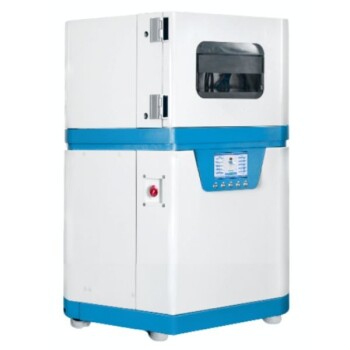
Vacuum hot pressing achieves degassing in SiC/Al composites by synchronizing a high-vacuum environment with a precise heating profile to actively discharge adsorbed gases and volatiles from powder surfaces. By lowering the surrounding pressure while introducing thermal energy, the system effectively strips impurities from the particle interfaces, preventing oxidation and pore formation before the material is fully densified.
Core Insight: The synergy between the vacuum system and the heating program is the primary driver for achieving high density. The vacuum lowers the boiling point of volatile impurities and prevents oxidation, while the thermal energy detaches adsorbed gases from the powder surface, ensuring the final composite is free of internal defects and structurally sound.
The Mechanics of the Coordination
The Role of the Vacuum System
The primary function of the vacuum system is to reduce the oxygen partial pressure within the furnace chamber.
By maintaining a high vacuum, the system creates an environment where the boiling point of volatile impurities is significantly lowered, facilitating their removal. This is critical for preventing the oxidation of the highly reactive aluminum alloy matrix and magnesium elements, which would otherwise degrade the material's performance.
The Role of the Heating Program
The heating program provides the kinetic energy required to release gases that are physically or chemically adsorbed onto the surface of the SiC and Aluminum powders.
As the temperature rises, these adsorbed molecules vibrate more vigorously and detach from the particle surfaces. The heating rate is carefully controlled to ensure this desorption occurs steadily without triggering premature reactions or melting before the gases are fully evacuated.
Synchronization for Defect Removal
The vacuum and heating systems must operate in tandem to eliminate internal pore defects.
If heating occurs without a vacuum, the gases expand and become trapped; if a vacuum is applied without sufficient heat, the adsorbed gases remain stuck to the particle surfaces. Only by coordinating heat to release the gas and vacuum to evacuate it can the process achieve the high density required for structural composites.
Why This Matters for SiC/Al Composites
Enhancing Wettability
Effective degassing significantly improves the wettability between the rigid Silicon Carbide (SiC) particles and the Aluminum matrix.
Adsorbed gases act as a barrier, preventing the molten or semi-solid aluminum from bonding effectively with the SiC. By removing these gases, the vacuum hot pressing process facilitates direct contact, leading to stronger metallurgical bonding and better load transfer.
Preventing Oxidation-Induced Embrittlement
Aluminum and its alloying elements (like Magnesium) are highly active and react easily with oxygen at high temperatures.
The vacuum environment acts as a shield, isolating oxygen to prevent the formation of oxide layers on the matrix or the SiC fiber coatings. This preserves the interface bonding strength and prevents the inclusion of brittle oxide impurities that would compromise the composite's ductility.
Critical Process Constraints and Risks
Managing Interface Reactions (Al4C3)
While heating is necessary for degassing, the temperature must be capped to avoid the formation of Al4C3 (Aluminum Carbide).
This is a brittle, hygroscopic phase that forms if the temperature gets too high during the sintering process. Precise thermocouple feedback is required to hold the temperature at an optimal point—high enough to degas and sinter, but low enough to prevent this harmful chemical reaction which degrades thermal conductivity and strength.
Timing the Pressure Application
The application of axial pressure must be coordinated with the degassing phase.
If high pressure is applied before the degassing is complete, gases may be trapped inside the compact, creating pressurized pores that cannot escape. The vacuum system must effectively evacuate the chamber before the material flows plastically to seal the interstitial gaps.
Making the Right Choice for Your Goal
To maximize the performance of your SiC/Al composite, tailor the furnace parameters to your specific performance requirements:
- If your primary focus is Maximum Density: Prioritize a high-vacuum hold time at moderate temperatures to ensure thorough evacuation of adsorbed gases before applying peak pressure.
- If your primary focus is Thermal Conductivity: strictly limit the maximum temperature to prevent the formation of the Al4C3 interfacial reaction layer.
- If your primary focus is Mechanical Strength: Ensure the vacuum level is sufficient to prevent oxidation of Magnesium (if present), as Mg-oxides significantly weaken grain boundaries.
Summary: The success of SiC/Al composite fabrication relies not just on heat or pressure, but on the vacuum system's ability to create a clean, gas-free environment that allows the heating program to facilitate pure, defect-free diffusion bonding.
Summary Table:
| Coordination Element | Function in Degassing Process | Impact on SiC/Al Composite |
|---|---|---|
| Vacuum System | Lowers oxygen partial pressure & boiling point of volatiles | Prevents oxidation & enables impurity removal |
| Heating Program | Provides kinetic energy to detach adsorbed gases | Prepares particle surfaces for metallurgical bonding |
| Pressure Timing | Applied after degassing is complete | Eliminates internal pores & achieves high density |
| Interface Control | Caps temperature to avoid Al4C3 formation | Preserves thermal conductivity & prevents embrittlement |
Elevate Your Material Research with KINTEK Precision
Achieving the perfect balance of vacuum, temperature, and pressure is critical for high-performance SiC/Al composites. KINTEK specializes in advanced laboratory equipment, offering high-performance vacuum hot pressing furnaces, high-temperature furnaces (muffle, tube, vacuum, CVD), and hydraulic presses designed for precision densification.
Our solutions empower researchers and manufacturers to eliminate internal defects, prevent oxidation, and optimize interface bonding. Whether you are working on battery research, powder metallurgy, or advanced ceramics, KINTEK provides the comprehensive tools and consumables—from PTFE products to crucibles—to ensure your success.
Ready to optimize your degassing process? Contact KINTEK today to find the ideal furnace or press for your specific application!
Related Products
- 600T Vacuum Induction Hot Press Furnace for Heat Treat and Sintering
- Vacuum Hot Press Furnace Heated Vacuum Press Machine Tube Furnace
- Vacuum Hot Press Furnace Machine for Lamination and Heating
- Vacuum Hot Press Furnace Machine Heated Vacuum Press
- Vacuum Heat Treat and Pressure Sintering Furnace for High Temperature Applications
People Also Ask
- What role does an induction vacuum hot pressing furnace play in sintering? Achieve 98% Density in Carbide Blocks
- What advantages does a vacuum hot press furnace provide for LSLBO ceramic electrolytes? Achieve 94% Relative Density
- What role does a Vacuum Hot Press (VHP) furnace play in the densification of austenitic stainless steel 316 composites?
- What are the advantages of a vacuum hot press furnace for W-50%Cu? Achieve 99.6% Density at Lower Temperatures
- What role does mechanical pressure play during the vacuum diffusion bonding of tungsten and copper? Keys to Solid Bonding