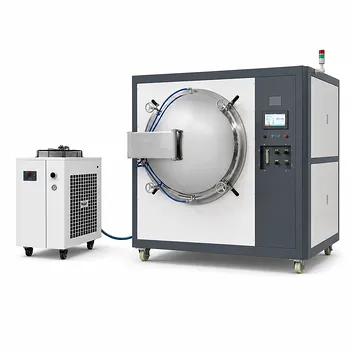
The vacuum environment acts as a critical chemical process enabler for sintering boron carbide-based ceramics. It primarily functions to prevent the oxidation of the base material and sintering aids while actively extracting gaseous byproducts generated during high-temperature reactions.
Boron carbide relies on complex chemical reactions to achieve full density, yet these reactions are easily disrupted by oxygen or trapped gases. A vacuum environment protects the integrity of these reactions, ensuring the formation of essential liquid phases that bind the ceramic together.
Preservation of Material Integrity
Preventing High-Temperature Oxidation
Boron carbide and its additives are highly susceptible to oxidation when exposed to high temperatures.
The vacuum environment eliminates oxygen from the chamber, protecting both the boron carbide matrix and sensitive sintering aids (such as rare earth oxides) from degradation.
Purification of Grain Boundaries
Raw ceramic powders often contain adsorbed gases and volatile impurities like boron oxide (B2O3).
The vacuum environment effectively removes these impurities, stripping them away to purify the grain boundaries. This purification is essential for creating strong, direct bonds between the ceramic grains.
Facilitating Complex Densification Reactions
Managing Gaseous Byproducts
The chemical reactions required to densify boron carbide often generate gaseous byproducts, such as carbon monoxide (CO).
If these gases remain trapped, they create pores that weaken the final material. The negative pressure of the vacuum actively draws these byproducts out of the material as they are formed.
Promoting Essential Liquid Phases
Achieving high density in boron carbide relies on the formation of specific liquid phases and compounds.
The controlled vacuum environment manages the reaction between alumina, carbon, and rare earth oxides. This allows for the stable formation of compounds like Al8B4C7 and LaAlO3, which are vital for the densification process.
Enhancing Structural Performance
Reducing Gas Resistance
Trapped gas within the pores of the material creates resistance that fights against densification.
By removing this gas, the vacuum reduces internal resistance. This allows the mechanical pressure applied by the hot-press to close pores more effectively.
Synergistic Densification
While mechanical pressure drives particle rearrangement, the vacuum ensures the chemistry supports it.
This combination allows for high-density ceramics (exceeding 90% relative density) to be produced at lower temperatures than would be possible with pressureless sintering.
Understanding the Trade-offs
Operational Complexity and Cost
While the vacuum environment is chemically superior, it introduces significant complexity to the manufacturing process.
Vacuum hot-press furnaces are considerably more expensive to operate and maintain than standard furnaces. The system requires rigorous seal maintenance to prevent leaks that could catastrophically oxidize the batch.
Volatilization Risks
A high vacuum is excellent for cleaning impurities, but it must be carefully controlled.
Excessive vacuum levels at peak temperatures can potentially volatilize desirable elements or additives if the vapor pressure limits are not respected. Precise control logic is required to balance purification with composition retention.
Making the Right Choice for Your Goal
Achieving the full potential of boron carbide requires balancing temperature, pressure, and atmosphere.
- If your primary focus is maximizing material density: Prioritize a high-vacuum stage during the onset of liquid phase formation to ensure all pore-forming gases are evacuated before the pores close.
- If your primary focus is mechanical strength: Ensure the vacuum system is capable of effectively removing B2O3 impurities, as clean grain boundaries are the strongest predictor of fracture toughness.
The vacuum environment transforms the sintering process from a simple heating cycle into a controlled chemical purification that is mandatory for high-performance boron carbide.
Summary Table:
| Key Feature | Advantage for Boron Carbide Sintering |
|---|---|
| Oxidation Prevention | Protects matrix and rare earth sintering aids from high-temp degradation. |
| Impurity Removal | Strips volatile B2O3 and adsorbed gases to purify grain boundaries. |
| Byproduct Extraction | Actively removes CO gas to prevent pore formation and structural weakness. |
| Phase Stabilization | Facilitates essential liquid phases like Al8B4C7 for full densification. |
| Pressure Synergy | Reduces gas resistance, allowing mechanical pressure to close pores effectively. |
Elevate Your Advanced Ceramic Production with KINTEK
Achieving the perfect balance of temperature, pressure, and atmosphere is critical for high-performance boron carbide. KINTEK specializes in precision laboratory equipment designed for the most demanding material science applications. Our comprehensive portfolio includes:
- High-Temperature Furnaces: Vacuum, atmosphere, muffle, and tube furnaces tailored for precise thermal processing.
- Hydraulic Presses: Advanced pellet, hot, and isostatic presses to ensure maximum densification.
- Specialized Reactors: High-temperature high-pressure reactors and autoclaves for complex chemical synthesis.
- Lab Consumables: High-purity ceramics, crucibles, and PTFE products to maintain material integrity.
Whether you are refining sintering protocols or scaling up production, KINTEK provides the reliable tools and technical expertise you need to succeed.
Ready to optimize your sintering process? Contact our experts today to find the perfect solution!
Related Products
- Vacuum Hot Press Furnace Heated Vacuum Press Machine Tube Furnace
- 600T Vacuum Induction Hot Press Furnace for Heat Treat and Sintering
- Vacuum Hot Press Furnace Machine Heated Vacuum Press
- Vacuum Hot Press Furnace Machine for Lamination and Heating
- Vacuum Heat Treat and Pressure Sintering Furnace for High Temperature Applications
People Also Ask
- What advantages does a vacuum hot press furnace provide for LSLBO ceramic electrolytes? Achieve 94% Relative Density
- What role does a Vacuum Hot Press (VHP) furnace play in the densification of austenitic stainless steel 316 composites?
- What are the advantages of using a vacuum hot pressing furnace? Superior Densification for 2024Al/Gr/SiC Composites
- What are the advantages of a vacuum hot press furnace for LTPO solid electrolytes? Boost Density and Conductivity
- What core processing conditions does a vacuum hot press furnace provide? Achieve High-Density Cu-SiC/Diamond Composites