Knowledge Why is a hot-press setup used instead of traditional high-temperature sintering? Optimize LATP/NCM-811 Interface Study
Author avatar

Tech Team · Kintek Solution

Updated 22 hours ago

Why is a hot-press setup used instead of traditional high-temperature sintering? Optimize LATP/NCM-811 Interface Study


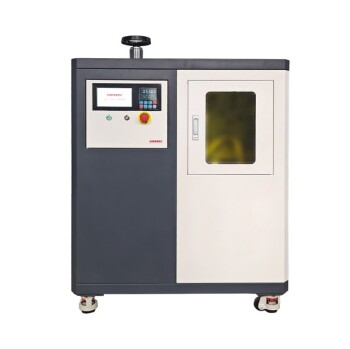
The hot-press setup is utilized primarily to circumvent the thermal incompatibility between LATP (solid electrolyte) and NCM-811 (cathode materials). By introducing high pressure as a variable, researchers can fabricate functional bulk-type batteries at approximately 150°C, drastically lower than the temperatures required for traditional manufacturing.

Core Takeaway Standard sintering processes require temperatures exceeding 900°C, which trigger severe, destructive side reactions at the interface of LATP and NCM-811. The hot-press method substitutes extreme heat with mechanical pressure, preserving the chemical integrity of the interface while ensuring sufficient contact for electrochemical testing.

The Incompatibility of Traditional Sintering

To understand why a hot-press is necessary, one must first understand the limitations of conventional ceramic processing for this specific material pairing.

The Thermal Threshold

Traditional high-temperature sintering is the standard method for densifying ceramic materials and ensuring good particle-to-particle contact. However, this process typically requires temperatures exceeding 900°C.

Interfacial Degradation

While effective for single materials, this high thermal environment is catastrophic for the LATP/NCM-811 interface. At these temperatures, severe interfacial side reactions occur between the electrolyte and the cathode. These reactions degrade the materials before the battery can even be tested, making it impossible to study the intrinsic electrochemical performance of the composite.

The Hot-Press Solution

The hot-press setup provides critical hardware support by altering the physics of fabrication, shifting the reliance from thermal energy to mechanical energy.

Operational Parameters

Instead of reaching 900°C, the hot-press setup operates at a relatively low temperature, specifically around 150°C. This creates a thermal environment that is benign enough to prevent the chemical breakdown of the interface.

The Role of Pressure

To compensate for the lower temperature, the setup applies high pressure. This mechanical force is what achieves the necessary densification and contact between particles, which is usually achieved through heat in sintering.

Direct Material Application

This configuration enables the direct application of LATP powder in bulk-type batteries. It allows researchers to bypass complex coating or buffer layer strategies that might otherwise be needed to survive high-temperature processing.

Understanding the Trade-offs

While the hot-press setup solves the immediate problem of material degradation, it represents a specific engineering compromise.

Thermal Constraints vs. Mechanical Complexity

The primary trade-off here is exchanging a simple thermal process (sintering) for a mechanically complex one (hot-pressing). While it avoids side reactions, it requires specialized hardware capable of maintaining uniform high pressure at elevated temperatures.

Research vs. Scalability

This method is described specifically as providing "hardware support for researching composite electrode electrochemical performance." It is a specialized tool for enabling analysis in a lab setting, allowing scientists to characterize materials that would otherwise be chemically unstable during fabrication.

Making the Right Choice for Your Goal

When designing experiments involving LATP and NCM-811, your processing method dictates your results.

  • If your primary focus is preserving interface chemistry: Use the hot-press method to keep processing temperatures below the reaction threshold (approx. 150°C).
  • If your primary focus is achieving particle contact: Rely on the high-pressure component of the hot-press setup to mimic the densification usually provided by sintering.

Ultimately, the hot-press setup is the only viable pathway to study the true performance of this composite, as it allows the battery to exist without destroying itself during manufacture.

Summary Table:

Feature Traditional Sintering Hot-Press Setup
Operating Temperature > 900°C ~ 150°C
Primary Force Thermal Energy Mechanical Pressure
Interface Stability Severe Side Reactions Chemically Preserved
Material Integrity Degraded/Destructive High Integrity
Key Application Standard Ceramics Composite Electrode Research

Elevate Your Solid-State Battery Research with KINTEK

Don't let interfacial degradation compromise your data. KINTEK specializes in advanced laboratory hardware designed for precision material science. Whether you are researching LATP and NCM-811 or developing next-generation energy storage, our range of hydraulic presses (hot and isostatic) and high-temperature furnaces provides the exact control you need over pressure and thermal environments.

From battery research tools to specialized PTFE products and ceramics, KINTEK delivers the equipment and consumables required for high-performance lab environments. Our experts are ready to help you select the ideal setup to ensure your composite materials maintain their chemical integrity.

Ready to optimize your fabrication process? Contact KINTEK today for expert solutions!

Related Products

People Also Ask

Related Products

Vacuum Hot Press Furnace Heated Vacuum Press Machine Tube Furnace

Vacuum Hot Press Furnace Heated Vacuum Press Machine Tube Furnace

Reduce forming pressure & shorten sintering time with Vacuum Tube Hot Press Furnace for high-density, fine-grain materials. Ideal for refractory metals.

Vacuum Hot Press Furnace Machine Heated Vacuum Press

Vacuum Hot Press Furnace Machine Heated Vacuum Press

Discover the advantages of Vacuum Hot Press Furnace! Manufacture dense refractory metals & compounds, ceramics, and composites under high temp and pressure.

600T Vacuum Induction Hot Press Furnace for Heat Treat and Sintering

600T Vacuum Induction Hot Press Furnace for Heat Treat and Sintering

Discover the 600T Vacuum Induction Hot Press Furnace, designed for high-temperature sintering experiments in vacuum or protected atmospheres. Its precise temperature and pressure control, adjustable working pressure, and advanced safety features make it ideal for nonmetal materials, carbon composites, ceramics, and metal powders.

Vacuum Heat Treat Furnace with Ceramic Fiber Liner

Vacuum Heat Treat Furnace with Ceramic Fiber Liner

Vacuum furnace with polycrystalline ceramic fiber insulation liner for excellent heat insulation and uniform temperature field. Choose from 1200℃ or 1700℃ max. working temperature with high vacuum performance and precise temperature control.

Vacuum Heat Treat and Molybdenum Wire Sintering Furnace for Vacuum Sintering

Vacuum Heat Treat and Molybdenum Wire Sintering Furnace for Vacuum Sintering

A vacuum molybdenum wire sintering furnace is a vertical or bedroom structure, which is suitable for withdrawal, brazing, sintering and degassing of metal materials under high vacuum and high temperature conditions. It is also suitable for dehydroxylation treatment of quartz materials.

High Pressure Laboratory Vacuum Tube Furnace Quartz Tubular Furnace

High Pressure Laboratory Vacuum Tube Furnace Quartz Tubular Furnace

KT-PTF High Pressure Tube Furnace: Compact split tube furnace with strong positive pressure resistance. Working temp up to 1100°C and pressure up to 15Mpa. Also works under controller atmosphere or high vacuum.

2200 ℃ Tungsten Vacuum Heat Treat and Sintering Furnace

2200 ℃ Tungsten Vacuum Heat Treat and Sintering Furnace

Experience the ultimate refractory metal furnace with our Tungsten vacuum furnace. Capable of reaching 2200℃, perfect for sintering advanced ceramics and refractory metals. Order now for high-quality results.

Vacuum Heat Treat Sintering Brazing Furnace

Vacuum Heat Treat Sintering Brazing Furnace

A vacuum brazing furnace is a type of industrial furnace used for brazing, a metalworking process that joins two pieces of metal using a filler metal that melts at a lower temperature than the base metals. Vacuum brazing furnaces are typically used for high-quality applications where a strong, clean joint is required.

Molybdenum Vacuum Heat Treat Furnace

Molybdenum Vacuum Heat Treat Furnace

Discover the benefits of a high-configuration molybdenum vacuum furnace with heat shield insulation. Ideal for high-purity, vacuum environments like sapphire crystal growth and heat treatment.

Vacuum Heat Treat and Sintering Furnace with 9MPa Air Pressure

Vacuum Heat Treat and Sintering Furnace with 9MPa Air Pressure

The air pressure sintering furnace is a high-tech equipment commonly used for the sintering of advanced ceramic materials. It combines vacuum sintering and pressure sintering techniques to achieve high-density and high-strength ceramics.

Laboratory Rapid Thermal Processing (RTP) Quartz Tube Furnace

Laboratory Rapid Thermal Processing (RTP) Quartz Tube Furnace

Get lightning-fast heating with our RTP Rapid Heating Tube Furnace. Designed for precise, high-speed heating and cooling with convenient sliding rail and TFT touch screen controller. Order now for ideal thermal processing!

1800℃ Muffle Oven Furnace for Laboratory

1800℃ Muffle Oven Furnace for Laboratory

KT-18 muffle furnace with Japan Al2O3 polycrystalline fibe and Silicon Molybdenum heating element, up to 1900℃, PID temperature control and 7" smart touch screen. Compact design, low heat loss, and high energy efficiency. Safety interlock system and versatile functions.

1700℃ Muffle Oven Furnace for Laboratory

1700℃ Muffle Oven Furnace for Laboratory

Get superior heat control with our 1700℃ Muffle Furnace. Equipped with intelligent temperature microprocessor, TFT touch screen controller & advanced insulation materials for precise heating up to 1700C. Order now!

Ultra-High Temperature Graphite Vacuum Graphitization Furnace

Ultra-High Temperature Graphite Vacuum Graphitization Furnace

The ultra-high temperature graphitization furnace utilizes medium frequency induction heating in a vacuum or inert gas environment. The induction coil generates an alternating magnetic field, inducing eddy currents in the graphite crucible, which heats up and radiates heat to the workpiece, bringing it to the desired temperature. This furnace is primarily used for graphitization and sintering of carbon materials, carbon fiber materials, and other composite materials.

Vacuum Dental Porcelain Sintering Furnace

Vacuum Dental Porcelain Sintering Furnace

Get precise and reliable results with KinTek's Vacuum Porcelain Furnace. Suitable for all porcelain powders, it features hyperbolic ceramic furnace function, voice prompt, and automatic temperature calibration.

1700℃ Laboratory High Temperature Tube Furnace with Alumina Tube

1700℃ Laboratory High Temperature Tube Furnace with Alumina Tube

Looking for a high-temperature tube furnace? Check out our 1700℃ Tube Furnace with Alumina Tube. Perfect for research and industrial applications up to 1700C.

1400℃ Muffle Oven Furnace for Laboratory

1400℃ Muffle Oven Furnace for Laboratory

Get precise high-temperature control up to 1500℃ with KT-14M Muffle furnace. Equipped with a smart touch screen controller and advanced insulation materials.

Dental Porcelain Zirconia Sintering Ceramic Vacuum Press Furnace

Dental Porcelain Zirconia Sintering Ceramic Vacuum Press Furnace

Get precise dental results with Dental Vacuum Press Furnace. Automatic temperature calibration, low noise tray, and touch screen operation. Order now!

Horizontal High Temperature Graphite Vacuum Graphitization Furnace

Horizontal High Temperature Graphite Vacuum Graphitization Furnace

Horizontal Graphitization Furnace: This type of furnace is designed with the heating elements placed horizontally, allowing for uniform heating of the sample. It's well-suited for graphitizing large or bulky samples that require precise temperature control and uniformity.

Mesh belt controlled atmosphere furnace

Mesh belt controlled atmosphere furnace

Discover our KT-MB mesh belt sintering furnace - perfect for high-temperature sintering of electronic components & glass insulators. Available for open air or controlled atmosphere environments.


Leave Your Message