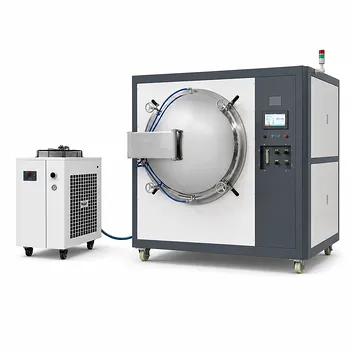
The consolidation of bulk amorphous Ni-Zr-Ti-Si alloys mandates the use of a vacuum hot pressing furnace to simultaneously manage extreme chemical reactivity and physical densification. This specific equipment is required because it integrates a high-vacuum environment to prevent the oxidation of active powders with mechanical pressure that exploits the alloy's viscous flow characteristics to eliminate porosity.
Core Takeaway Processing amorphous alloys requires a delicate balance of protection and force. A vacuum hot pressing furnace provides the necessary oxygen-free environment to preserve the material's purity while utilizing the supercooled liquid region to press the powder into a dense, defect-free bulk form.
The Critical Role of the Vacuum Environment
Preventing Oxidation of Active Elements
The specific composition of Ni-Zr-Ti-Si alloys includes highly reactive elements, particularly Titanium (Ti) and Zirconium (Zr).
These elements are prone to rapid oxidation at elevated temperatures. The furnace’s vacuum environment creates a barrier that prevents these active amorphous powders from reacting with oxygen, preserving the chemical integrity of the alloy.
Degassing and Purification
Beyond simple shielding, the high vacuum serves an active purification role.
It facilitates the degassing of adsorbed gases trapped between powder particles. Removing these volatiles before the pores close is essential to prevent gas entrapment, which would otherwise compromise the cleanliness and mechanical strength of the final bulk material.
Mechanisms for Achieving High Density
Exploiting Viscous Flow
Unlike crystalline metals that rely heavily on atomic diffusion for sintering, amorphous alloys have a unique processing window known as the supercooled liquid region.
The vacuum hot pressing furnace heats the material into this specific temperature range. Under these conditions, the amorphous alloy exhibits viscous flow characteristics, softening effectively without crystallizing.
Eliminating Macroscopic Defects
Heat alone is often insufficient to fully densify amorphous powders.
The equipment applies mechanical pressure simultaneously with heating. This external force drives the softened material to rearrange and flow, effectively closing pores between particles. This results in high-density samples free from the macroscopic defects common in pressure-less sintering.
Lowering Activation Energy
The application of mechanical pressure has a thermodynamic benefit.
It significantly lowers the sintering activation energy, promoting particle contact and plastic deformation. This allows for densification at relatively lower temperatures, which is crucial for maintaining the amorphous nature of the alloy and avoiding crystallization.
Understanding the Trade-offs
Equipment Complexity vs. Process Efficiency
While vacuum hot pressing is more complex than traditional cold-pressing and sintering, it is far more efficient for advanced alloys.
Traditional methods often result in long process flows and densification difficulties. Vacuum hot pressing integrates degassing, compression molding, and sintering into a single step, significantly shortening the processing cycle and ensuring near-net-shape production.
Sensitivity to Parameters
The advantage of this equipment lies in its precision, but this also presents a challenge.
The process relies on a strict balance of temperature and pressure. If the temperature exceeds the supercooled liquid region, the alloy risks crystallization, losing its amorphous properties. If the pressure is insufficient, the material will fail to reach full density (95% to 100%).
Making the Right Choice for Your Goal
When configuring your consolidation process for Ni-Zr-Ti-Si alloys:
- If your primary focus is Material Purity: Prioritize a high-vacuum setting to ensure the complete removal of adsorbed gases and total protection of the Ti and Zr elements from oxidation.
- If your primary focus is Structural Density: Focus on optimizing the mechanical pressure within the supercooled liquid region to maximize viscous flow and eliminate microscopic pores.
The vacuum hot pressing furnace is not just a heating tool; it is a requisite environment for navigating the narrow processing window of bulk amorphous alloys.
Summary Table:
| Feature | Function in Ni-Zr-Ti-Si Consolidation | Benefit to Amorphous Alloy |
|---|---|---|
| High Vacuum | Prevents oxidation of Zr and Ti; facilitates degassing | Maintains chemical purity and mechanical strength |
| Mechanical Pressure | Drives particle rearrangement and plastic deformation | Eliminates porosity and achieves 95-100% density |
| Thermal Control | Operates within the supercooled liquid region | Enables viscous flow while avoiding crystallization |
| Integrated Process | Combines degassing, molding, and sintering | Shortens production cycles and ensures near-net-shape |
Maximize Your Material Integrity with KINTEK
Precision is paramount when processing reactive amorphous alloys. KINTEK specializes in advanced laboratory equipment, offering high-performance vacuum hot pressing systems and high-temperature furnaces designed to handle the most demanding consolidation tasks.
Whether you are working with Ni-Zr-Ti-Si alloys or developing next-generation battery materials, our comprehensive range—including high-pressure reactors, hydraulic presses, and specialized ceramics—provides the control you need to achieve defect-free results.
Ready to elevate your lab’s capabilities? Contact our experts today to find the perfect solution for your research and production needs!
Related Products
- Vacuum Hot Press Furnace Heated Vacuum Press Machine Tube Furnace
- 600T Vacuum Induction Hot Press Furnace for Heat Treat and Sintering
- Vacuum Hot Press Furnace Machine Heated Vacuum Press
- Vacuum Hot Press Furnace Machine for Lamination and Heating
- Vacuum Heat Treat and Pressure Sintering Furnace for High Temperature Applications
People Also Ask
- What advantages does a vacuum hot press furnace provide for LSLBO ceramic electrolytes? Achieve 94% Relative Density
- What role does a Vacuum Hot Press (VHP) furnace play in the densification of austenitic stainless steel 316 composites?
- What are the advantages of using a vacuum hot pressing furnace? Superior Densification for 2024Al/Gr/SiC Composites
- What are the advantages of a vacuum hot press furnace for LTPO solid electrolytes? Boost Density and Conductivity
- What core processing conditions does a vacuum hot press furnace provide? Achieve High-Density Cu-SiC/Diamond Composites