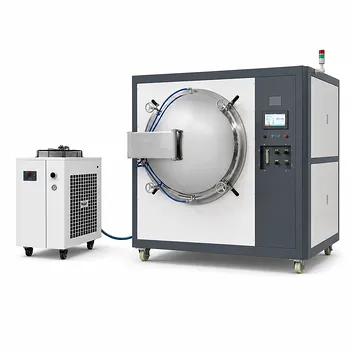
The core function of a Vacuum Hot Pressing (VHP) furnace in Ruthenium target preparation is to drive densification through the simultaneous application of uniaxial mechanical pressure and thermal energy. By subjecting Ruthenium powder to pressures around 40 MPa and temperatures up to 1250°C, the furnace forces particle consolidation. This process yields a highly dense metallic structure (approximately 12.2 g cm⁻³) with fine grain sizes, achievable at temperatures significantly lower than the metal's melting point.
By integrating mechanical pressure with heat, VHP activates plastic deformation and diffusion creep mechanisms that thermal sintering alone cannot induce. This synergy effectively eliminates internal porosity, resulting in a target with near-theoretical density (up to 99.7%) and a fine, uniform microstructure essential for high-performance applications.
Mechanisms of Densification
The Synergy of Heat and Pressure
The primary advantage of VHP is the application of uniaxial pressure (typically 40 MPa) alongside high temperatures. While standard sintering relies solely on thermal energy to bond particles, VHP uses mechanical force to physically compress the powder. This allows for successful sintering at 1250°C, which is well below the melting point of Ruthenium.
Activating Microscopic Flow
The combination of heat and pressure triggers specific physical mechanisms within the Ruthenium powder: particle rearrangement, plastic deformation, and diffusion creep. As the particles are heated, they soften; the applied pressure then forces them to slide past one another and deform to fill voids. This mechanical action is critical for closing the interstitial gaps that would otherwise remain as pores.
Controlling Grain Size
Because VHP achieves densification at lower temperatures and faster rates than pressure-less sintering, it restricts excessive grain growth. The result is a fine grain size, typically between 4 and 5 micrometers. A finer grain structure generally leads to better sputtering performance and film quality in the final application.
The Role of the Vacuum Environment
Elimination of Internal Pores
The "vacuum" component of the furnace is as critical as the pressure. By operating in a vacuum, the system removes entrapped air and volatile gases from between the powder particles before the pores seal off. This prevents gas pockets from becoming trapped inside the material, which is a primary cause of low density and structural weakness.
Enhancing Material Purity
The vacuum environment facilitates the removal of impurities that might otherwise contaminate the Ruthenium. The low pressure aids in the volatilization of contaminants, ensuring that the final target maintains the high purity levels required for sensitive electronic or semiconductor applications.
Understanding the Trade-offs
Balancing Cost and Performance
When selecting a manufacturing method, VHP is often chosen over alternatives like Hot Isostatic Pressing (HIP) or Spark Plasma Sintering (SPS) due to cost efficiency. VHP offers a lower equipment and operational cost structure while maintaining high controllability. It provides an optimal balance, achieving the necessary high density for Ruthenium without the extreme expense of more complex isostatic systems.
Process Limitations
While highly effective, VHP applies pressure primarily in one direction (uniaxial). This differs from isostatic pressing, which applies pressure from all sides. While VHP is sufficient for the geometry of most sputtering targets, operators must ensure that the uniaxial force is applied uniformly to prevent density gradients across the target's thickness.
Making the Right Choice for Your Goal
To determine if Vacuum Hot Pressing is the correct methodology for your specific Ruthenium application, consider your primary constraints:
- If your primary focus is Material Quality: Rely on VHP to achieve a fine grain size (4–5 µm) and high density (12.2 g cm⁻³) through plastic deformation and creep.
- If your primary focus is Manufacturing Efficiency: Utilize VHP to reduce energy consumption and cycle times by sintering at temperatures significantly lower than the melting point.
- If your primary focus is Cost Management: Choose VHP as a cost-effective alternative to HIP or SPS, offering operational simplicity without sacrificing critical density metrics.
VHP remains the industry standard for Ruthenium targets because it reliably bridges the gap between economic feasibility and the strict requirement for near-theoretical density.
Summary Table:
| Parameter | VHP Performance Metric |
|---|---|
| Core Mechanism | Simultaneous Uniaxial Pressure & Thermal Energy |
| Sintering Temperature | Approx. 1250°C (Below melting point) |
| Applied Pressure | ~40 MPa |
| Achieved Density | Up to 12.2 g/cm³ (99.7% Theoretical) |
| Grain Size | 4 – 5 μm (Fine Microstructure) |
| Atmosphere | Vacuum (Removes gas pockets & impurities) |
Elevate Your Materials Research with KINTEK Precision
Unlock the full potential of your thin-film applications with KINTEK’s advanced Vacuum Hot Pressing (VHP) solutions. Our high-performance furnaces provide the precise control of pressure and temperature needed to achieve near-theoretical density and uniform microstructures in challenging materials like Ruthenium.
As experts in laboratory equipment, KINTEK offers a comprehensive range of solutions for the semiconductor and electronics industries, including:
- High-Temperature Furnaces: Muffle, tube, vacuum, and specialized VHP systems.
- Crushing & Milling: Precision systems for consistent powder preparation.
- Hydraulic Presses: Pellet, hot, and isostatic presses for optimal consolidation.
- Advanced Reactors: High-temperature high-pressure reactors and autoclaves.
Ready to optimize your sputtering target production? Contact our technical specialists today to find the perfect equipment configuration for your lab's unique requirements.
Related Products
- Vacuum Hot Press Furnace Heated Vacuum Press Machine Tube Furnace
- 600T Vacuum Induction Hot Press Furnace for Heat Treat and Sintering
- Vacuum Hot Press Furnace Machine Heated Vacuum Press
- Vacuum Hot Press Furnace Machine for Lamination and Heating
- Vacuum Heat Treat and Pressure Sintering Furnace for High Temperature Applications
People Also Ask
- What advantages does a vacuum hot press furnace provide for LSLBO ceramic electrolytes? Achieve 94% Relative Density
- What role does a Vacuum Hot Press (VHP) furnace play in the densification of austenitic stainless steel 316 composites?
- What are the advantages of using a vacuum hot pressing furnace? Superior Densification for 2024Al/Gr/SiC Composites
- What are the advantages of a vacuum hot press furnace for LTPO solid electrolytes? Boost Density and Conductivity
- What core processing conditions does a vacuum hot press furnace provide? Achieve High-Density Cu-SiC/Diamond Composites