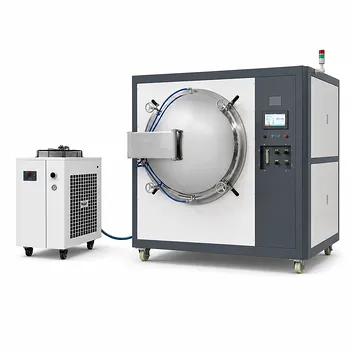
The vacuum hot pressing furnace serves as the definitive consolidation tool for fabricating Al-20% Si and graphite flake composites. It functions by simultaneously applying high temperature and axial pressure within a controlled, inert environment. This dual-action process is essential for transforming loose powders into a solid, high-performance material.
By synchronizing mechanical force with thermal energy in an oxygen-free atmosphere, this equipment solves the twin challenges of porosity and oxidation, ensuring the aluminum-silicon matrix and graphite reinforcement bond intimately into a high-density composite.
Achieving Near-Theoretical Density
The primary challenge in powder metallurgy is eliminating voids between particles. The vacuum hot pressing furnace addresses this through a distinct mechanical process.
Facilitating Particle Rearrangement
The furnace applies axial pressure directly to the powder mixture.
This physical force compels the Al-20% Si and graphite particles to physically move and reorganize into a tighter packing configuration before sintering fully begins.
Inducing Plastic Deformation
As temperatures rise, the aluminum alloy matrix softens.
The continued application of pressure causes plastic deformation of the powder particles. This deformation forces the material to flow into and fill the remaining microscopic voids, effectively eliminating internal pores.
Resulting Material Density
The combination of rearrangement and deformation leads to a composite with high density.
Without this simultaneous pressure, the material would likely retain porosity, which would severely compromise its mechanical strength and thermal properties.
Preserving Material Chemistry
Aluminum and graphite are reactive materials, particularly at elevated temperatures. The furnace’s environmental controls are critical for preserving their properties.
Preventing Oxidation
The furnace operates under a high vacuum or an inert atmosphere.
This deprives the environment of oxygen, preventing the high-temperature oxidation of the aluminum alloy. It protects the graphite flakes, which would otherwise degrade or burn off in an oxygen-rich environment.
Ensuring Interfacial Bonding
Clean surfaces are a prerequisite for strong bonding between the matrix and the reinforcement.
By preventing oxide layers from forming on the particles, the furnace ensures excellent interfacial bonding between the Al-20% Si matrix and the graphite flakes. This bond is the key factor in transferring stress and heat throughout the composite.
Understanding the Trade-offs
While vacuum hot pressing is superior for densification, it requires precise management of process variables to avoid defects.
The Risk of Excessive Reaction
While high temperature aids densification, precise temperature control is non-negotiable.
Exceeding critical temperature limits can trigger unwanted chemical reactions between the matrix and reinforcement. This can create brittle interfacial products that weaken the composite rather than strengthen it.
Balancing Pressure and Flow
Applying pressure is beneficial, but it must be synchronized with the material's softening point.
If pressure is applied too early or is too high before the material is pliable, it can crush the graphite flakes rather than densify the matrix around them, reducing the composite's functional properties.
Making the Right Choice for Your Project
The vacuum hot pressing furnace is a precision instrument that must be tuned to your specific performance targets.
- If your primary focus is Mechanical Strength: Prioritize the optimization of axial pressure to maximize plastic deformation and eliminate even the smallest microscopic pores.
- If your primary focus is Thermal Conductivity: Prioritize the vacuum integrity and inert atmosphere to ensure the graphite flakes remain pure and the metallic interfaces are free of insulating oxides.
The vacuum hot pressing furnace is not merely a heater; it is a mechanism for forcing disparate materials to unite without compromising their chemical purity.
Summary Table:
| Feature | Function in Composite Fabrication | Benefit to Material |
|---|---|---|
| Vacuum Environment | Eliminates oxygen and reactive gases | Prevents oxidation and preserves graphite purity |
| Axial Pressure | Forces particle rearrangement and flow | Eliminates internal pores and increases density |
| High Temperature | Softens the aluminum-silicon matrix | Facilitates plastic deformation and interfacial bonding |
| Precision Control | Balances thermal and mechanical forces | Prevents brittle reactions and preserves flake integrity |
Elevate Your Material Research with KINTEK
Precision is the difference between a porous sample and a high-performance composite. KINTEK specializes in advanced laboratory solutions, providing high-performance vacuum hot pressing furnaces and hydraulic presses designed for demanding powder metallurgy applications.
Whether you are working on Al-Si/graphite composites or advanced battery research, our comprehensive portfolio—from crushing and milling systems to high-temperature reactors and crucibles—ensures your lab has the tools to achieve near-theoretical density and superior material purity.
Ready to optimize your fabrication process? Contact our technical experts today to find the perfect equipment for your specific project needs.
Related Products
- 600T Vacuum Induction Hot Press Furnace for Heat Treat and Sintering
- Vacuum Hot Press Furnace Heated Vacuum Press Machine Tube Furnace
- Vacuum Hot Press Furnace Machine for Lamination and Heating
- Vacuum Hot Press Furnace Machine Heated Vacuum Press
- Vacuum Heat Treat and Pressure Sintering Furnace for High Temperature Applications
People Also Ask
- What role does an induction vacuum hot pressing furnace play in sintering? Achieve 98% Density in Carbide Blocks
- What advantages does a vacuum hot press furnace provide for LSLBO ceramic electrolytes? Achieve 94% Relative Density
- What role does a Vacuum Hot Press (VHP) furnace play in the densification of austenitic stainless steel 316 composites?
- What role does mechanical pressure play during the vacuum diffusion bonding of tungsten and copper? Keys to Solid Bonding
- What are the advantages of a vacuum hot press furnace for W-50%Cu? Achieve 99.6% Density at Lower Temperatures