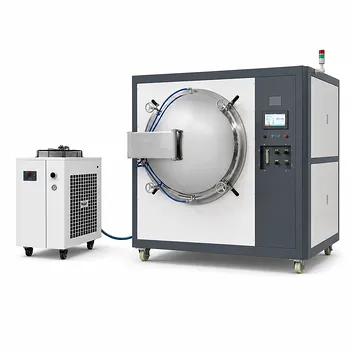
Vacuum hot pressing fundamentally outperforms pressureless sintering for Al-Si composites by overcoming the natural barriers of aluminum processing.
While pressureless sintering relies solely on thermal energy, a vacuum hot press furnace introduces uniaxial mechanical pressure (e.g., 61.1 MPa) within a vacuum environment. This combination physically destroys stubborn oxide films on powder surfaces and accelerates solid-state diffusion, allowing for near-perfect densification and the suppression of brittle phases at temperatures below the melting point.
The Core Insight The critical advantage is not just the application of heat, but the mechanical disruption of the aluminum oxide barrier. By forcibly rearranging particles under vacuum, this process enables chemical reactions and bonding that simply cannot occur effectively in a passive, pressureless environment.
Overcoming the Oxide Barrier
The Limitation of Pressureless Sintering
Aluminum powder is naturally coated with a stable, dense oxide film (Al2O3). In traditional pressureless sintering, this film prevents direct contact between metallic particles, hindering diffusion and preventing true bonding.
Mechanical Disruption of Oxide Films
The vacuum hot press applies significant external pressure during the heating cycle. This pressure forces plastic deformation and particle rearrangement.
As the particles deform, the brittle oxide layer fractures and breaks apart. This exposes fresh, reactive metal surfaces, allowing for direct metallic bonding that thermal energy alone cannot achieve.
Accelerating In Situ Reactions
Enhancing Solid-State Diffusion
For Al-Si based composites, the goal is often to induce a specific reaction between Aluminum (Al) and Silica (SiO2).
The applied pressure maximizes the contact area between these distinct materials. This physical proximity accelerates the solid-state diffusion reaction, driving the transformation process much faster and more completely than passive heating.
Lower Temperature Processing
Because pressure aids densification, the process can occur at temperatures below the conventional melting point.
This is distinct from liquid infiltration or casting. By keeping the matrix in a solid or semi-solid state, the process maintains dimensional stability and prevents the segregation of reinforcement particles.
Controlling Microstructure and Phases
Inhibiting Brittle Phases
A major risk in sintering aluminum composites is the formation of unwanted brittle phases, such as aluminum carbide (Al4C3), which degrades mechanical properties.
The vacuum hot press environment suppresses these reactions. By allowing for densification at lower thermal loads and in a controlled atmosphere, it inhibits the kinetics required for these detrimental brittle phases to grow.
Prevention of Matrix Oxidation
The high-vacuum environment is essential for purity. It prevents further oxidation of the aluminum matrix at high temperatures.
Additionally, the vacuum actively removes gases and moisture adsorbed on the powder surfaces. This purification results in a "clean" interface, which is the foundational factor for high interfacial bonding strength.
Understanding the Trade-offs
Geometry Limitations
The primary disadvantage of vacuum hot pressing is the restriction on component geometry.
Because the pressure is applied uniaxially (from top and bottom), this method is generally limited to simple shapes like plates, disks, or cylinders. Complex 3D geometries typically require secondary machining or alternative processing methods.
Scalability and Cost
This is a batch process that requires sophisticated, capital-intensive equipment. Compared to continuous pressureless sintering, the cycle times are longer and the cost per part is significantly higher, making it less suitable for high-volume, low-cost commodity parts.
Making the Right Choice for Your Goal
To maximize the success of your Al-Si composite project, match your processing method to your performance requirements:
- If your primary focus is Maximum Density and Strength: Choose vacuum hot pressing to actively break oxide films and achieve near-theoretical density with superior interfacial bonding.
- If your primary focus is Complex Geometry: Recognize that vacuum hot pressing will likely require extensive post-process machining, and consider if a lower-performance pressureless method might suffice for net-shape requirements.
- If your primary focus is Phase Purity: Rely on vacuum hot pressing to react reactants in the solid state, preventing the formation of brittle byproducts like aluminum carbide.
High-performance Al-Si composites require the forced disruption of oxide films that only combined heat, vacuum, and pressure can provide.
Summary Table:
| Feature | Vacuum Hot Pressing | Pressureless Sintering |
|---|---|---|
| Driving Force | Combined Heat & Mechanical Pressure | Thermal Energy Only |
| Oxide Film Control | Mechanical Disruption (Breaks Al2O3) | Remains Intact (Hinders Bonding) |
| Densification | Near-Theoretical Density | Lower Density (Residual Porosity) |
| Phase Control | Inhibits Brittle Phases (e.g., Al4C3) | Harder to Control Reaction Kinetics |
| Environment | High Vacuum (Prevents Oxidation) | Atmospheric or Inert Gas |
| Shape Complexity | Limited to Simple Geometries | High (Net-Shape Capability) |
Elevate Your Material Performance with KINTEK Precision
Don't let oxide films and porosity compromise your research or production. KINTEK specializes in advanced laboratory equipment designed to meet the rigorous demands of material science. Our high-performance vacuum hot press furnaces and hydraulic presses provide the precise pressure and temperature control needed to achieve near-perfect densification in Al-Si composites and advanced ceramics.
From high-temperature furnaces and crushing systems to specialized PTFE consumables and crucibles, KINTEK delivers the end-to-end solutions your laboratory deserves. Our team of experts is ready to help you select the ideal configuration for your specific in situ reaction requirements.
Ready to transform your material synthesis? Contact KINTEK Today to Consult with an Expert
Related Products
- Vacuum Hot Press Furnace Heated Vacuum Press Machine Tube Furnace
- 600T Vacuum Induction Hot Press Furnace for Heat Treat and Sintering
- Vacuum Hot Press Furnace Machine for Lamination and Heating
- Vacuum Hot Press Furnace Machine Heated Vacuum Press
- Vacuum Heat Treat and Pressure Sintering Furnace for High Temperature Applications
People Also Ask
- What advantages does a vacuum hot press furnace provide for LSLBO ceramic electrolytes? Achieve 94% Relative Density
- What role does a Vacuum Hot Press (VHP) furnace play in the densification of austenitic stainless steel 316 composites?
- What are the advantages of using a vacuum hot pressing furnace? Superior Densification for 2024Al/Gr/SiC Composites
- What are the advantages of a vacuum hot press furnace for LTPO solid electrolytes? Boost Density and Conductivity
- What core processing conditions does a vacuum hot press furnace provide? Achieve High-Density Cu-SiC/Diamond Composites