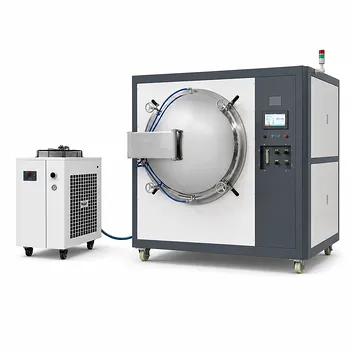
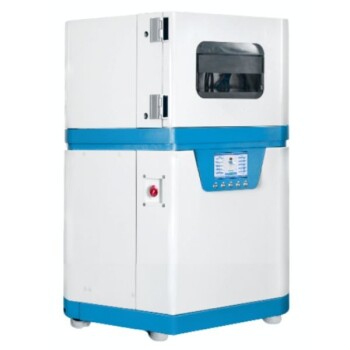
Utilizing a Vacuum Hot Press (VHP) furnace offers a distinct advantage for sintering Zinc Sulfide (ZnS) transparent ceramics by decoupling densification from grain growth. By applying axial mechanical pressure (typically around 15 MPa) simultaneously with precise heating (960-1040°C) in a high-vacuum environment, VHP forces the material to reach full density at temperatures lower than those required by pressureless methods.
Core Takeaway: The primary value of VHP for Zinc Sulfide is the ability to achieve near-perfect density—which is non-negotiable for optical transparency—without overheating the material. The mechanical pressure drives pore elimination and phase transformation, allowing you to maintain fine grain structures that ensure superior mechanical strength and infrared transmission.
Achieving Optical Transparency through Densification
The Critical Role of Pressure
In pressureless sintering, you rely solely on high temperatures to fuse particles, which often leads to residual porosity. VHP applies uniaxial mechanical pressure (often exceeding 15 MPa) to the powder during heating.
Eliminating Scattering Centers
This pressure forces particle rearrangement and plastic flow, mechanically closing internal pores. Since even microscopic pores scatter light and ruin transparency, this mechanism is essential for creating high-quality optical ceramics.
Facilitating Phase Transition
The combination of heat and pressure effectively induces the phase transition from wurtzite to sphalerite. This structural change is critical for eliminating internal voids and achieving the high infrared transmittance required for ZnS applications.
Controlling Microstructure and Grain Growth
Lower Sintering Temperatures
Because mechanical pressure assists in densification, VHP allows you to sinter ZnS at significantly lower temperatures compared to other methods. You do not need extreme thermal energy to fuse the particles because the physical force is doing much of the work.
Preventing "Runaway" Grain Growth
High temperatures in traditional sintering often cause grains to grow excessively large, which weakens the material mechanically. By keeping the temperature lower (960-1040°C), VHP restricts grain boundary migration, preserving a fine microstructure and resulting in stronger, more durable ceramics.
Environmental Control and Material Purity
Prevention of Oxidation
ZnS is susceptible to oxidation at high temperatures, which degrades its optical properties. The VHP process operates in a high-vacuum environment (typically $10^{-3}$ Torr), ensuring the powder remains chemically pure throughout the heating cycle.
Cleaner Phase Boundaries
The vacuum aids in the removal of volatile impurities from the grain boundaries. This results in "cleaner" ceramics with better inter-particle bonding and higher theoretical density (often exceeding 98.5%).
Understanding the Trade-offs
Shape Limitations
While VHP is superior for density, the axial pressure mechanism generally limits geometry to simple shapes like flat plates or discs. Unlike Gas Pressure Sintering (GPS), VHP cannot easily produce complex, near-net-shape components without significant post-process machining.
Throughput and Cost
VHP is typically a batch process that involves heating and cooling massive thermal mass (the die set), making it slower than continuous sintering methods. Additionally, the graphite dies used to contain the powder under pressure are consumables, which adds to the operational cost compared to pressureless sintering.
Making the Right Choice for Your Goal
To determine if VHP is the correct tool for your specific ZnS application, consider the following:
- If your primary focus is maximum optical transparency: VHP is the ideal choice because the pressure-assisted densification eliminates the porosity that causes light scattering.
- If your primary focus is mechanical strength: VHP is highly recommended as it inhibits grain growth, preserving the fine microstructure needed for durability.
- If your primary focus is complex geometric shapes: You may need to investigate Gas Pressure Sintering (GPS) or Hot Isostatic Pressing (HIP) instead, as VHP is limited to simple axial geometries.
VHP remains the industry standard for high-performance ZnS optics because it uniquely balances the need for total density with the preservation of fine grain structure.
Summary Table:
| Feature | Vacuum Hot Press (VHP) | Pressureless Sintering | Benefits for ZnS |
|---|---|---|---|
| Densification | Pressure-assisted (Axial) | Thermal diffusion only | Eliminates light-scattering pores |
| Sintering Temp | Lower (960-1040°C) | Significantly Higher | Prevents grain growth & preserves strength |
| Environment | High Vacuum ($10^{-3}$ Torr) | Variable/Inert | Prevents oxidation; ensures chemical purity |
| Phase Control | Induces wurtzite-sphalerite transition | Harder to control | Maximizes infrared transmittance |
| Density | Near-theoretical (>98.5%) | Lower/Porous | Essential for optical transparency |
Elevate Your Material Science with KINTEK
Unlock the full potential of your advanced ceramics and optical materials with KINTEK’s industry-leading thermal processing solutions. Whether you require Vacuum Hot Press (VHP) furnaces for superior densification or specialized high-temperature vacuum furnaces for high-purity sintering, KINTEK provides the precision equipment necessary to achieve near-theoretical density and optimal microstructure.
Our extensive portfolio caters to labs and industrial manufacturers focusing on:
- Advanced Sintering: VHP, Spark Plasma Sintering (SPS), and Hot Isostatic Pressing (HIP).
- Material Synthesis: CVD, PECVD, and MPCVD systems for thin films and diamonds.
- Sample Preparation: High-performance crushing, milling, and hydraulic pellet presses.
Ready to achieve superior optical transparency and mechanical strength in your Zinc Sulfide applications? Contact KINTEK today to consult with our experts and find the perfect equipment for your research and production goals.
Related Products
- Vacuum Hot Press Furnace Heated Vacuum Press Machine Tube Furnace
- 600T Vacuum Induction Hot Press Furnace for Heat Treat and Sintering
- Vacuum Hot Press Furnace Machine Heated Vacuum Press
- Vacuum Hot Press Furnace Machine for Lamination and Heating
- Laboratory High Pressure Vacuum Tube Furnace
People Also Ask
- What advantages does a vacuum hot press furnace provide for LSLBO ceramic electrolytes? Achieve 94% Relative Density
- What role does a Vacuum Hot Press (VHP) furnace play in the densification of austenitic stainless steel 316 composites?
- What are the advantages of using a vacuum hot pressing furnace? Superior Densification for 2024Al/Gr/SiC Composites
- What are the advantages of a vacuum hot press furnace for LTPO solid electrolytes? Boost Density and Conductivity
- What core processing conditions does a vacuum hot press furnace provide? Achieve High-Density Cu-SiC/Diamond Composites