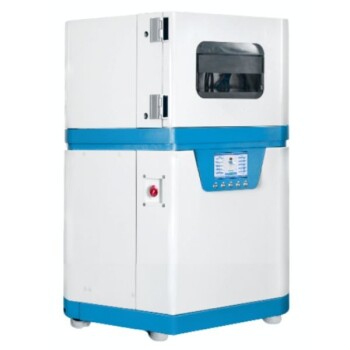
The primary functions of a vacuum hot press furnace during this process are to establish a high-vacuum environment that prevents oxidation and to provide precise thermal regulation that transitions the amorphous powder into a viscous flow state. This specific physical state, achieved within the material's supercooled liquid region, allows applied pressure to consolidate the loose powder into a dense bulk material.
Core Takeaway Consolidating amorphous composites like WC/Cu-Zr-Ti requires navigating a narrow processing window where the material softens but does not crystallize. The vacuum hot press serves as the critical enabler, providing the interference-free environment and thermal precision necessary to achieve full density while preserving the material's unique amorphous structure.
The Critical Role of Environmental Control
Prevention of Surface Oxidation
The most immediate function of the furnace is the creation of a high-vacuum environment.
For composites containing reactive elements like Zirconium (Zr) and Titanium (Ti), exposure to oxygen at elevated temperatures leads to rapid degradation.
Ensuring Interparticle Bonding
By removing air and gases, the furnace ensures that the surfaces of the powder particles remain clean.
This lack of oxide layers allows for direct atomic contact between the WC reinforcement and the Cu-Zr-Ti matrix, which is a prerequisite for strong physical bonding during consolidation.
Managing the Supercooled Liquid Region
Precise Temperature Regulation
The furnace provides the exact thermal control required to heat the composite to its specific supercooled liquid region.
This is distinct from standard melting; the goal is to soften the amorphous matrix without overheating it, which would cause it to crystallize and lose its desirable properties.
Facilitating Viscous Flow
Once the correct temperature is reached, the amorphous powder transitions into a viscous flow state.
In this state, the metallic glass matrix behaves like a thick fluid, allowing it to move and fill the spaces between the harder Tungsten Carbide (WC) particles.
Mechanisms of Densification
Pressure-Assisted Consolidation
While the material is in its viscous state, the furnace applies mechanical pressure.
This force is the driving factor that physically compresses the softened powder, overcoming the material's internal resistance to shape change.
Elimination of Voids
The combination of viscous flow and external pressure effectively closes internal pores and voids.
This synergy results in a bulk material that approaches its theoretical density, transforming loose powder into a solid, structural component.
Understanding the Trade-offs
The Risk of Crystallization
While the furnace enables densification, holding the material at high temperatures for too long—or exceeding the temperature ceiling of the supercooled region—poses a significant risk.
If the thermal budget is exceeded, the amorphous Cu-Zr-Ti matrix may crystallize (devitrify), causing the material to become brittle and lose the mechanical benefits of the amorphous phase.
Uniformity vs. Speed
Applying pressure allows for faster densification, but rapid processing must be balanced against thermal uniformity.
If the heating rate is too aggressive, thermal gradients within the vacuum chamber can lead to uneven consolidation, where the outside of the sample is dense but the core remains porous.
Making the Right Choice for Your Goal
When configuring a vacuum hot press cycle for WC/Cu-Zr-Ti composites, your parameters should shift based on your specific engineering targets:
- If your primary focus is maximum density: Prioritize the application of higher mechanical pressure while the material is deep within the supercooled liquid region to mechanically force void closure.
- If your primary focus is preserving the amorphous structure: Strictly limit the peak temperature and holding time to ensure the matrix consolidates without crossing the threshold into crystallization.
Precision in the supercooled region is the difference between a high-performance composite and a brittle failure.
Summary Table:
| Function | Role in Consolidation | Key Benefit |
|---|---|---|
| High Vacuum | Eliminates oxygen and reactive gases | Prevents oxidation of Zr/Ti and ensures clean bonding |
| Thermal Control | Regulates supercooled liquid region | Facilitates viscous flow without causing crystallization |
| Mechanical Pressure | Compresses softened powder | Eliminates voids and ensures near-theoretical density |
| Process Synergy | Balances heat, vacuum, and force | Preserves the unique amorphous structure of the matrix |
Elevate Your Material Research with KINTEK Precision
Achieving the perfect balance between densification and structural integrity in amorphous composites requires world-class equipment. KINTEK specializes in advanced laboratory solutions, offering a comprehensive range of vacuum hot press furnaces, high-temperature systems (muffle, tube, rotary), and precision crushing and milling equipment.
Whether you are working on WC/Cu-Zr-Ti composites or advanced battery research, our high-performance vacuum and atmosphere furnaces ensure the thermal precision and environmental control your project demands. From hydraulic presses for pelletizing to specialized PTFE and ceramic consumables, we provide everything you need to transform powder into performance.
Ready to optimize your consolidation process? Contact our technical experts today to find the ideal vacuum hot press configuration for your laboratory!
Related Products
- Vacuum Hot Press Furnace Heated Vacuum Press Machine Tube Furnace
- 600T Vacuum Induction Hot Press Furnace for Heat Treat and Sintering
- Vacuum Hot Press Furnace Machine Heated Vacuum Press
- Vacuum Hot Press Furnace Machine for Lamination and Heating
- Vacuum Heat Treat and Pressure Sintering Furnace for High Temperature Applications
People Also Ask
- What advantages does a vacuum hot press furnace provide for LSLBO ceramic electrolytes? Achieve 94% Relative Density
- What role does a Vacuum Hot Press (VHP) furnace play in the densification of austenitic stainless steel 316 composites?
- What are the advantages of using a vacuum hot pressing furnace? Superior Densification for 2024Al/Gr/SiC Composites
- What are the advantages of a vacuum hot press furnace for LTPO solid electrolytes? Boost Density and Conductivity
- What core processing conditions does a vacuum hot press furnace provide? Achieve High-Density Cu-SiC/Diamond Composites