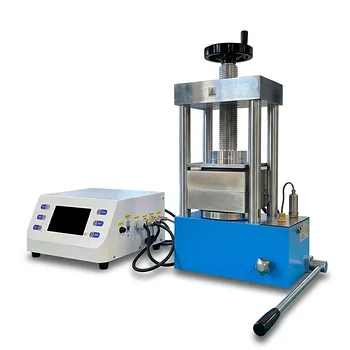
Vacuum Hot Pressing fundamentally alters the densification mechanism of Dispersion Copper-MoS2-Mo materials by applying external mechanical pressure alongside heat. Unlike traditional pressureless sintering, this process forces powder particles into intimate contact and induces plastic flow, which actively breaks up particle agglomerates and eliminates internal voids to create a superior microstructure.
The Core Insight While pressureless sintering relies on passive diffusion that can leave gaps and clusters, Vacuum Hot Pressing acts as an active consolidation force. By mechanically driving particle rearrangement and plastic deformation, it creates a significantly denser, more uniform microstructure where strengthening compounds are distributed in a specific discontinuous network, directly unlocking higher hardness and wear resistance.
The Mechanics of Microstructural Improvement
Active Elimination of Porosity
In traditional sintering, densification is driven by surface energy, which often fails to close all internal pores. A Vacuum Hot Pressing (VHP) machine overcomes this by applying continuous axial pressure.
This pressure provides an additional driving force that physically squeezes particles together. This action eliminates the interstitial pores that typically remain in pressureless sintering, resulting in a near-fully dense material.
Inducing Plastic Flow
The application of external pressure does more than just compact the powder; it induces plastic flow in the copper matrix.
This flow is critical for material uniformity. It forces the material to fill voids and conform to the die, ensuring that the microstructure is consistent throughout the entire volume of the component, rather than just at the surface.
Breaking Down Agglomerates
One of the primary challenges in dispersion materials is the clumping (agglomeration) of the reinforcing phases.
The mechanical force exerted by the VHP effectively breaks up these agglomerates. By shearing and redistributing the clusters during the pressing phase, the machine ensures a homogeneous distribution of the MoS2 and Mo components within the copper matrix.
Specific Changes to the Material Matrix
Creating a Discontinuous Network
The most distinct microstructural advantage of this process is the arrangement of the constituent phases.
The VHP process ensures that copper-molybdenum-sulfur compounds are distributed in a discontinuous network. This specific structural arrangement prevents the propagation of cracks and ensures that the material retains its integrity under stress.
Enhancing Interface Bonding
The combination of a vacuum environment and pressure promotes tighter bonding between the matrix and the dispersed particles.
By removing gases that could form voids or oxides, and forcing physical contact, the process ensures robust interface bonding. This minimizes internal defects that could act as failure points during operation.
Understanding the Trade-offs
While Vacuum Hot Pressing offers superior microstructural results, it introduces specific operational constraints compared to pressureless sintering.
Complexity and Throughput
VHP is typically a batch process, meaning components are made one at a time or in small groups. This contrasts with continuous sintering furnaces which can process high volumes rapidly.
Geometry Limitations
Because pressure is applied uniaxially (from one direction), there are limitations on the complexity of shapes you can produce. Uniform density is difficult to achieve in parts with complex varying cross-sections without specialized tooling.
Cost Implications
The equipment requires vacuum systems, hydraulics, and heating elements capable of operating simultaneously. This generally results in higher capital and operational costs compared to standard sintering ovens.
Making the Right Choice for Your Goal
When deciding between Vacuum Hot Pressing and traditional sintering for Copper-MoS2-Mo materials, consider your performance requirements:
- If your primary focus is Maximum Wear Resistance: Choose Vacuum Hot Pressing to achieve the specific discontinuous network of compounds that directly enhances hardness and durability.
- If your primary focus is Structural Integrity: Choose Vacuum Hot Pressing to utilize plastic flow for eliminating internal pores and ensuring high density.
- If your primary focus is High-Volume Production: Evaluate if pressureless sintering can meet your minimum density requirements, as VHP is a slower, more intensive process.
By leveraging the mechanical force of Vacuum Hot Pressing, you transform a loose powder aggregate into a fully dense, high-performance composite optimized for demanding friction applications.
Summary Table:
| Feature | Pressureless Sintering | Vacuum Hot Pressing (VHP) |
|---|---|---|
| Densification Force | Passive Surface Energy | Active Mechanical Pressure + Heat |
| Microstructure | Prone to voids and clusters | Dense, uniform, and refined |
| Particle Distribution | High risk of agglomeration | Mechanical breakup of clusters |
| Bonding Quality | Risk of oxides/weak interfaces | High-strength vacuum-assisted bonding |
| Network Structure | Random/Continuous | Discontinuous network for hardness |
| Common Use Case | High-volume, simple parts | High-performance, low-porosity materials |
Elevate Your Material Performance with KINTEK
Unlock the full potential of your research and production with KINTEK’s advanced laboratory solutions. Whether you are developing high-performance Copper-MoS2-Mo composites or advanced alloys, our vacuum hot pressing machines and hydraulic presses provide the precise pressure and temperature control needed to eliminate porosity and achieve a superior microstructure.
From high-temperature muffle and vacuum furnaces to specialized crushing and milling systems, KINTEK specializes in the tools that transform powders into high-density components. Our comprehensive portfolio—including high-temperature high-pressure reactors, PTFE consumables, and battery research tools—is designed to meet the rigorous demands of material scientists and laboratory professionals.
Ready to optimize your densification process? Contact us today to discuss how our custom equipment solutions can enhance your lab's efficiency and material durability.
Related Products
- Vacuum Hot Press Furnace Machine for Lamination and Heating
- Vacuum Hot Press Furnace Machine Heated Vacuum Press
- Vacuum Hot Press Furnace Heated Vacuum Press Machine Tube Furnace
- Electric Heated Hydraulic Vacuum Heat Press for Lab
- Heated Hydraulic Press Machine with Heated Plates for Vacuum Box Laboratory Hot Press
People Also Ask
- What advantages does a vacuum hot press furnace provide for LSLBO ceramic electrolytes? Achieve 94% Relative Density
- Why is it necessary to maintain a high-vacuum environment within a vacuum hot press furnace? Optimize Cu-SiC Sintering
- What are the advantages of using a vacuum hot press furnace for sintering CNT/Cu composites? Superior Density & Bonding
- What are the advantages of a vacuum hot press furnace for W-50%Cu? Achieve 99.6% Density at Lower Temperatures
- What role does mechanical pressure play during the vacuum diffusion bonding of tungsten and copper? Keys to Solid Bonding