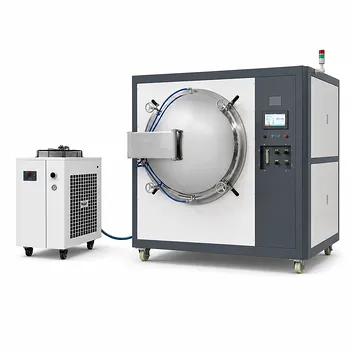
Vacuum hot press sintering is the superior method for preparing CuW30 composites because it simultaneously applies heat and mechanical pressure in a controlled environment. Unlike conventional sintering, which relies solely on thermal diffusion, this technique utilizes the plastic deformation of the copper matrix to fill voids between tungsten particles, achieving material densities as high as 99.1%.
The core advantage of vacuum hot press sintering lies in its ability to overcome the natural porosity of composite materials. By mechanically forcing the matrix material into the skeletal structure while removing gaseous impurities, it produces a CuW30 composite that is denser, stronger, and more conductive than is possible with atmospheric heating alone.
Achieving Superior Density
The Power of Mechanical Pressure
Conventional sintering relies on particles bonding naturally over time at high heat. Vacuum hot pressing introduces an external force—typically around 30 MPa—during the heating phase (e.g., 950°C). This pressure provides an additional driving force that standard sintering lacks.
Plastic Deformation Mechanisms
Under this pressure, the copper matrix undergoes plastic deformation. This forces the copper to flow effectively, filling the microscopic gaps between the tungsten particles. This mechanism eliminates residual porosity that thermal energy alone often cannot resolve.
Quantifiable Density Gains
The result of this pressure-assisted process is exceptional densification. While conventional atmospheric sintering often leaves voids, vacuum hot pressing pushes the relative density of CuW30 materials up to 99.1%. This high density is the foundation for the material's structural integrity.
Enhancing Material Purity and Bonding
Eliminating Oxidation
High-temperature processing usually invites oxidation, which degrades material performance. The vacuum environment (reaching levels like 1x10^-2 Pa) effectively prevents oxygen from reacting with the copper and tungsten components.
Removing Internal Impurities
The vacuum system actively discharges adsorbed gases and volatiles trapped within the powder gaps. By removing gases dissolved in the metal and allowing byproducts to escape, the process prevents the formation of internal "gas pockets" that would otherwise weaken the structure.
Improving Interfacial Bonding
A critical advantage is the removal of oxide films from the particle surfaces before the liquid phase appears. This ensures a pure interfacial bond between the copper and tungsten. Clean surfaces improve wettability, allowing the liquid copper to adhere more effectively to the tungsten carbide phase.
Performance Outcomes
Maximized Electrical Conductivity
Conductivity in composites is often hampered by porosity and oxide layers, which scatter charge carriers. By achieving near-total density and eliminating oxide barriers, vacuum hot pressing ensures the CuW30 material retains excellent electrical conductivity.
Superior Mechanical Strength
The reduction in structural defects and grain boundary issues leads to higher wear resistance and overall strength. The dense, non-porous structure is less prone to cracking or deformation under stress compared to loosely sintered counterparts.
Understanding the Trade-offs
Equipment Complexity
While the results are superior, vacuum hot press systems are more complex than standard atmospheric furnaces. They require precise control over vacuum levels, hydraulic pressure systems, and temperature uniformity, which can increase initial setup requirements.
Process Constraints
The application of mechanical pressure often limits the geometry of the parts being produced. While conventional sintering can handle complex net shapes easily, hot pressing is typically best suited for simpler geometries like plates or discs that can withstand uniaxial pressure.
Making the Right Choice for Your Goal
The decision to use vacuum hot press sintering should be driven by the specific performance requirements of your application.
- If your primary focus is maximum electrical conductivity: Choose vacuum hot press sintering to eliminate porosity and oxides that disrupt electron flow.
- If your primary focus is mechanical durability: Choose vacuum hot press sintering to ensure high density (99.1%) and superior wear resistance.
- If your primary focus is complex geometric shaping: Evaluate if the simple shapes typically produced by hot pressing can be machined to your final specifications, or if a different forming method is required.
Vacuum hot pressing transforms the theoretical potential of CuW30 into a practical reality, delivering a material where the matrix and reinforcement work in perfect unison.
Summary Table:
| Feature | Conventional Sintering | Vacuum Hot Press Sintering |
|---|---|---|
| Driving Force | Thermal diffusion only | Thermal energy + 30 MPa pressure |
| Relative Density | Lower (residual porosity) | Up to 99.1% |
| Environment | Atmospheric / Inert | High Vacuum (1x10^-2 Pa) |
| Purity | Risk of oxidation | Oxide-free, degassing included |
| Bonding | Surface oxides may remain | Pure interfacial bonding |
| Performance | Standard conductivity/strength | Maximized electrical & mechanical properties |
Elevate Your Material Performance with KINTEK Precision
Unlock the full potential of your CuW30 composites and advanced materials with KINTEK’s industry-leading thermal processing solutions. Whether you require high-performance vacuum hot press systems, high-temperature furnaces (muffle, tube, or vacuum), or precision hydraulic presses, our equipment is engineered to deliver the 99.1% densification and purity your research demands.
From battery research tools and high-pressure reactors to essential PTFE and ceramic consumables, KINTEK provides the comprehensive support laboratory and industrial pioneers need to succeed.
Ready to optimize your sintering process? Contact our technical experts today to find the perfect solution for your application.
Related Products
- 600T Vacuum Induction Hot Press Furnace for Heat Treat and Sintering
- Vacuum Heat Treat and Sintering Furnace with 9MPa Air Pressure
- Vacuum Heat Treat and Pressure Sintering Furnace for High Temperature Applications
- Vacuum Hot Press Furnace Heated Vacuum Press Machine Tube Furnace
- Vacuum Hot Press Furnace Machine Heated Vacuum Press
People Also Ask
- What role does an induction vacuum hot pressing furnace play in sintering? Achieve 98% Density in Carbide Blocks
- What advantages does a vacuum hot press furnace provide for LSLBO ceramic electrolytes? Achieve 94% Relative Density
- What role does a Vacuum Hot Press (VHP) furnace play in the densification of austenitic stainless steel 316 composites?
- What role does mechanical pressure play during the vacuum diffusion bonding of tungsten and copper? Keys to Solid Bonding
- What are the advantages of a vacuum hot press furnace for W-50%Cu? Achieve 99.6% Density at Lower Temperatures