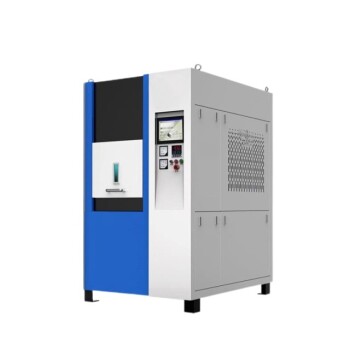
Hot pressing sintering equipment fundamentally outperforms standard furnaces by introducing axial pressure alongside high-temperature heat. This dual-action approach forces particle rearrangement and promotes plastic flow, resulting in NASICON plates that are significantly denser, mechanically stronger, and more ionically conductive than those produced by conventional pressureless methods.
The Core Advantage: While standard sintering relies solely on thermal energy to bond particles, hot pressing leverages mechanical force to physically eliminate internal pores. This maximizes the electrolyte's efficiency by lowering grain boundary resistance and ensuring structural durability.
The Mechanics of Densification
Simultaneous Heat and Pressure
Standard sintering furnaces rely exclusively on a high-temperature thermal field to fuse ceramic particles. Hot pressing improves this by applying axial pressure while the material is heated.
Driving Plastic Flow
The addition of physical pressure forces the ceramic material into a state of plastic flow. This allows the material to deform and fill voids that thermal energy alone cannot resolve.
Enhanced Particle Rearrangement
Pressure causes the particles within the NASICON structure to shift and reorganize more efficiently. This particle rearrangement is the primary driver for achieving theoretical density in thin plates.
Critical Performance Improvements
Elimination of Internal Pores
The primary defect in standard sintering is residual porosity—tiny air gaps left inside the material. Hot pressing effectively squeezes out these pores, resulting in a solid, non-porous microstructure.
Reduced Grain Boundary Resistance
In a solid electrolyte, ions must travel between grains of material. Pores act as barriers to this movement. By eliminating pores, hot pressing significantly lowers grain boundary resistance.
Higher Ionic Conductivity
Because resistance is minimized, the ionic conductivity of the NASICON plate increases. This allows for more efficient energy transfer within the battery cell.
Superior Mechanical Strength
Thin ceramic plates are inherently brittle. The high density achieved through hot pressing grants these plates higher mechanical strength, making them less prone to cracking during handling or operation.
Understanding the Trade-offs
Equipment Complexity
Unlike standard furnaces, which are often simple thermal chambers, hot pressing equipment involves complex hydraulic or mechanical systems. You must manage pressure vectors in addition to temperature profiles.
Process Constraints
The application of axial pressure generally requires specific tooling and molds. This creates a more rigid process environment compared to the flexibility of pressureless sintering.
Aligning Production Methods with Goals
To determine if hot pressing is the right solution for your NASICON production, consider your specific performance targets.
- If your primary focus is maximizing battery efficiency: Hot pressing is essential to achieve the high ionic conductivity required for high-performance cells.
- If your primary focus is durability: The mechanical strength provided by hot pressing is critical for producing thin plates that will not fracture under stress.
- If your primary focus is microstructure quality: Hot pressing is the only reliable way to eliminate internal pores and achieve near-theoretical density.
Hot pressing transforms the production of solid electrolytes from a simple thermal process into a precision engineering operation, delivering a superior component for high-performance energy storage.
Summary Table:
| Feature | Standard Sintering Furnace | Hot Pressing Sintering Equipment |
|---|---|---|
| Mechanism | Thermal energy only | Simultaneous heat + axial pressure |
| Densification | Slow, partial rearrangement | Rapid plastic flow & rearrangement |
| Porosity | High residual internal pores | Near-zero/Theoretical density |
| Ionic Conductivity | Lower (high grain resistance) | Maximum (minimal grain resistance) |
| Mechanical Integrity | Brittle, prone to cracking | Superior strength for thin plates |
| Process Complexity | Simple thermal control | High (Thermal + Hydraulic control) |
Elevate Your Battery Research with KINTEK Precision
Unlock the full potential of your NASICON solid electrolytes with KINTEK’s advanced hot pressing and hydraulic press systems. Our equipment is engineered to eliminate porosity, maximize ionic conductivity, and ensure the structural integrity of your thinnest ceramic plates.
Beyond sintering, KINTEK provides a comprehensive ecosystem for energy storage development, including:
- High-performance milling and crushing systems for precursor preparation.
- Vacuum, atmosphere, and muffle furnaces for versatile heat treatment.
- Electrolytic cells, battery research tools, and specialized consumables like PTFE and crucibles.
Ready to achieve theoretical density and superior mechanical strength? Contact KINTEK today to find the perfect high-pressure solution for your laboratory or production line.
Related Products
- 600T Vacuum Induction Hot Press Furnace for Heat Treat and Sintering
- Vacuum Heat Treat and Pressure Sintering Furnace for High Temperature Applications
- Vacuum Heat Treat and Sintering Furnace with 9MPa Air Pressure
- 30T 40T Split Automatic Heated Hydraulic Press Machine with Heated Plates for Laboratory Hot Press
- Automatic Heated Hydraulic Press Machine with Heated Plates for Laboratory Hot Press
People Also Ask
- What role does an induction vacuum hot pressing furnace play in sintering? Achieve 98% Density in Carbide Blocks
- What advantages does a vacuum hot press furnace provide for LSLBO ceramic electrolytes? Achieve 94% Relative Density
- What role does a Vacuum Hot Press (VHP) furnace play in the densification of austenitic stainless steel 316 composites?
- What are the advantages of a vacuum hot press furnace for W-50%Cu? Achieve 99.6% Density at Lower Temperatures
- What role does mechanical pressure play during the vacuum diffusion bonding of tungsten and copper? Keys to Solid Bonding