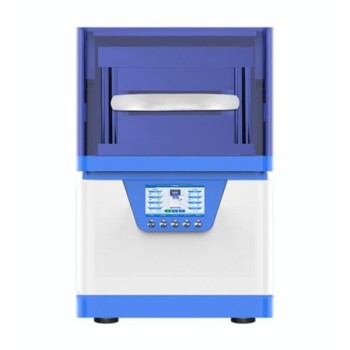
A high-temperature hot press serves as the critical enabler for densifying NITE-SiC materials by providing simultaneous thermal and mechanical energy. Specifically, it applies heat (approximately 1875 °C) and pressure (around 10 MPa) to activate a transient liquid phase, allowing Silicon Carbide nanopowders to consolidate into a dense, high-strength material at temperatures significantly lower than traditional sintering requires.
Core Insight: The hot press is not merely a heating element; it provides the thermo-mechanical coupling necessary to lower the sintering threshold. By applying mechanical pressure during heating, it forces oxide additives to liquefy and bind the SiC matrix, achieving high density without the structural degradation caused by ultra-high temperatures.
The Mechanism of Thermo-Mechanical Coupling
The success of the Nano-Infiltration and Transient Eutectoid (NITE) process relies on the precise synchronization of heat and physical force.
Activation of the Transient Eutectic Phase
The hot press creates an environment where oxide additives mixed with SiC powders can reach their melting point.
Under the applied temperature of 1875 °C, these additives form a transient eutectic liquid phase. This liquid acts as a carrier and binder, facilitating the movement and rearrangement of solid SiC particles.
Synergistic Densification
Thermal energy alone is often insufficient to fully density SiC due to its covalent nature.
The hot press introduces a mechanical pressure of 10 MPa, which physically forces the liquid phase to fill voids and gaps between the SiC nanopowders. This synergy ensures the material achieves near-theoretical density, which is critical for high-performance applications.
Preserving Material Integrity
A major challenge in processing Silicon Carbide is balancing densification with microstructural control. The hot press plays a vital role in navigating this narrow processing window.
Preventing Abnormal Grain Growth
Traditional sintering of SiC often requires temperatures exceeding 2000 °C, which can lead to "abnormal grain growth"—a phenomenon where grains become too large and irregular, weakening the material.
By utilizing mechanical pressure, the hot press enables effective sintering below 1900 °C. This lower temperature regime prevents uncontrolled grain growth, preserving the fine microstructure necessary for mechanical durability.
Maintaining Mechanical Strength
The ultimate goal of the NITE process is to produce a material that is both dense and strong.
Because the hot press facilitates densification at moderate temperatures (relative to SiC's melting point), the resulting material retains its intended mechanical properties. The process avoids the brittleness or structural flaws often introduced by excessive thermal exposure.
Understanding the Trade-offs
While the hot press is essential for NITE-SiC, the process requires rigorous control of operating parameters.
Sensitivity to Parameter Deviations
The relationship between temperature and pressure is non-linear. If the temperature drops significantly below the target (e.g., 1875 °C), the eutectic liquid phase may not form sufficiently, leading to porosity.
Conversely, while pressure aids densification, excessive pressure combined with temperature fluctuations could potentially distort the pre-form or fiber architecture in composite applications. The "window" for success is defined by the specific thermo-mechanical coupling conditions.
Making the Right Choice for Your Goal
To maximize the efficacy of a high-temperature hot press in your NITE-SiC process, align your operational parameters with your specific material objectives.
- If your primary focus is Maximum Density: Ensure the transient eutectic liquid phase is fully activated by maintaining the temperature at 1875 °C to allow the liquid to completely fill inter-particle voids.
- If your primary focus is Mechanical Strength: Strictly cap your process temperature below 1900 °C to prevent abnormal grain growth, relying on the 10 MPa mechanical pressure to compensate for the lower thermal energy.
The hot press is the tool that transforms the theoretical potential of NITE-SiC into a physical reality by substituting extreme heat with smart, pressurized consolidation.
Summary Table:
| Parameter | Target Value | Critical Role in NITE-SiC Sintering |
|---|---|---|
| Sintering Temperature | Approx. 1875 °C | Activates the transient eutectic liquid phase while preventing grain growth. |
| Mechanical Pressure | Around 10 MPa | Provides physical force to fill voids and achieve near-theoretical density. |
| Material Synergy | Thermo-mechanical | Allows consolidation at lower temperatures than traditional SiC sintering (>2000 °C). |
| Key Outcome | High Strength | Preserves fine microstructure and mechanical durability of the SiC matrix. |
Elevate Your Advanced Material Research with KINTEK
Precision is paramount when working with high-performance ceramics like NITE-SiC. KINTEK specializes in cutting-edge laboratory equipment, offering a robust range of high-temperature hot presses and isostatic presses designed to handle the rigorous thermo-mechanical demands of your sintering process.
Our portfolio also includes:
- Sintering Solutions: Vacuum, atmosphere, and induction melting furnaces.
- Sample Preparation: Crushing, milling systems, and hydraulic pellet presses.
- Specialized Labware: High-quality ceramics, crucibles, and PTFE consumables.
Whether you are aiming for maximum density or superior mechanical strength, KINTEK provides the reliability and control your lab needs. Contact us today to find the perfect sintering solution for your research!
References
- Chad M. Parish, Yutai Katoh. Microstructure and hydrothermal corrosion behavior of NITE-SiC with various sintering additives in LWR coolant environments. DOI: 10.1016/j.jeurceramsoc.2016.11.033
This article is also based on technical information from Kintek Solution Knowledge Base .
Related Products
- Manual High Temperature Heated Hydraulic Press Machine with Heated Plates for Lab
- Automatic High Temperature Heated Hydraulic Press Machine with Heated Plates for Lab
- Automatic Heated Hydraulic Press Machine with Heated Plates for Laboratory Hot Press
- Vacuum Heat Treat and Pressure Sintering Furnace for High Temperature Applications
- Customizable Laboratory High Temperature High Pressure Reactors for Diverse Scientific Applications
People Also Ask
- What is a hot hydraulic press? Harness Heat and Pressure for Advanced Manufacturing
- Why is a heated hydraulic press used for warm pressing NASICON green tapes? Optimize Your Solid Electrolyte Density
- What is a heated hydraulic press used for? Essential Tool for Curing, Molding, and Laminating
- What does a hydraulic heat press do? Achieve Industrial-Scale, Consistent Pressure for High-Volume Production
- Why is a heated laboratory hydraulic press necessary for composite laminates? Achieve Void-Free Structural Integrity