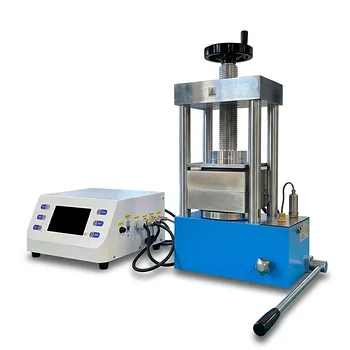
Constant hydraulic pressure is the fundamental driver for both physical integration and chemical bonding in layered composites. During hot press diffusion bonding, this sustained force—typically around 20 MPa—mechanically compresses the layers to deform the aluminum foil and eliminate voids. By ensuring absolute contact between the amorphous ribbons and aluminum, the pressure catalyzes atomic diffusion and creates a structurally dense final product.
The primary function of constant pressure is to overcome physical barriers to bonding. By enforcing plastic deformation and eliminating gaps, the hydraulic system creates the necessary environment for atomic diffusion and precise phase formation, resulting in a high-density composite.
Achieving Physical Continuity
Forcing Plastic Deformation
The hydraulic system applies a specific, continuous load to the composite stack. This force causes plastic deformation in the aluminum foil layers, which are generally softer than the amorphous ribbons.
Filling Interlayer Gaps
As the aluminum deforms under pressure, it flows into microscopic irregularities. This action effectively fills interlayer gaps, removing air pockets and voids that would otherwise weaken the material.
Ensuring Intimate Contact
The physical removal of gaps results in intimate contact between the distinct layers. This proximity between the amorphous ribbons and the aluminum foils is the prerequisite for any subsequent chemical reaction.
Driving Chemical Reactions
Accelerating Atomic Interdiffusion
Once physical contact is established, the pressure drives activity at the atomic level. It accelerates the interdiffusion reaction specifically between iron (Fe) and aluminum (Al) atoms across the material interfaces.
Promoting Phase Formation
This enhanced atomic movement is not merely for mixing; it facilitates specific chemical changes. The pressure actively promotes the formation of the FeAl3 phase, a critical intermetallic compound for the composite's performance.
Optimizing Structural Density
Eliminating Lattice Mismatches
At the microstructural level, the constant pressure helps harmonize the interface between different materials. It works to eliminate lattice mismatches, which helps stabilize the crystal structure and reduce internal strain.
Achieving a Dense Internal Structure
The cumulative effect of filling physical voids and aligning atomic structures is a highly compacted material. The hydraulic system ensures the final composite possesses a dense internal structure, maximizing its mechanical integrity.
Understanding the Trade-offs
The Requirement for Consistency
The pressure provided must be continuous throughout the bonding process. Any fluctuation or drop in pressure could interrupt the plastic deformation necessary to maintain contact, potentially halting the diffusion process prematurely.
Material Dependency
The process relies heavily on the deformability of the aluminum layers. The pressure magnitude (e.g., 20 MPa) is specifically calibrated to deform the aluminum; if the pressure is insufficient for the specific foil grade, intimate contact will fail to materialize.
Making the Right Choice for Your Goal
To achieve high-quality diffusion bonding, you must view pressure as a tool for manipulating material structure.
- If your primary focus is Structural Integrity: Ensure the pressure is sustained at levels (like 20 MPa) sufficient to force plastic deformation and completely fill all interlayer gaps.
- If your primary focus is Chemical Reaction: Maintain constant pressure to maximize the surface contact area, which directly accelerates the interdiffusion of Fe and Al atoms and the formation of FeAl3.
By precisely controlling hydraulic pressure, you convert distinct material layers into a unified, high-performance composite through forced deformation and atomic diffusion.
Summary Table:
| Function Category | Mechanism of Action | Impact on Composite |
|---|---|---|
| Physical Continuity | Forces plastic deformation in Al foils | Eliminates voids and fills interlayer gaps |
| Chemical Bonding | Accelerates Fe-Al atomic interdiffusion | Promotes critical FeAl3 phase formation |
| Structural Density | Resolves lattice mismatches | Ensures a dense, high-integrity internal structure |
| Process Stability | Provides 20 MPa sustained load | Maintains intimate contact for consistent bonding |
Elevate Your Composite Fabrication with KINTEK Precision
Achieving perfect diffusion bonding requires absolute control over pressure and temperature. KINTEK specializes in advanced laboratory equipment designed for material science excellence. Our high-performance hydraulic presses (pellet, hot, isostatic) and high-temperature vacuum furnaces provide the precision needed to eliminate voids and accelerate atomic diffusion in your layered composites.
Whether you are developing next-generation intermetallics or optimizing structural density, our comprehensive range—from milling systems to high-pressure reactors—is engineered to meet your strictest research standards.
Ready to achieve high-density results? Contact our laboratory specialists today to find the ideal pressing and heating solution for your application!
Related Products
- Automatic High Temperature Heated Hydraulic Press Machine with Heated Plates for Lab
- Manual High Temperature Heated Hydraulic Press Machine with Heated Plates for Lab
- Heated Hydraulic Press Machine with Heated Plates for Vacuum Box Laboratory Hot Press
- 24T 30T 60T Heated Hydraulic Press Machine with Heated Plates for Laboratory Hot Press
- Heated Hydraulic Press Machine with Integrated Manual Heated Plates for Lab Use
People Also Ask
- What is a heated hydraulic press used for? Essential Tool for Curing, Molding, and Laminating
- Why is a heated hydraulic press used for warm pressing NASICON green tapes? Optimize Your Solid Electrolyte Density
- Why is a heated laboratory hydraulic press necessary for composite laminates? Achieve Void-Free Structural Integrity
- What is a hot hydraulic press? Harness Heat and Pressure for Advanced Manufacturing
- How is a heated hydraulic press used for Li-LLZO batteries? Optimize Interfacial Bonding with Thermal-Pressure