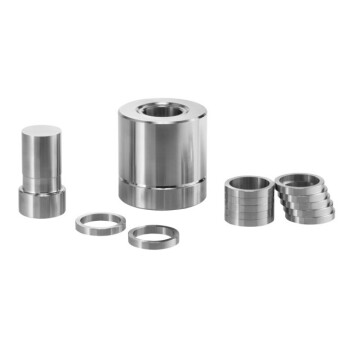
Press molds serve as the primary geometric constraint during the fabrication of SiCf/Ti-43Al-9V composites, specifically bridging the gap between loose assembly and a consolidated solid. Their main function is to enforce the precise overlapping and positioning of the SiC fibers and Ti-43Al-9V foils while restricting lateral material flow, ensuring that vacuum hot pressing results in dimensionally accurate, fully densified components.
By physically confining the stacked raw materials, the mold forces the titanium-aluminum matrix to flow vertically into internal voids rather than spreading horizontally. This mechanism is essential for achieving full density without disrupting the delicate alignment of the reinforcing fibers.
The Mechanics of Material Constraint
Precision Alignment During Assembly
In the initial assembly stage, the mold acts as a rigid guide for the raw materials. It allows for the exact stacking of Silicon Carbide (SiC) fibers and Titanium-Aluminum (Ti-43Al-9V) foils.
This precise positioning is critical because the mechanical properties of the final composite depend entirely on the uniform distribution of these fibers within the matrix.
Restricting Lateral Flow
During high-temperature processing, the metallic matrix softens and becomes plastic. Without a mold, applied pressure would cause the material to "pancake" or spread outwards laterally.
The press mold provides a physical barrier that restricts this lateral flow. This ensures that the material stays within the desired net shape rather than deforming uncontrollably.
Facilitating Densification Under Load
Vertical Pressure Transmission
The mold is designed to withstand the extreme environment of vacuum hot pressing, serving as the vessel through which force is applied. It ensures that the pressure from the press is transmitted strictly vertically into the stacked material.
Eliminating Internal Voids
By preventing outward expansion, the mold forces the softened Ti-43Al-9V matrix to flow into the microscopic gaps between the SiC fibers. This process is what creates a cohesive, single filament or plate structure with high dimensional accuracy.
Operational Challenges and Trade-offs
The Risk of Mold-Sample Interaction
While molds are essential for shaping, they introduce a physical interface that can lead to sticking or chemical reactions at high temperatures. As noted in general hot pressing contexts, isolation layers (such as alumina) are often required to prevent the composite from bonding to the mold, which would make demolding destructive or impossible.
Thermal Transfer Dynamics
The mold acts as an intermediary for heat as well as pressure. If the mold material (typically graphite) does not have uniform density or thickness, it can lead to uneven heating of the composite. This thermal gradient could result in heterogeneous microstructures, where some areas are fully densified while others remain porous.
Making the Right Choice for Your Goal
To maximize the quality of your SiCf/Ti-43Al-9V composites, consider how the mold design impacts your specific objectives:
- If your primary focus is Dimensional Accuracy: Ensure your mold design features tight tolerances to strictly confine lateral flow, forcing the matrix to conform exactly to the internal cavity.
- If your primary focus is Microstructural Homogeneity: Prioritize mold materials with high thermal conductivity to ensure the heating profile is uniform across the entire fiber-matrix stack during consolidation.
Ultimately, the press mold is not just a container, but an active tool that converts raw heat and pressure into structural precision.
Summary Table:
| Function | Description | Key Benefit |
|---|---|---|
| Geometric Constraint | Physically confines stacked SiC fibers and Ti-Al foils. | Ensures dimensional accuracy and net-shape formation. |
| Flow Restriction | Prevents lateral spreading ("pancaking") of the matrix. | Forces material into voids for maximum density. |
| Pressure Transmission | Directs vertical force from the press into the sample. | Facilitates consolidation of the fiber-matrix interface. |
| Thermal Interface | Acts as the medium for heat transfer during hot pressing. | Influences microstructural homogeneity across the composite. |
Elevate Your Composite Fabrication with KINTEK Precision
Achieving full densification and precise fiber alignment in SiCf/Ti-43Al-9V composites requires more than just pressure—it requires high-performance tooling. KINTEK specializes in advanced laboratory equipment and consumables designed for the most demanding material science applications.
Whether you are performing vacuum hot pressing or advanced sintering, we provide the essential tools to optimize your workflow:
- High-Temperature Furnaces: Including vacuum, muffle, and atmosphere furnaces for perfect thermal profiles.
- Hydraulic Presses: Precision pellet, hot, and isostatic presses to ensure uniform material consolidation.
- Specialized Consumables: High-purity ceramics, crucibles, and PTFE products to prevent mold-sample interaction.
- Crushing & Milling: Systems to prepare your Ti-43Al-9V foils and powders with exacting consistency.
Ready to achieve superior structural precision? Contact our technical experts at KINTEK today to find the perfect equipment and consumable solutions for your research and production needs.
Related Products
- Anti-Cracking Press Mold for Lab Use
- Special Heat Press Mold for Lab Use
- Ring Press Mold for Lab Applications
- Round Bidirectional Press Mold for Lab
- Carbide Lab Press Mold for Laboratory Applications
People Also Ask
- What is the press mould method? A Guide to Consistent, Detailed Ceramic Forms
- How to use a press mold? Master the Art of Creating Consistent Ceramic Forms
- What is a press mold used for? Achieve Repeatable Precision and Efficiency
- What is the purpose of specialized pressure devices in sulfide solid-state batteries? Ensure Chemo-Mechanical Stability
- What is the primary function of mold pressing for LAGP powders? Achieve High-Performance Solid Electrolytes