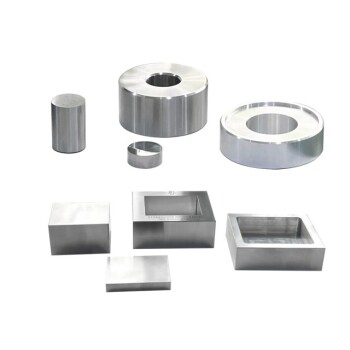
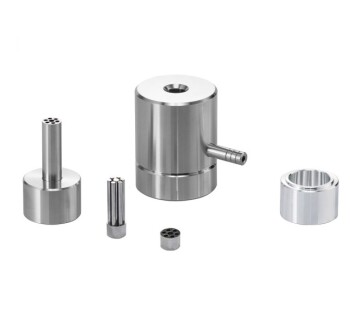
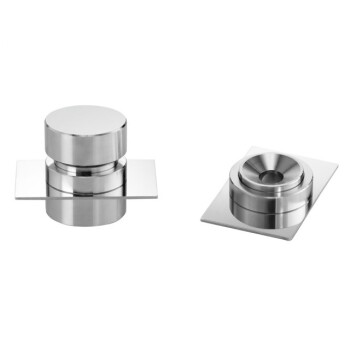
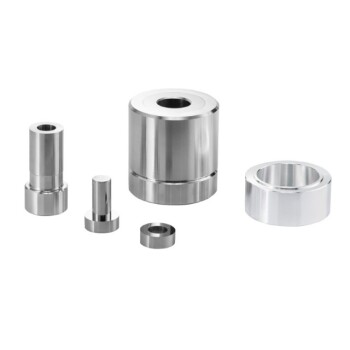
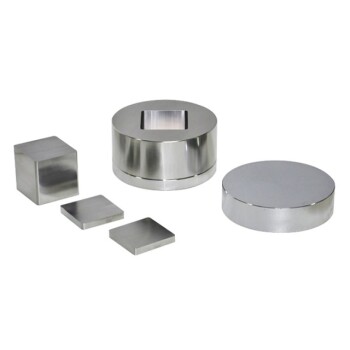
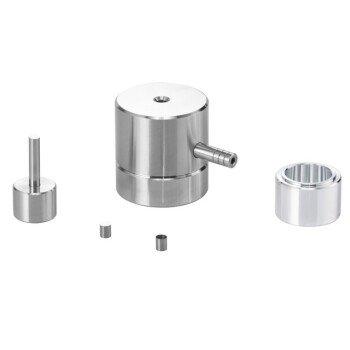
High-temperature pressure molds function as the critical forming vessels in the powder metallurgy fabrication of Silicon Carbide particle-reinforced Aluminum (SiCp/Al) composites. They act as the primary interface between the press and the raw material, transferring mechanical pressure to the internal powder mixture while maintaining structural integrity at processing temperatures typically ranging from 520°C to 590°C.
The mold is not merely a container; it is an active component of the densification process. By restricting lateral material flow and effectively transferring pressure, it forces the loose powder particles to rearrange and bond, transforming a mix of raw materials into a solid, dimensionally accurate green compact.
The Mechanics of Densification
Pressure Transfer and Rearrangement
The primary technical function of the mold is to serve as a pressure transfer medium.
During the hot pressing process, the mold receives mechanical pressure from the press and transmits it directly to the internal powder.
This force drives the rearrangement of the aluminum and silicon carbide particles, reducing porosity and increasing the density of the composite.
Geometric Constraint
To achieve high density, the powder must be compressed, not displaced.
The mold provides the necessary geometric constraints to restrict the lateral flow of the material.
By preventing the powder from spreading outward, the mold ensures that the applied force results in vertical compaction and internal consolidation rather than deformation.
Thermal Management Roles
Withstanding Process Temperatures
SiCp/Al composites require sintering temperatures between 520°C and 590°C.
The mold material must maintain its mechanical strength and shape stability within this specific thermal window to prevent failure during compression.
Ensuring Thermal Homogeneity
In vacuum hot pressing, molds—often made of high-purity graphite—play a crucial role in heat distribution.
Because the heat source is external (the furnace), the mold’s thermal conductivity is vital for transferring heat uniformly to the composite material.
This ensures the sintering temperature field remains homogeneous, preventing defects caused by uneven heating or cooling.
Understanding the Trade-offs
Mechanical Strength vs. Thermal Conductivity
Selecting the right mold involves balancing mechanical rigidity with thermal properties.
A mold with poor thermal conductivity may isolate the powder, leading to incomplete sintering in the center of the part.
Conversely, a material that conducts heat well but lacks high-temperature compressive strength will deform under pressure, compromising the dimensional accuracy of the final component.
Making the Right Choice for Your Goal
The effectiveness of your mold directly dictates the quality of your SiCp/Al composite.
- If your primary focus is densification: Prioritize mold materials with high compressive strength to withstand maximum pressure without deflection.
- If your primary focus is microstructural uniformity: Select mold materials like high-purity graphite that offer superior thermal conductivity to ensure an even temperature field.
- If your primary focus is net-shape manufacturing: Ensure the mold design accounts for thermal expansion to maintain strict dimensional accuracy during the 520°C–590°C cycle.
The mold is the defining boundary of your product; its stability determines the integrity of the final composite.
Summary Table:
| Function | Description | Key Requirement |
|---|---|---|
| Pressure Transfer | Transmits mechanical force to rearrange powder particles. | High Compressive Strength |
| Geometric Constraint | Restricts lateral flow to ensure vertical compaction. | Dimensional Stability |
| Thermal Management | Transfers heat from furnace to powder for sintering (520°C-590°C). | High Thermal Conductivity |
| Structural Integrity | Maintains shape under high heat and pressure cycles. | Thermal Shock Resistance |
Elevate Your Composite Fabrication with KINTEK Precision Solutions
Achieving the perfect balance of densification and microstructural uniformity in SiCp/Al composites requires high-performance tooling that can withstand the rigors of powder metallurgy. KINTEK specializes in advanced laboratory equipment and consumables designed for extreme environments.
Whether you need precision high-temperature pressure molds, robust hot presses, or vacuum sintering furnaces, our team provides the technical expertise to optimize your manufacturing process. We also offer a comprehensive range of crushing systems, graphite crucibles, and ceramic consumables to support your research from raw material preparation to final consolidation.
Ready to enhance your lab's efficiency and product quality? Contact KINTEK today to discuss our range of custom molds and high-temperature solutions!
Related Products
- Special Heat Press Mold for Lab Use
- Anti-Cracking Press Mold for Lab Use
- Ball Press Mold for Lab
- Special Shape Press Mold for Lab
- Double Plate Heating Press Mold for Lab
People Also Ask
- How to use a press mold? Master the Art of Creating Consistent Ceramic Forms
- What is the press mould method? A Guide to Consistent, Detailed Ceramic Forms
- What is a press mold used for? Achieve Repeatable Precision and Efficiency
- What is the function of press molds during the preparation of SiCf/Ti-43Al-9V composites? Achieve Structural Precision
- What is the purpose of specialized pressure devices in sulfide solid-state batteries? Ensure Chemo-Mechanical Stability