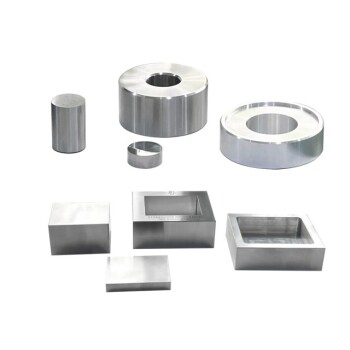
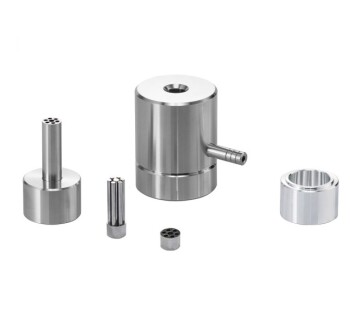
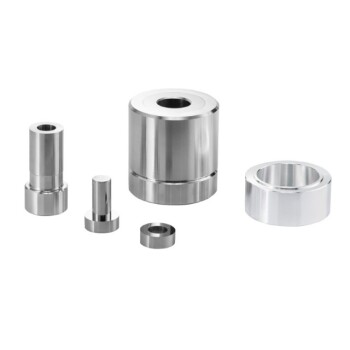
The core function of a Graphite Mold in the vacuum hot-pressing of Ti-6Al-4V is to serve as a high-strength containment vessel that defines the final geometry of the alloy. Specifically, it must maintain complete dimensional stability while transmitting uniaxial pressures up to 30 MPa at temperatures reaching 1300°C. This capability allows the mold to guide the loose powder into a fully densified solid without deforming under the extreme environment.
Core Takeaway The Graphite Mold acts as the critical interface between the hydraulic system and the material, simultaneously containing the powder and transmitting the force required for densification. Its success relies entirely on maintaining mechanical strength and thermal stability at temperatures where most other containment materials would fail or deform.
The Mechanics of Containment and Shaping
Defining Geometry Under Stress
The primary role of the mold is to confine loose Ti-6Al-4V powder into a specific shape. Unlike cold pressing, this shaping occurs simultaneously with sintering.
The mold must act as a rigid boundary. It forces the powder to adopt the mold's internal geometry exactly, ensuring the final component meets precise dimensional requirements.
Withstanding Extreme Thermal Loads
The process requires temperatures up to 1300°C to ensure proper sintering of the titanium alloy.
The graphite mold is selected because it possesses exceptional thermal stability. It must resist softening, melting, or warping, ensuring that the defining geometry remains consistent throughout the entire heating cycle.
Pressure Transmission and Densification
Acting as a Pressure Medium
Beyond simple containment, the mold serves as an active transmission medium. It transfers the mechanical force from the hydraulic rams directly to the powder compact.
In this specific process, the mold must endure and transmit uniaxial pressures of 30 MPa. It effectively converts the external hydraulic force into the internal compressive stress needed to consolidate the powder.
Facilitating Particle Rearrangement
The combination of heat and pressure transmitted by the mold facilitates the densification of the Ti-6Al-4V powder.
As the mold compresses the heated powder, it forces particle rearrangement and plastic deformation. This eliminates voids and porosity, resulting in a solid, dense material.
Understanding the Trade-offs
Mechanical Limits and Fracture Risks
While graphite acts as a robust pressure vessel, it is not indestructible. It is a brittle material with distinct mechanical limits.
If the applied pressure exceeds the mold's specific compressive strength, or if the pressure is applied unevenly, the mold can fracture. This would lead to a loss of containment and a failed sintering run.
Chemical and Dimensional Integrity
Graphite is chosen for its chemical stability, but the environment must be controlled.
In a vacuum, graphite resists oxidation, but at 1300°C, the interface between the mold and the titanium alloy is critical. The mold must be sufficiently inert or lubricated to prevent the alloy from bonding to the walls, ensuring the sample can be removed without damage.
Making the Right Choice for Your Goal
The effectiveness of your vacuum hot-pressing process depends on matching the mold's capabilities to your specific processing parameters.
- If your primary focus is Maximum Densification: Ensure your mold design includes thick enough walls to withstand pressures exceeding 30 MPa without bulging, as this maximizes the force transferred to the powder.
- If your primary focus is Dimensional Precision: Prioritize high-density, high-strength graphite grades that offer minimal thermal expansion and maximum rigidity at 1300°C to prevent even microscopic deformation.
By treating the graphite mold as a precision instrument for pressure and heat transfer rather than just a container, you ensure the structural integrity of your final Ti-6Al-4V components.
Summary Table:
| Feature | Requirement for Ti-6Al-4V Hot-Pressing |
|---|---|
| Core Function | Shape containment & uniaxial pressure transmission |
| Temperature Limit | Stable up to 1300°C |
| Pressure Capacity | Must withstand and transmit up to 30 MPa |
| Material Benefit | High thermal stability and vacuum compatibility |
| Key Outcome | Full densification and precise final geometry |
Elevate Your Material Research with KINTEK Precision Solutions
Achieving the perfect densification of Ti-6Al-4V requires more than just high temperatures—it demands high-performance equipment that can withstand extreme uniaxial pressures and thermal loads. At KINTEK, we specialize in the advanced laboratory equipment you need to succeed. From precision-engineered graphite molds and hydraulic presses to high-performance vacuum hot-pressing furnaces and high-temperature reactors, our solutions are designed for maximum durability and dimensional accuracy.
Whether you are working on battery research, metallurgical sintering, or advanced ceramics, our team is ready to provide the high-quality consumables and systems—including muffle furnaces, rotary kilns, and specialized crucibles—tailored to your laboratory's needs.
Ready to optimize your sintering process? Contact us today for a consultation and custom quote!
Related Products
- Special Heat Press Mold for Lab Use
- 2200 ℃ Graphite Vacuum Heat Treat Furnace
- Ball Press Mold for Lab
- Anti-Cracking Press Mold for Lab Use
- Double Plate Heating Press Mold for Lab
People Also Ask
- How to use a press mold? Master the Art of Creating Consistent Ceramic Forms
- What is the press mould method? A Guide to Consistent, Detailed Ceramic Forms
- What is a press mold used for? Achieve Repeatable Precision and Efficiency
- What is the function of press molds during the preparation of SiCf/Ti-43Al-9V composites? Achieve Structural Precision
- What is the purpose of specialized pressure devices in sulfide solid-state batteries? Ensure Chemo-Mechanical Stability