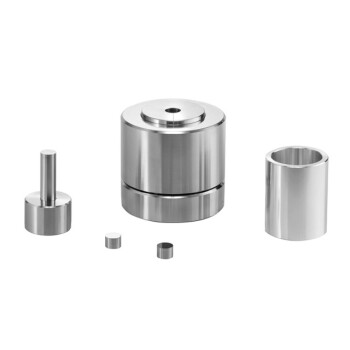
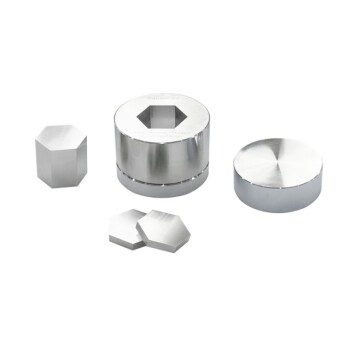
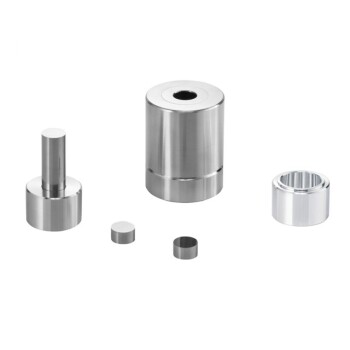
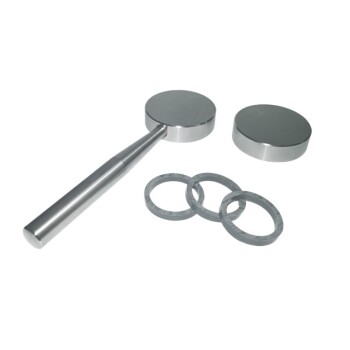
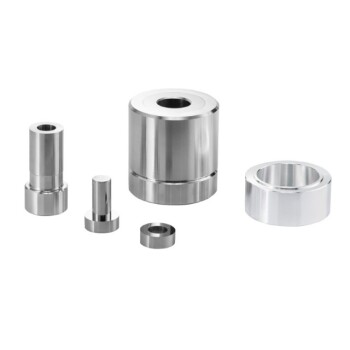
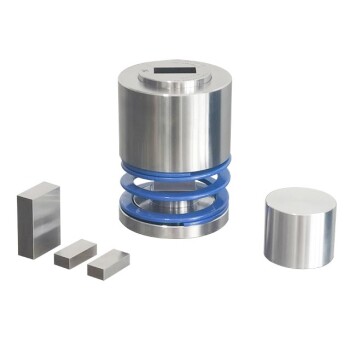
The collaboration between graphite molds and laboratory hydraulic presses forms the critical "cold pressing" foundation of composite fabrication. The graphite mold acts as a precision containment vessel with self-lubricating properties, while the hydraulic press delivers the massive axial force required to transform loose FeCrAl powder into a cohesive, manageable solid.
Core Takeaway The primary function of this pairing is to produce a "green body"—a compacted solid that holds its shape but has not yet been sintered. By applying significant pressure (e.g., 200 MPa) to powder confined in a graphite mold, you force particle rearrangement and expel trapped air, creating the density required for successful vacuum hot-pressing later.
The Mechanics of the Pre-Forming Stage
The Role of the Graphite Mold
Graphite molds are selected for this stage due to their high mechanical strength and inherent self-lubricating properties.
The mold serves as the shaping container, defining the geometry of the final cylindrical sample.
Its self-lubricating nature reduces friction between the powder and the mold walls, allowing for smoother compaction.
The Application of Axial Pressure
The laboratory hydraulic press functions as the engine of the process, applying high mechanical pressure to the powder held within the mold.
This pressure is typically axial, meaning it is applied vertically via punches.
For FeCrAl-based composites, pressures can reach 200 MPa and are often held for a duration of roughly one minute.
Material Transformation Under Load
Particle Rearrangement and Deformation
When the hydraulic press engages, the loose powder particles are forced to move.
They undergo rearrangement and plastic deformation, shifting positions to fill voids.
This physical interlocking establishes the initial contact points between particles, which is essential for the material's structural integrity.
Elimination of Trapped Air
One of the most critical functions of this stage is the removal of air trapped between powder particles.
The compression forces this air out, significantly reducing porosity in the green body.
Removing air now is vital to improving the efficiency of the subsequent vacuum hot-pressing sintering and ensuring a high final density.
Understanding the Trade-offs
Managing Density Gradients
While hydraulic pressing is effective, axial pressure can lead to non-uniform density.
Friction between the powder and the graphite walls can cause the edges of the cylinder to be denser than the center.
Graphite Mold Durability
Graphite is mechanically strong but can be brittle under shear stress.
If the hydraulic press is misaligned or if pressure is applied too abruptly, the mold risks cracking or shattering.
Making the Right Choice for Your Goal
To maximize the effectiveness of the pre-forming stage, tailor your approach to your specific outcome:
- If your primary focus is high final density: Ensure you apply the maximum safe pressure (e.g., 200 MPa) to maximize plastic deformation and air expulsion.
- If your primary focus is mold longevity: Apply pressure gradually rather than instantly to reduce shock stress on the graphite walls.
By utilizing the self-lubricating nature of graphite and the brute force of the hydraulic press, you establish the essential density required for a high-performance composite.
Summary Table:
| Feature | Function in Cold Pressing | Key Benefit for FeCrAl Composites |
|---|---|---|
| Graphite Mold | Precision containment & shaping | Self-lubricating walls reduce friction & ease ejection |
| Hydraulic Press | Application of axial force (up to 200 MPa) | Drives particle rearrangement & plastic deformation |
| Pressure Holding | Sustained load for ~1 minute | Ensures elimination of trapped air & uniform compaction |
| Green Body Output | Cohesive, manageable solid | Provides the structural integrity needed for sintering |
Elevate Your Composite Fabrication with KINTEK
Precision in the pre-forming stage is the foundation of high-performance material science. KINTEK specializes in providing the high-end laboratory equipment you need to achieve superior results. From robust hydraulic pellet and isostatic presses capable of precise axial loads to durable graphite molds and ceramic crucibles, we offer the complete toolkit for your research.
Whether you are developing FeCrAl-based composites or advanced battery materials, our range of high-temperature furnaces, crushing systems, and cooling solutions ensures your lab operates at peak efficiency.
Ready to optimize your material density and mold longevity? Contact our technical experts today to find the perfect equipment solution for your specific application requirements!
Related Products
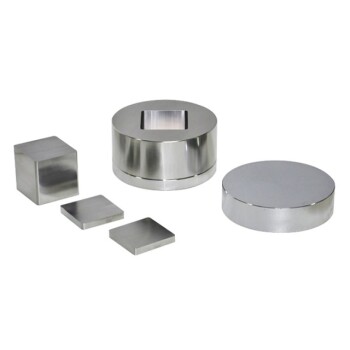
- Assemble Square Lab Press Mold for Laboratory Applications
- Ball Press Mold for Lab
- Anti-Cracking Press Mold for Lab Use
- XRF & KBR steel ring lab Powder Pellet Pressing Mold for FTIR
- Special Shape Press Mold for Lab
People Also Ask
- How to use a press mold? Master the Art of Creating Consistent Ceramic Forms
- What is a laboratory press? Achieve Precise Sample Preparation for Reliable Analysis
- How does a laboratory press contribute to the initial forming of a porous copper wick? Optimize Wick Pore Architecture
- What is the press mould method? A Guide to Consistent, Detailed Ceramic Forms
- What is the process of mold press? A Step-by-Step Guide to Compression Molding