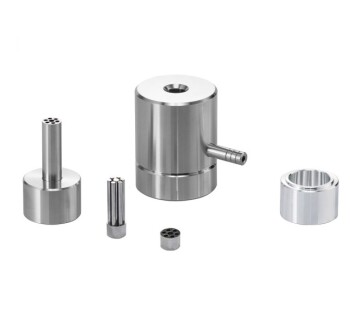
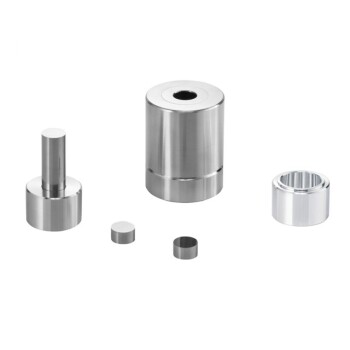
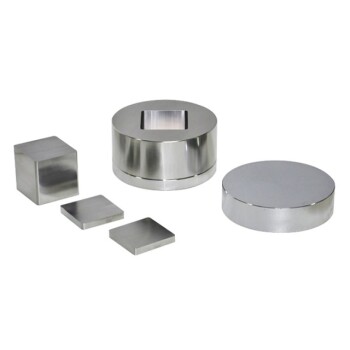
High-strength graphite molds serve a dual functional role in the vacuum hot pressing of Beryllium: they act as the precision containment vessel to define the geometry of the blank and function as the primary medium for transferring immense hydraulic pressure to the powder. By bridging the gap between the machinery and the raw material, these molds ensure the Beryllium powder is compacted into a dense, solid form while maintaining strict dimensional control.
Core Insight: The success of Beryllium sintering hinges on the mold's material properties. High-strength graphite provides a unique combination of thermal conductivity and mechanical rigidity, ensuring that heat and pressure are distributed evenly. This prevents the formation of density gradients, guaranteeing a uniform internal microstructure in the final block.
The Mechanics of Densification
Transmitting Hydraulic Pressure
The mold is not merely a static container; it is an active component in the application of force.
It serves as the transmission medium that transfers the hydraulic pressure from the press directly to the Beryllium powder.
This efficient transfer of force is necessary to promote densification, forcing particle contact and eliminating voids within the powder mass.
Defining Geometry Under Load
While subjected to significant pressure, the mold must maintain its structural integrity to define the precise shape of the Beryllium blank.
High-strength graphite is selected because it offers dimensional stability even when subjected to the high temperatures and mechanical loads inherent to the process.
This ensures that the final Beryllium block emerges with the intended geometric specifications, minimizing the need for excessive post-process machining.
Thermal Regulation and Microstructure
Ensuring Uniform Heat Distribution
One of the most critical properties of high-strength graphite is its high thermal conductivity.
During the sintering process, the mold facilitates the rapid and even spread of heat throughout the Beryllium powder.
This uniform thermal environment is essential for consistent sintering kinetics across the entire volume of the material.
Eliminating Density Gradients
If heat distribution is uneven, the outer layers of the block may sinter at a different rate than the core, leading to structural weaknesses.
The graphite mold prevents this by minimizing thermal variances.
This results in a Beryllium block with a uniform internal microstructure and no significant density gradients, which is vital for the material's performance reliability.
Understanding the Trade-offs
Mechanical Limits and Brittleness
While graphite is termed "high-strength" for its ability to withstand compressive loads at high temperatures, it remains a brittle material.
It excels at uniaxial pressure transmission (compression), but it has low tolerance for tensile or shear forces. Misalignment in the press can lead to catastrophic mold failure.
Environmental Dependency
Graphite's effectiveness is strictly tied to the vacuum environment of the hot press.
While it is thermally stable in a vacuum, graphite will rapidly oxidize if exposed to air at sintering temperatures. The vacuum hot press protects the mold, allowing it to function without degrading.
Making the Right Choice for Your Project
The selection of the mold material is as critical as the selection of the powder itself. When planning your vacuum hot pressing parameters, consider the following:
- If your primary focus is Geometric Precision: Ensure the graphite grade selected has high dimensional stability to resist deformation under hydraulic load.
- If your primary focus is Material Homogeneity: Prioritize graphite with the highest available thermal conductivity to eliminate density gradients within the Beryllium block.
By leveraging the thermal and mechanical capabilities of high-strength graphite, you ensure the production of Beryllium components that are both dimensionally accurate and structurally sound.
Summary Table:
| Feature | Role in Beryllium Hot Pressing | Benefit to Final Product |
|---|---|---|
| Pressure Transmission | Transfers hydraulic force to powder | Maximizes density & eliminates voids |
| Dimensional Stability | Maintains shape under mechanical load | Ensures geometric accuracy & less machining |
| Thermal Conductivity | Distributes heat evenly across the blank | Prevents density gradients & uniform microstructure |
| Material Integrity | Resists deformation at high temperatures | Reliable performance and mold longevity |
Optimize Your Advanced Material Sintering with KINTEK
High-performance materials like Beryllium demand precision at every stage. KINTEK specializes in cutting-edge laboratory equipment, providing the vacuum hot press systems and high-strength graphite molds necessary to achieve superior material homogeneity and structural integrity.
Beyond molding, our comprehensive portfolio includes high-temperature vacuum furnaces, isostatic hydraulic presses, and specialized ceramic crucibles designed to meet the rigorous standards of aerospace, defense, and research applications.
Ready to elevate your production quality? Contact our technical experts today to find the perfect solution for your laboratory or industrial processing needs.
Related Products
- Anti-Cracking Press Mold for Lab Use
- Special Shape Press Mold for Lab
- Ultra-High Temperature Graphite Vacuum Graphitization Furnace
- Horizontal High Temperature Graphite Vacuum Graphitization Furnace
- Vertical High Temperature Graphite Vacuum Graphitization Furnace
People Also Ask
- What is the press mould method? A Guide to Consistent, Detailed Ceramic Forms
- How to use a press mold? Master the Art of Creating Consistent Ceramic Forms
- What is the function of press molds during the preparation of SiCf/Ti-43Al-9V composites? Achieve Structural Precision
- What is a press mold used for? Achieve Repeatable Precision and Efficiency
- What is the purpose of specialized pressure devices in sulfide solid-state batteries? Ensure Chemo-Mechanical Stability