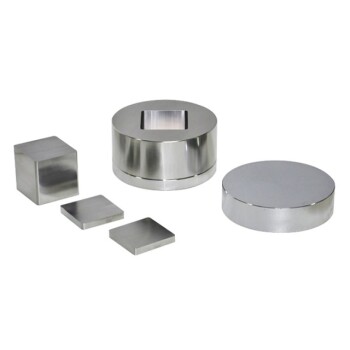
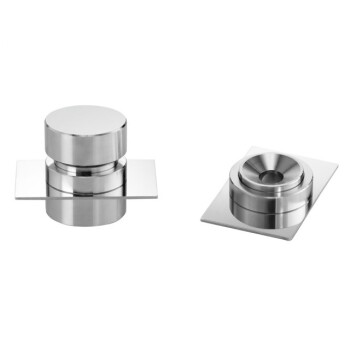
Graphite molds serve as the essential structural interface between raw alloy powder and the extreme mechanical forces of a vacuum hot pressing system. They function simultaneously as a containment vessel, a geometric guide, and a pressure transmission medium, specifically engineered to withstand temperatures of approximately 1150°C and hydraulic pressures up to 40 MPa in a high-vacuum environment.
Core Insight: Graphite molds are not merely passive containers; they are active process components that enable full alloy densification by efficiently transferring both heat and hydraulic pressure to the powder while maintaining dimensional stability under extreme conditions.
The Functional Mechanics of Graphite Molds
Defining Geometry and Containment
The most immediate role of the graphite mold is to act as the primary container for loading pre-alloyed powders.
It rigidly defines the geometric shape of the resulting bulk material. By confining the loose alloy powders within a specific cavity, the mold ensures the final product achieves the desired dimensional form during consolidation.
Transmitting Mechanical Pressure
Beyond simple containment, the mold acts as the primary medium for pressure transmission.
Hydraulic systems apply immense external mechanical pressure—often ranging from 20 to 50 MPa—directly to the mold assembly. The rigid graphite components transfer this uniaxial pressure uniformly to the interior powder body.
This transmission is critical for particle rearrangement. It assists in eliminating internal pores and achieving full densification of the alloy, transforming loose powder into a solid, high-performance material.
Withstanding Extreme Thermal Environments
Graphite is chosen for its ability to maintain structural integrity at elevated temperatures.
During vacuum hot pressing, the mold must endure temperatures often reaching 1150°C, and in some applications, up to 1300°C. High-strength graphite resists deformation under heat, ensuring that the sample geometry remains precise throughout the sintering cycle.
Facilitating Heat Transfer
The mold also serves as a thermal conduit.
Graphite’s high thermal conductivity ensures that heat is transferred efficiently from the heating elements to the internal powder mixture. This facilitates uniform heating of the alloy, which is vital for consistent material properties.
Assisting in Sample Removal
Graphite possesses natural lubricity, which plays a subtle but vital role in the manufacturing workflow.
This characteristic prevents the alloy from adhering strongly to the mold walls during the high-heat sintering process. Consequently, this facilitates the easy removal of the densified sample once the process is complete.
Operational Considerations and Trade-offs
The Necessity of Vacuum Environments
While graphite is thermally robust, it is susceptible to oxidation at high temperatures.
Therefore, the process must occur within a high-vacuum environment. This protects the graphite mold from degrading and prevents contamination of the alloy powder, ensuring the longevity of the mold and the purity of the final product.
Pressure Limitations
Graphite is strong, but it is brittle compared to metals like steel.
While these molds are designed to withstand significant pressures (up to 40–50 MPa), exceeding these limits can cause the mold to fracture. Engineers must carefully balance the pressure required for densification against the mechanical limits of the graphite grade being used.
Making the Right Choice for Your Goal
To maximize the effectiveness of your vacuum hot pressing process, align your mold usage with your specific material objectives:
- If your primary focus is Maximum Density: Ensure your mold design allows for uniform uniaxial pressure distribution (up to 40-50 MPa) to effectively eliminate porosity.
- If your primary focus is Dimensional Precision: Select high-strength graphite grades capable of maintaining rigidity at temperatures exceeding 1150°C to prevent warping.
- If your primary focus is Process Efficiency: Leverage graphite's natural lubricity to streamline the ejection phase, reducing cycle times and minimizing damage to the finished part.
Success in vacuum hot pressing relies on treating the graphite mold as a precision tool that bridges the gap between raw powder and a solid, densified component.
Summary Table:
| Role of Graphite Mold | Functional Benefit | Operational Impact |
|---|---|---|
| Pressure Transmission | Transfers 20–50 MPa to powder | Eliminates pores and achieves full densification |
| Thermal Stability | Withstands temperatures up to 1300°C | Maintains geometric precision and resists deformation |
| Thermal Conductivity | Efficient heat transfer to powder | Ensures uniform heating and consistent material properties |
| Natural Lubricity | Prevents alloy adhesion to walls | Facilitates easy sample removal and reduces cycle times |
| Containment | Defines geometric cavity | Ensures the final product meets dimensional specifications |
Maximize Your Material Density with KINTEK Precision Solutions
Elevate your research and production with KINTEK’s specialized vacuum hot pressing components. Whether you are working on advanced alloy consolidation or ceramic sintering, our high-strength graphite molds and crushing, milling, and hydraulic press systems ensure uncompromising precision and durability.
Why choose KINTEK?
- Comprehensive Laboratory Range: From high-temperature furnaces (vacuum, CVD, dental, and induction melting) to robust high-temperature high-pressure reactors and autoclaves.
- Material Expertise: Specialized consumables including PTFE products, ceramics, and crucibles designed for extreme environments.
- Precision Engineering: Equipment tailored for battery research, cooling solutions, and homogenization.
Ready to achieve full alloy densification? Contact our technical experts today to find the perfect equipment and consumables for your laboratory requirements.
Related Products
- 2200 ℃ Graphite Vacuum Heat Treat Furnace
- Ball Press Mold for Lab
- Anti-Cracking Press Mold for Lab Use
- Double Plate Heating Press Mold for Lab
- Ultra-High Temperature Graphite Vacuum Graphitization Furnace
People Also Ask
- What is the process of vacuum heat treating? Achieve Superior Hardening with a Clean, Bright Finish
- How does heat transmit in a vacuum? Mastering Thermal Radiation for Purity & Precision
- Why do you heat treat in a vacuum? Achieve Perfect Surface Finish and Material Integrity
- How does a vacuum heat treat furnace work? Achieve Pristine, Oxide-Free Metal Parts
- What is graphite heating? A Guide to Durable, High-Temp Industrial Furnace Solutions