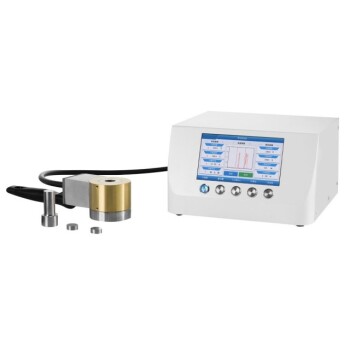
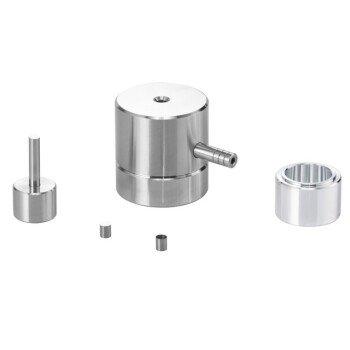
Graphite mold components act as the primary structural interface in the vacuum hot pressing of Ti-3Al-2.5V alloy powders. They serve a dual function: containing the loose powder within a defined geometry and transmitting the mechanical force necessary to transform that powder into a solid, dense material.
Core Insight The graphite mold is not merely a container; it is an active transmission medium. Its ability to remain rigid at 1300°C allows it to transfer hydraulic force uniformly to the powder, forcing particle rearrangement and densification without the mold itself deforming.
The Mechanics of Pressure Transmission
Uniaxial Force Distribution
The primary role of the graphite mold is to act as a pressure transmission medium. It conveys force from the hydraulic system directly to the powder body.
Facilitating Densification
The mold typically applies a uniaxial pressure of roughly 30 MPa to the Ti-3Al-2.5V powder. This pressure forces the powder particles to rearrange and bond.
Uniform Consolidation
By distributing this pressure evenly, the mold ensures that the powder body densifies uniformly. This prevents density gradients that could lead to structural weaknesses in the final alloy.
Thermal Stability and Containment
High-Temperature Structural Integrity
Vacuum hot pressing of titanium alloys occurs at extreme temperatures, typically around 1300°C. The graphite mold is selected specifically for its ability to maintain mechanical strength in this thermal environment.
Defining Geometric Shape
The mold serves as the central containment vessel. It confines the loose alloy powders into a specific shape prior to compression.
Resisting Deformation
While the powder yields and compacts under heat and pressure, the mold must remain dimensionally stable. It ensures the final sample retains the intended geometry rather than bulging or warping.
Operational Constraints and Material Interaction
The Necessity of Vacuum Compatibility
Titanium alloys, including Ti-3Al-2.5V, are highly reactive to oxygen and nitrogen at elevated temperatures. The graphite mold operates within a vacuum environment (e.g., 10^-1 mbar) to prevent embrittlement of the alloy.
Lubricity and Sample Removal
Graphite is utilized not just for strength, but for its natural lubricity. This property facilitates the ejection of the densified sample after the sintering process is complete, preventing the part from seizing against the mold walls.
Load Limitations
While graphite is robust, it has physical limits. The process relies on the mold having higher structural integrity than the powder at 30 MPa; exceeding the mold's specific crush strength would result in catastrophic failure of the containment.
Making the Right Choice for Your Goal
To optimize the vacuum hot pressing process for Ti-3Al-2.5V, consider how the mold interacts with your specific processing targets:
- If your primary focus is Maximum Density: Ensure the graphite grade selected can withstand pressures slightly exceeding 30 MPa to maximize particle rearrangement without mold creep.
- If your primary focus is Geometric Precision: Prioritize graphite components with verified high-temperature thermal stability to prevent dimensional distortion at 1300°C.
- If your primary focus is Surface Finish: Leverage the natural lubricity of the graphite to ensure clean separation of the sample, minimizing post-process machining.
The success of the consolidation process relies entirely on the graphite mold's ability to remain rigid while the alloy powder becomes plastic.
Summary Table:
| Function | Description | Key Benefit |
|---|---|---|
| Pressure Transmission | Conveys uniaxial force (~30 MPa) to powder | Ensures uniform particle bonding and density |
| Structural Containment | Defines geometry at 1300°C | Prevents deformation and maintains precision |
| Vacuum Compatibility | Operates at 10^-1 mbar | Prevents oxidation and embrittlement of Titanium |
| Natural Lubricity | Facilitates sample ejection | Minimizes surface damage and post-processing |
Elevate Your Material Research with KINTEK Precision
Achieving full densification in reactive alloys like Ti-3Al-2.5V requires high-performance hardware. KINTEK specializes in providing advanced laboratory solutions, including high-temperature vacuum hot presses and durable graphite mold components designed to withstand extreme 1300°C environments.
Whether you are working with CVD/PECVD systems, hydraulic pellet presses, or high-pressure reactors, our technical experts are ready to help you optimize your sintering and consolidation workflows. We offer a comprehensive range of consumables, from high-purity graphite and ceramics to PTFE products and crucibles, ensuring your lab achieves repeatable, high-precision results every time.
Ready to optimize your alloy production? Contact KINTEK today for a consultation!
Related Products
- Special Heat Press Mold for Lab Use
- Ball Press Mold for Lab
- Anti-Cracking Press Mold for Lab Use
- Double Plate Heating Press Mold for Lab
- Ring Press Mold for Lab Applications
People Also Ask
- How to use a press mold? Master the Art of Creating Consistent Ceramic Forms
- What is the press mould method? A Guide to Consistent, Detailed Ceramic Forms
- What is a press mold used for? Achieve Repeatable Precision and Efficiency
- What is the function of press molds during the preparation of SiCf/Ti-43Al-9V composites? Achieve Structural Precision
- What is the purpose of specialized pressure devices in sulfide solid-state batteries? Ensure Chemo-Mechanical Stability