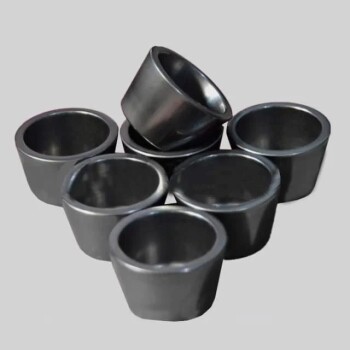
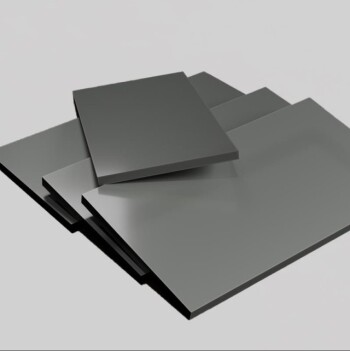
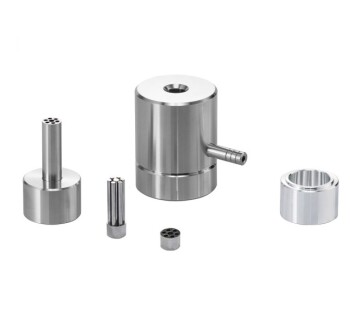
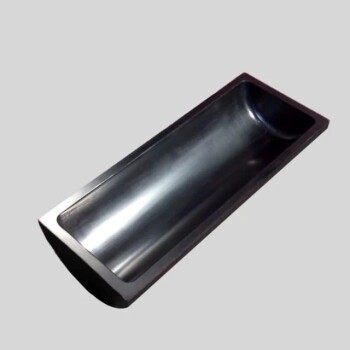
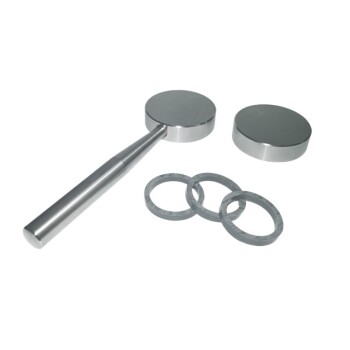
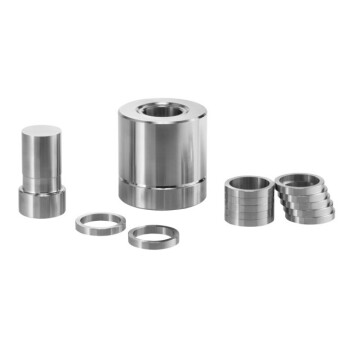
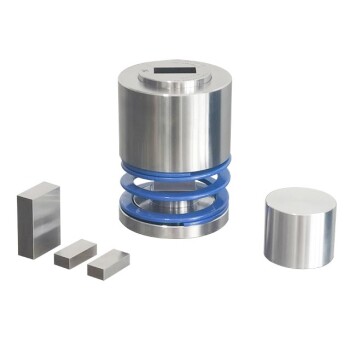
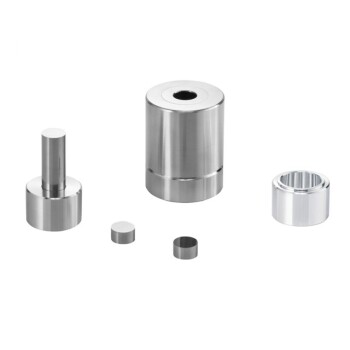
High-density graphite molds perform a triple function in Field Assisted Sintering Technology (FAST/SPS): they act as the precise shaping container for the powder, serve as the active heating element via Joule heating, and function as the mechanical ram to transmit pressure. By combining excellent electrical conductivity with high-temperature structural integrity, these molds facilitate the rapid densification and geometric accuracy of the final sintered product.
In FAST/SPS processes, the graphite mold is not merely a passive vessel; it is an active component of the machine's thermal and mechanical circuit, directly determining the efficiency of heat generation and the uniformity of the final part's density.
The Operational Roles of the Mold
Precision Containment and Shaping
At its most fundamental level, the high-density graphite mold acts as a container.
It holds the loose powder samples in place prior to sintering.
Furthermore, the internal geometry of the mold dictates the final shape and geometric accuracy of the component once the process is complete.
Functioning as a Joule Heating Source
In the SPS process, the mold is an integral part of the heating system.
Because high-density graphite possesses excellent electrical conductivity, it allows high currents to pass through the mold assembly.
For non-conductive samples (such as ceramics), the mold acts as the primary resistive heating element, generating heat via the Joule effect to raise the sample temperature rapidly.
Transmission of Uniaxial Pressure
Sintering in FAST/SPS relies heavily on mechanical force to achieve density.
The graphite mold must possess sufficient mechanical strength at high temperatures to withstand and transmit this force.
It acts as a conductor for uniaxial pressure, transferring tons of force uniformly to the powder to drive the densification process.
Critical Material Requirements
Rapid Thermal Response
The efficiency of FAST/SPS relies on speed.
Graphite molds must exhibit high thermal conductivity alongside their electrical properties.
This ensures that the heat generated is distributed quickly and evenly, allowing for the rapid temperature increases that characterize this technology.
Structural Integrity Under Load
The environment inside an SPS chamber is hostile, combining extreme heat with immense physical pressure.
The graphite used must be of high density to maintain its structural integrity without deforming.
Failure to maintain this strength would compromise the transmission of pressure, resulting in poor density or distorted geometry in the sintered product.
Understanding the Operational Trade-offs
While high-density graphite is the standard for these molds, it is not without operational constraints.
The mold acts as a consumable interface between the machine's rams and the sample.
Because the mold serves as the current path, any inconsistency in the graphite's density or purity can lead to uneven heating or "hot spots."
Furthermore, if the mold lacks the specific mechanical strength required for the target temperature, it may fracture under the uniaxial pressure, ruining the sample and potentially damaging the machine.
Optimizing Process Success
To ensure your FAST/SPS process yields high-quality components, you must match the mold's capabilities to your specific processing goals.
- If your primary focus is densifying non-conductive materials: Prioritize molds with consistent electrical resistivity to ensure they function efficiently as stable Joule heating sources.
- If your primary focus is geometric precision: Ensure the graphite grade has exceptional high-temperature mechanical strength to prevent deformation under uniaxial loads.
- If your primary focus is process speed: Select high-density graphite with superior thermal conductivity to facilitate the most rapid heating and cooling rates possible.
Success in Spark Plasma Sintering is ultimately defined by the mold's ability to simultaneously conduct current, transfer heat, and apply pressure without compromise.
Summary Table:
| Function | Description | Impact on Sintering |
|---|---|---|
| Shaping Container | Holds powder and defines geometry | Ensures high geometric accuracy and precision. |
| Joule Heating Source | Conducts high current to generate heat | Enables rapid heating rates, especially for ceramics. |
| Pressure Transmission | Transfers uniaxial force to the sample | Drives material densification and structural integrity. |
| Thermal Conduction | Distributes heat rapidly across the mold | Promotes thermal uniformity and prevents hot spots. |
Maximize Your Material Research Precision with KINTEK
Achieve unmatched sintering results with KINTEK’s high-performance laboratory equipment. Whether you are utilizing Field Assisted Sintering Technology (FAST/SPS) or exploring advanced ceramics, our high-density graphite molds, vacuum and atmosphere furnaces, and hydraulic presses provide the reliability your research demands.
From high-temperature high-pressure reactors to precision milling systems, KINTEK specializes in empowering labs with durable consumables and cutting-edge tools. Partner with us to enhance your densification efficiency and material integrity.
Contact Our Technical Experts Today
Related Products
- High Purity Pure Graphite Crucible for Evaporation
- High Purity Pure Graphite Crucible for Electron Beam Evaporation
- Horizontal High Temperature Graphite Vacuum Graphitization Furnace
- Ultra-High Temperature Graphite Vacuum Graphitization Furnace
- Vertical High Temperature Graphite Vacuum Graphitization Furnace
People Also Ask
- Why are high-purity graphite crucibles preferred for sulfide solid electrolytes? Achieve Superior Material Purity
- Why is a high-purity graphite crucible required for Chromel-TaC composites? Ensure Peak Purity at 1400°C
- What role do high-purity graphite crucibles play in molten salt corrosion research? Ensure Reactor-Grade Precision
- Why are high-purity graphite crucibles used for magnesium distillation? Ensure 3N8 Purity & Thermal Stability
- Why is a high-purity graphite crucible ideal for nitrogen-doped graphene at 1500 °C? Maximize Purity and Stability