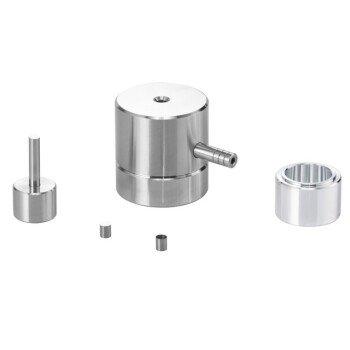
Graphite molds function as the primary interface between the raw material and the sintering machinery during the vacuum hot pressing of Zinc Sulfide (ZnS). They serve three simultaneous roles: acting as the physical container to define the ceramic's geometry, conducting heat to ensure thermal uniformity, and serving as the transmission medium for the axial pressure required to densify the powder.
By converting hydraulic force into uniform axial pressure at high temperatures, graphite molds drive the "plastic flow" mechanism. This is the critical process that transforms loose ZnS powder into a solid, high-density ceramic with optical transparency.
The Mechanics of Densification
Transmitting Axial Pressure
The most vital function of the graphite mold is to act as a mechanical transmission medium. The hydraulic system of the hot press applies force to the mold, which then transfers this pressure directly to the Zinc Sulfide powder.
In ZnS processing, this often involves uniaxial pressures up to 50 MPa. The mold must maintain structural rigidity to ensure this force is applied evenly across the powder bed, rather than being absorbed by the mold's deformation.
Driving Plastic Flow
The pressure transmitted by the mold is not passive; it is the catalyst for plastic flow. Under high heat and pressure, the ZnS particles undergo rearrangement and deformation.
The graphite mold facilitates this by maintaining confinement. This forces the material to fill voids and eliminate porosity, resulting in the high density required for optical applications.
Thermal Regulation and Geometry
Defining Physical Dimensions
Graphite molds serve as the shaping container for the ceramic. They hold the loose powder or green body and restrict its expansion during the pressing cycle.
Because ZnS ceramics are often used for infrared windows or domes, the mold’s internal dimensions directly dictate the final near-net shape of the product, minimizing the need for extensive post-processing.
Ensuring Uniform Heating
Graphite possesses high thermal and electrical conductivity. This property is essential for stabilizing the thermal environment within the vacuum chamber.
By conducting heat efficiently, the mold ensures that the ZnS powder is heated uniformly from all sides. This prevents thermal gradients that could lead to internal stresses, cracking, or uneven densification in the final ceramic.
Understanding the Trade-offs: Carbon Contamination
The Risk of Ion Diffusion
While graphite is mechanically ideal, it presents a chemical challenge during the sintering of ZnS. At the high temperatures (around 1000°C) and pressures required, carbon ions from the mold can diffuse into the ceramic.
These ions migrate through the grain boundaries of the Zinc Sulfide structure. This is an inherent risk of using carbon-based tooling in direct contact with the powder.
Impact on Optical Performance
If carbon diffusion occurs, it can react to form carbonate defects within the ceramic lattice. These defects create specific absorption bands that impair the material's performance.
For ZnS, which is prized for its infrared transparency, these defects appear as impurities in the infrared spectrum. Therefore, the mold is not just a tool; it is a potential source of contamination that must be managed.
Making the Right Choice for Your Goal
To maximize the quality of Zinc Sulfide ceramics, the selection and handling of graphite molds must be strategic.
- If your primary focus is Optical Purity: Prioritize high-purity, high-density graphite dies. Denser graphite minimizes the surface area available for carbon diffusion and reduces the risk of carbonate defects appearing in the infrared spectrum.
- If your primary focus is Mechanical Density: Ensure the mold is engineered to withstand pressures exceeding 50 MPa without deformation. Any elasticity in the mold will result in a loss of pressure transmission, leading to incomplete densification and residual porosity.
Ultimately, the graphite mold is not merely a passive container, but an active participant in the thermodynamic process that determines the final optical integrity of the ceramic.
Summary Table:
| Function | Role in ZnS Vacuum Hot Pressing | Impact on Final Ceramic |
|---|---|---|
| Pressure Transmission | Converts hydraulic force to uniaxial pressure (up to 50 MPa) | Drives particle rearrangement and eliminates porosity |
| Plastic Flow | Facilitates material deformation under heat and pressure | Ensures full densification for high optical transparency |
| Thermal Regulation | Provides high thermal conductivity and uniform heating | Prevents internal stresses and cracking during sintering |
| Geometric Shaping | Acts as a rigid physical container for the powder | Defines near-net shape, reducing post-processing needs |
| Purity Management | High-density graphite limits carbon ion diffusion | Minimizes carbonate defects and infrared absorption bands |
Elevate Your Material Research with KINTEK Precision Tooling
Achieve unmatched optical purity and mechanical density in your Zinc Sulfide ceramics. KINTEK specializes in high-performance laboratory equipment, providing the vacuum hot pressing systems and high-density graphite molds essential for advanced material science.
Our comprehensive range includes:
- High-Temperature Furnaces & Hydraulic Presses: From vacuum and atmosphere furnaces to precision pellet and isostatic presses.
- Advanced Reactors: High-temperature high-pressure reactors and autoclaves for demanding synthesis.
- Specialized Consumables: High-purity ceramics, crucibles, and PTFE products designed to prevent contamination.
Don't let inferior tooling compromise your infrared windows or domes. Let our experts provide the cooling solutions, milling systems, and precision molds your project requires.
Contact KINTEK today to optimize your sintering process!
Related Products
- Ball Press Mold for Lab
- 2200 ℃ Graphite Vacuum Heat Treat Furnace
- Horizontal High Temperature Graphite Vacuum Graphitization Furnace
- Special Shape Press Mold for Lab
- Ultra-High Temperature Graphite Vacuum Graphitization Furnace
People Also Ask
- What are the advantages of using a laboratory hydraulic press for hot pressing? Achieve Peak Nano-Composite Density
- How to use a press mold? Master the Art of Creating Consistent Ceramic Forms
- What is the press mould method? A Guide to Consistent, Detailed Ceramic Forms
- What is the purpose of specialized pressure devices in sulfide solid-state batteries? Ensure Chemo-Mechanical Stability
- Why are pressure molds with non-conductive resin inner walls required for battery testing? Ensure Data Accuracy