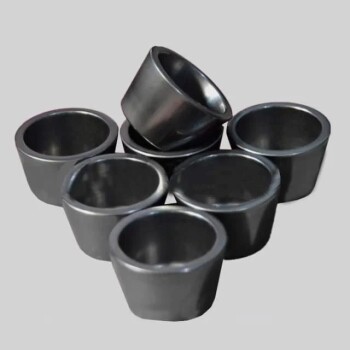
High-strength graphite molds act as the primary structural interface that defines the geometry and quality of the final composite material. Specifically, for CuAlMn and sodium chloride mixtures, these molds provide the necessary containment to convert loose powder into a solid, precise billet under extreme thermal and mechanical stress.
Core Takeaway Graphite molds are not merely containers; they are active thermal and mechanical components of the manufacturing process. By maintaining structural integrity under high pressure while facilitating efficient heat transfer, they ensure the alloy achieves high dimensional precision and uniform density without chemical contamination.
The Mechanics of Containment and Shaping
Withstanding Uniaxial Pressure
The primary function of the mold is to endure significant mechanical stress without deformation. During the vacuum hot pressing of CuAlMn and sodium chloride, the mold must withstand uniaxial pressures up to 28 MPa.
Restricting Lateral Flow
To achieve high density, the powder mixture must be compressed significantly. The graphite mold provides rigid confinement, restricting the lateral flow of the powder.
Ensuring Dimensional Precision
Because the mold maintains its shape rigidly under pressure, it dictates the final geometry of the sample. This results in the production of cylindrical billets with precise dimensions and high-quality surface finishes.
Thermal Dynamics and Efficiency
Facilitating Heat Transfer
Graphite is selected for its high thermal conductivity. The mold acts as a conduit, transferring heat efficiently from the furnace elements to the internal CuAlMn and sodium chloride powder mixture.
Promoting Uniform Heating
The mold’s ability to conduct heat ensures that the temperature distribution within the powder remains uniform. This prevents thermal gradients that could lead to inconsistent material properties or structural defects in the final alloy.
Operating at Elevated Temperatures
The process requires the mold to maintain strength at temperatures as high as 930 degrees Celsius. Unlike many metals that would soften, high-strength graphite retains its structural integrity in this thermal range.
Understanding the Operational Trade-offs
Mechanical Limits
While robust, these molds have a finite pressure threshold. The primary operational limit for this specific mixture is cited at 28 MPa. Exceeding this pressure risks fracturing the graphite, which is inherently brittle compared to steel dies.
Chemical Stability vs. Reactivity
Graphite offers excellent chemical stability in a vacuum, preventing significant reactions with copper alloys. However, operators must ensure the vacuum environment is maintained; in the presence of oxygen at these temperatures, the graphite mold would degrade rapidly.
Making the Right Choice for Your Goal
To maximize the quality of your CuAlMn composites, align your processing parameters with the mold's capabilities.
- If your primary focus is Dimensional Accuracy: Ensure your applied pressure does not exceed 28 MPa to prevent mold deformation or micro-cracking that distorts the sample.
- If your primary focus is Homogeneity: Utilize the mold's thermal conductivity by ramping temperature steadily, allowing the heat to penetrate the powder mixture uniformly before applying peak pressure.
Success in vacuum hot pressing relies on treating the graphite mold as a precision instrument that balances extreme force with delicate thermal control.
Summary Table:
| Feature | Function in Vacuum Hot Pressing | Impact on CuAlMn/NaCl Mixture |
|---|---|---|
| Pressure Tolerance | Withstands up to 28 MPa | Prevents lateral flow; ensures high density |
| Thermal Conductivity | Efficient heat transfer | Ensures uniform temperature distribution |
| Temperature Limit | Stable up to 930°C | Maintains structural integrity under heat |
| Material Properties | Chemical stability in vacuum | Prevents contamination of the alloy |
| Rigidity | Fixed geometry containment | Guarantees high dimensional precision |
Elevate Your Material Research with KINTEK Precision Solutions
Achieving high-density alloys like CuAlMn requires a perfect balance of pressure and thermal control. KINTEK specializes in high-performance laboratory equipment designed for the most demanding applications. Whether you need robust vacuum hot pressing systems, precision-engineered high-strength graphite molds, or advanced hydraulic presses (pellet, hot, isostatic), we provide the tools to ensure your success.
Our extensive portfolio also includes high-temperature furnaces (muffle, vacuum, CVD), high-temperature high-pressure reactors, and specialized laboratory consumables like ceramics and crucibles.
Ready to optimize your production of high-precision billets? Contact us today to discover how KINTEK can enhance your lab's efficiency and material quality!
Related Products
- High Purity Pure Graphite Crucible for Evaporation
- High Purity Pure Graphite Crucible for Electron Beam Evaporation
- Vertical High Temperature Graphite Vacuum Graphitization Furnace
- Ultra-High Temperature Graphite Vacuum Graphitization Furnace
- Horizontal High Temperature Graphite Vacuum Graphitization Furnace
People Also Ask
- Why are high-purity graphite crucibles preferred for sulfide solid electrolytes? Achieve Superior Material Purity
- Why is a high-purity graphite crucible required for Chromel-TaC composites? Ensure Peak Purity at 1400°C
- What role do high-purity graphite crucibles play in molten salt corrosion research? Ensure Reactor-Grade Precision
- Why are high-purity graphite crucibles used for magnesium distillation? Ensure 3N8 Purity & Thermal Stability
- Why is a high-purity graphite crucible ideal for nitrogen-doped graphene at 1500 °C? Maximize Purity and Stability