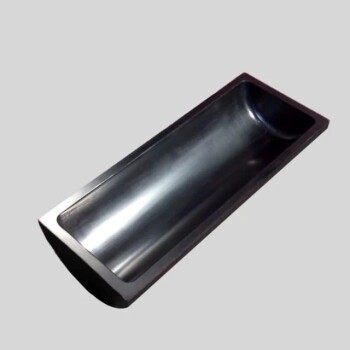
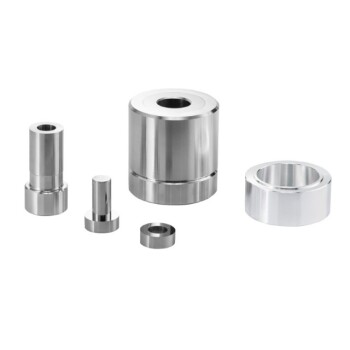
Graphite dies serve as the structural foundation for the vacuum hot press sintering of nano-Aluminum Nitride powders. Their primary functions are to act as a high-strength containment vessel and to serve as the medium for transferring significant mechanical pressure (often around 30 MPa) directly to the powder mass, ensuring the material is compacted into a precise shape with high density.
The graphite die acts as the critical interface between the machine and the material. It must convert external hydraulic force into internal material density without deforming, even while subjected to extreme thermal stress.
The Mechanics of Pressure and Shaping
Efficient Pressure Transmission
The most critical role of the graphite die is to translate force into densification. In vacuum hot pressing, the die acts as a piston-cylinder system.
It effectively transfers the mechanical load—specifically designed for pressures like 30 MPa—from the hydraulic press to the nano-Aluminum Nitride powder. This force forces particles into close contact, driving the rearrangement necessary for high density.
Defining Precise Geometry
The die functions as the primary mold that dictates the final form of the sintered component. Because the powder is essentially loose prior to sintering, the die provides the rigid boundaries required to define the component's geometry.
By maintaining its shape under load, the die ensures that the final sintered ceramic achieves precise dimensional tolerances.
Thermal and Structural Integrity
Withstanding High-Temperature Environments
Sintering nano-Aluminum Nitride requires aggressive thermal environments, often ranging between 1550°C and 1650°C.
The graphite die is selected for its ability to maintain structural integrity at these extremes. It must resist softening or degrading, which would otherwise compromise the sintering process.
Facilitating Uniform Heating
Beyond mechanical strength, graphite acts as a thermal conductor. The die facilitates the transfer of heat from the heating elements into the powder compact.
This high thermal conductivity promotes uniform heat distribution, which is essential for consistent densification throughout the ceramic body.
Understanding the Trade-offs
The Risk of High-Temperature Creep
While graphite is chosen for its high-temperature strength, it is not immune to deformation.
If the mechanical load exceeds the specific grade's capacity at peak temperatures (e.g., significantly above 30-35 MPa), the die may experience creep. This gradual deformation can lead to warped parts or a loss of dimensional accuracy in the final product.
Material Compatibility and Chemical Inertness
The die must remain chemically stable relative to the powder being sintered.
Although graphite is generally inert, the specific process conditions must ensure no adverse chemical reactions occur between the carbon in the die and the aluminum nitride, which could affect the purity or structural integrity of the ceramic.
Making the Right Choice for Your Goal
To maximize the effectiveness of your sintering process, consider the specific demands of your project:
- If your primary focus is Maximum Density: Prioritize high-strength graphite grades capable of withstanding pressures exceeding 30 MPa to force particle rearrangement without die failure.
- If your primary focus is Dimensional Precision: Select a die grade with exceptional resistance to high-temperature creep to ensure the mold geometry remains static at 1650°C.
Success in vacuum hot pressing relies on viewing the graphite die not just as a container, but as an active tool for thermal and mechanical transfer.
Summary Table:
| Function | Description | Key Performance Indicator |
|---|---|---|
| Pressure Transmission | Translates 30+ MPa hydraulic force into material densification. | Particle rearrangement and high density. |
| Geometric Definition | Acts as a rigid mold for precise dimensional tolerances. | Final component shape and accuracy. |
| Thermal Conductivity | Facilitates uniform heat transfer from elements to powder. | Consistent densification throughout the body. |
| Structural Integrity | Resists deformation at high temperatures (1550°C - 1650°C). | Resistance to high-temperature creep. |
Elevate Your Material Research with KINTEK Precision Solutions
Achieving peak density and dimensional accuracy in nano-Aluminum Nitride sintering requires more than just high temperatures; it demands the right engineering tools. KINTEK specializes in providing high-performance laboratory equipment, including advanced vacuum hot press systems, graphite dies, and crushing and milling systems designed to handle the most rigorous sintering environments.
Whether you are focusing on high-pressure densification or precise thermal control, our team offers the expertise and the comprehensive range of high-temperature furnaces, hydraulic presses, and ceramic consumables you need to succeed.
Ready to optimize your sintering process? Contact KINTEK today to discuss your project requirements!
Related Products
- Graphite Vacuum Furnace Bottom Discharge Graphitization Furnace for Carbon Materials
- Graphite Disc Rod and Sheet Electrode Electrochemical Graphite Electrode
- Graphite Vacuum Furnace High Thermal Conductivity Film Graphitization Furnace
- High Purity Pure Graphite Crucible for Evaporation
- Ultra-High Temperature Graphite Vacuum Graphitization Furnace
People Also Ask
- What is the use of graphite furnace? Achieve Extreme-Temperature Processing for Advanced Materials
- What is the disadvantage of graphite furnace? Managing Reactivity and Contamination Risks
- What gas is used in graphite furnace? Maximize Accuracy with the Right Inert Gas
- What is the graphite furnace used for? Achieve Extreme Heat Up to 3000°C in a Controlled Environment
- What are the stages of graphite furnace? A Guide to Precise Multi-Stage Temperature Programming