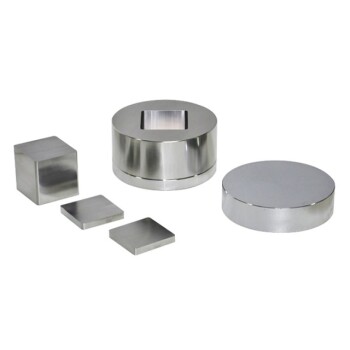
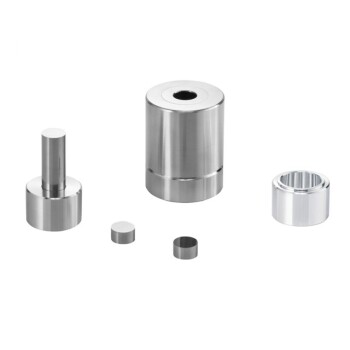
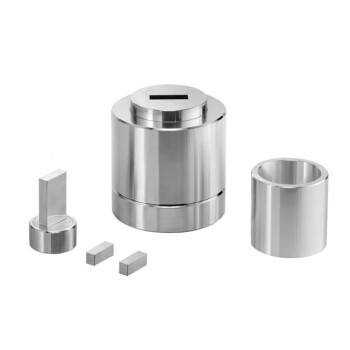
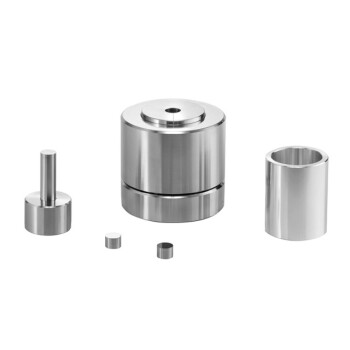
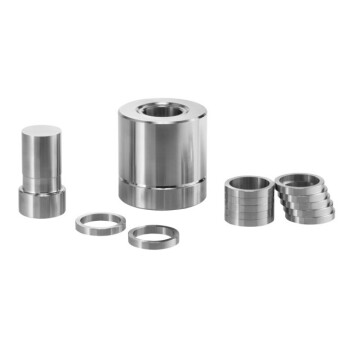
The primary advantages of using PEEK (Polyetheretherketone) molds are their unique combination of high mechanical strength, chemical inertness, and electrical insulation. Specifically for sulfide all-solid-state batteries, PEEK serves as an ideal vessel because it can withstand the immense pressures required for powder densification while preventing short circuits and ensuring the highly reactive electrolyte remains pure.
Core Takeaway Reliable solid-state battery data requires isolating the active materials from the testing equipment. PEEK molds achieve this by enduring forming pressures of hundreds of megapascals without conducting electricity or chemically degrading in the presence of sensitive sulfide electrolytes.
Mechanical Integrity Under Extreme Loads
To function correctly, solid-state electrolytes must be compressed into a dense pellet. PEEK provides the structural rigidity necessary for this process.
Withstanding High-Pressure Densification
Sulfide electrolytes require significant compression to minimize porosity and ensure good ion transport. PEEK molds are capable of withstanding forming pressures ranging from 200 to 450 MPa. This allows researchers to densify powders effectively without fracturing the mold.
Maintaining Dimensional Stability
Unlike softer polymers that might warp under load, PEEK retains its shape during the pressing process. This stability ensures that the geometry of the electrolyte pellet remains consistent, which is critical for calculating accurate conductivity and density metrics.
Electrical Isolation for Accurate Data
One of the most critical roles of the mold is to act as an insulator between the conductive parts of the pressing setup.
Preventing Internal Short Circuits
In a typical pressing setup, metal plungers apply force from the top and bottom. PEEK acts as a non-conductive sleeve, preventing electrical contact between the upper and lower plungers. Without this insulation, the cell would short-circuit immediately, rendering any electrical testing impossible.
Enabling Electrochemical Impedance Spectroscopy (EIS)
Because PEEK is electrically insulating, it allows the mold to serve as the test cell itself during characterization. It ensures that the current flows only through the battery materials, guaranteeing that EIS and cycling data reflect the actual performance of the battery, not the housing.
Chemical Inertness in a Reactive Environment
Sulfide electrolytes are chemically aggressive and highly sensitive to moisture and incompatible materials.
Preventing Undesirable Side Reactions
PEEK is chemically inert toward sulfide electrolytes. This prevents parasitic reactions that could degrade the electrolyte or contaminate the sample surface.
Ensuring Long-Term Stability
During long-term cycling, the interface between the mold and the active components must remain stable. PEEK ensures that the electrolyte and metal electrodes (like lithium or sodium) do not react with the container, preserving the integrity of the cell over time.
Understanding the Trade-offs
While PEEK is exceptional, it is not a replacement for high-strength steel in all scenarios. It is vital to understand its limitations to avoid equipment failure.
Pressure Limitations vs. Metal
While PEEK is strong for a polymer, it has a lower yield strength than hardened steel or cemented carbide. If pressures exceed the material's specific limit (typically above 450-500 MPa depending on the grade), PEEK can undergo plastic deformation or creep, potentially jamming the plungers or losing pressure accuracy.
Temperature and Environment Constraints
Although PEEK has high thermal stability, it is not immune to extreme thermal fluctuations combined with high mechanical stress. Users must ensure their testing protocols stay within the thermal and mechanical operating window of the specific PEEK grade being used to avoid warping.
Making the Right Choice for Your Goal
When selecting mold materials for solid-state battery research, align your choice with your specific testing phase.
- If your primary focus is Powder Densification: Use PEEK for pressures up to 450 MPa to achieve high density without risking electrical shorts between plungers.
- If your primary focus is Electrochemical Testing: Rely on PEEK molds to act as the cell body, ensuring zero chemical interference with sulfides and accurate impedance data.
- If your primary focus is Long-Term Cycling: Utilize PEEK's stability to maintain constant stack pressure (1.5–10 MPa) to counteract volume changes in materials like NCM-811 without degrading the housing.
PEEK molds are the industry standard for bridging the gap between mechanical durability and electrochemical precision in sulfide battery research.
Summary Table:
| Feature | PEEK Mold Advantage | Benefit for Sulfide Batteries |
|---|---|---|
| Pressure Resistance | Withstands 200–450 MPa | Enables high powder densification without fracture |
| Electrical Property | High Insulation | Prevents short circuits between plungers during testing |
| Chemical Stability | Chemically Inert | No parasitic reactions with aggressive sulfide electrolytes |
| Structural Integrity | Dimensional Stability | Ensures consistent pellet geometry for accurate data |
| Test Compatibility | Non-conductive Sleeve | Allows for precise EIS and electrochemical characterization |
Elevate Your Battery Research with KINTEK Precision Engineering
Don't compromise your solid-state battery data with inferior materials. KINTEK provides high-performance PEEK molds and hydraulic pellet presses specifically designed to withstand the rigors of sulfide electrolyte research.
Our extensive laboratory portfolio includes:
- Specialized Pressing Solutions: Hydraulic presses (pellet, hot, isostatic) for optimal densification.
- Thermal & Chemical Processing: High-temperature furnaces, autoclaves, and chemically inert crucibles.
- Advanced Analysis Tools: Electrolytic cells, electrodes, and comprehensive battery research consumables.
Ready to achieve superior electrochemical precision? Contact KINTEK today to discuss how our high-pressure PEEK solutions and laboratory equipment can streamline your workflow and ensure reliable, repeatable results.
Related Products
- Button Battery Tablet Press Sealing Mold for Lab Use
- Button Battery Disassembly and Sealing Mold for Lab Use
- Special Shape Press Mold for Lab
- Anti-Cracking Press Mold for Lab Use
- Polygon Press Mold for Lab
People Also Ask
- What role do battery test molds or coin cell cases play? Optimize Your All-Solid-State Battery Assembly Today
- What is the function of a tablet press? Transforming Powder into Precise, Uniform Tablets
- What is tablet pressing in pharmaceutical industry? The Core Process for Producing Solid Oral Dosage Forms
- What is the difference between single punch and rotary tablet press? Choose the Right Machine for Your Lab or Production
- What are pill presses called? The Correct Term is Tablet Press for Pharmaceutical Manufacturing