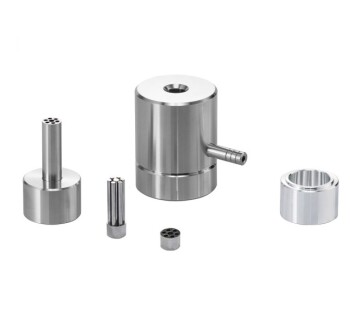
Graphite molds act as both the definitive shaping vessel and the active medium for pressure transmission. During the vacuum hot pressing of Cu-Al2O3 green bodies, these molds restrict the lateral flow of the powder, ensuring that the unidirectional force from the press is effectively converted into densification energy.
The graphite mold is not a passive container; it is an active mechanical component that converts axial force into the hydrostatic-like pressure required to create a dense, crack-free composite.
The Mechanics of Pressure Transmission
Converting Axial Force
The hot press applies pressure in a single direction (uniaxial).
The graphite mold walls confine the powder, preventing it from spreading outward. This constraint forces the powder to consolidate, effectively converting the vertical force into hydrostatic pressure within the mold.
Restricting Lateral Flow
For the Cu-Al2O3 green bodies to densify rather than deform, the powder must be contained.
The rigid walls of the mold provide the necessary resistance to stop lateral flow. This ensures that the applied energy results in the elimination of pores and the compaction of the material.
Defining Final Geometry
The mold serves as the negative for the final product.
It defines the exact dimensions and shape of the composite. Because the mold restricts movement, the final densified solid retains the precise geometry dictated by the mold's internal walls.
Understanding the Trade-offs: Wall Friction
The Friction Challenge
While the mold walls are essential for containment, they introduce a mechanical side effect: friction.
As the powder compresses, it rubs against the graphite walls. This friction can absorb some of the applied force, potentially leading to non-uniform pressure distribution throughout the green body.
Overcoming Resistance
To counteract the effects of friction, the hot pressing system must utilize high pressures.
By applying significant force (often up to 30 MPa or even 100 MPa depending on the specific setup), the system overcomes wall resistance to ensure the material achieves structural integrity and uniform density.
Thermal and Chemical Stability
High-Temperature Structural Integrity
The process requires temperatures that can exceed 950°C.
Graphite is chosen because it maintains high dimensional stability and mechanical strength at these temperatures. It does not soften or deform, ensuring the pressure transmission remains consistent throughout the sintering cycle.
Thermal Conductivity
The mold acts as a thermal conduit.
Graphite's excellent thermal conductivity ensures that heat is transferred uniformly from the heating elements to the copper-alumina powder. This prevents thermal gradients that could lead to cracking or uneven sintering.
Chemical Inertness
The mold must interact physically with the powder, but not chemically.
Graphite remains largely chemically inert to copper-based composites in vacuum environments. This prevents the mold from reacting with the Cu-Al2O3, ensuring the purity of the composite and facilitating easy removal (demolding) of the finished billet.
Making the Right Choice for Your Goal
While the graphite mold is standard, understanding its limitations helps you optimize your process parameters.
- If your primary focus is Uniform Density: Increase the applied pressure to overcome wall friction and ensure the axial force reaches the center of the green body.
- If your primary focus is Dimensional Accuracy: Ensure the graphite grade chosen has high thermal stability to prevent even microscopic deformation at peak temperatures (950°C+).
Ultimately, the success of your sintering process relies on the mold's ability to maintain rigidity while efficiently transferring both heat and massive mechanical loads.
Summary Table:
| Function | Physical Role & Impact | Key Benefit |
|---|---|---|
| Pressure Transmission | Converts uniaxial axial force into hydrostatic-like pressure. | Ensures high densification and pore elimination. |
| Lateral Restriction | Confines powder to prevent outward flow during compression. | Maintains precise final geometry and dimensions. |
| Thermal Conduit | Evenly transfers heat from heating elements to the green body. | Prevents thermal gradients and material cracking. |
| Chemical Stability | Maintains inertness and structural integrity at 950°C+. | Guarantees material purity and easy demolding. |
Elevate Your Material Research with KINTEK Precision
Achieving the perfect Cu-Al2O3 composite requires more than just high temperatures—it demands equipment that masters the physics of pressure and heat. KINTEK specializes in advanced laboratory solutions, providing the high-performance vacuum hot presses, graphite molds, and high-temperature furnaces essential for superior sintering and densification.
From high-pressure hydraulic systems to precision-engineered crushing and milling tools, our portfolio is designed to help researchers and manufacturers overcome friction and thermal challenges. Don’t let equipment limitations compromise your structural integrity.
Contact KINTEK experts today to find the ideal hot pressing solution for your lab!
Related Products
- 2200 ℃ Graphite Vacuum Heat Treat Furnace
- Ball Press Mold for Lab
- Ultra-High Temperature Graphite Vacuum Graphitization Furnace
- Horizontal High Temperature Graphite Vacuum Graphitization Furnace
- Vertical High Temperature Graphite Vacuum Graphitization Furnace
People Also Ask
- What is the process of vacuum heat treating? Achieve Superior Hardening with a Clean, Bright Finish
- How does heat transmit in a vacuum? Mastering Thermal Radiation for Purity & Precision
- Why do you heat treat in a vacuum? Achieve Perfect Surface Finish and Material Integrity
- How does a vacuum heat treat furnace work? Achieve Pristine, Oxide-Free Metal Parts
- What is graphite heating? A Guide to Durable, High-Temp Industrial Furnace Solutions