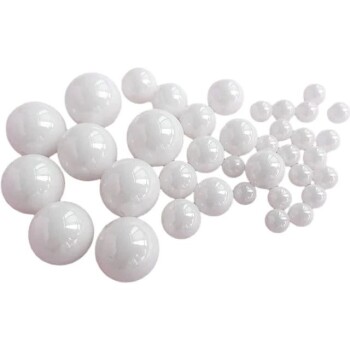
The selection of hardened steel balls for reactive ball milling is a strategic necessity driven by physics. Hardened steel provides the specific combination of high density and extreme hardness required to generate the kinetic energy needed to break down stable chemical bonds. This mechanical force triggers the decomposition of silicides while simultaneously protecting the purity of the resulting nanopowders through superior wear resistance.
Core Takeaway: Hardened steel balls serve as high-energy catalysts that convert mechanical motion into the chemical work required to decompose silicides, while their durability prevents metallic contamination from degrading the final material's performance.
The Mechanics of Energy Transfer
Overcoming Chemical Stability
Silicides are characterized by their inherent stability and strong atomic bonds. To initiate a chemical reaction or decomposition at the molecular level, the milling media must deliver high-velocity impacts that exceed the threshold of these bonds.
Leveraging High Density and Hardness
The high density of hardened steel ensures that each collision carries significant momentum and kinetic energy. Because the material is also exceptionally hard, it does not deform upon impact, allowing nearly all the energy to be transferred directly into the powder particles.
Driving Mechanochemical Decomposition
This intensive energy transfer facilitates mechanochemical decomposition, a process where mechanical stress drives chemical changes. The repeated fracturing and cold-welding of particles under high-pressure impacts force the silicides to react and transform into the desired nanostructured phases.
Preserving Material Integrity
Minimizing Impurity Introduction
During prolonged milling, inferior materials often shed microscopic fragments due to the high-frequency stress. Hardened steel's wear resistance is critical here, as it minimizes the volume of foreign metallic particles introduced into the system.
Protecting Thermoelectric Performance
In applications like thermoelectrics, even trace amounts of contamination can significantly alter electrical and thermal conductivity. By using hardened media, researchers ensure that the nanopowder’s chemical composition remains pure, preserving its specialized functional properties.
Ensuring Structural Longevity
The structural integrity of the milling tools—both the balls and the jars—is vital for process consistency. Hardened steel withstands the mechanical stress of high-frequency impacts over long durations without significant degradation, ensuring reproducible results across different batches.
Understanding the Trade-offs
The Risk of Iron Contamination
While hardened steel is highly wear-resistant, it is not completely immune to erosion. Over extended milling cycles, a small amount of iron contamination may still occur, which can be detrimental to certain sensitive alloy systems or specific electronic applications.
Thermal Management Challenges
The high-energy impacts generated by dense steel balls produce significant heat. Without proper thermal management or cooling cycles, this heat can lead to unwanted grain growth or phase transformations that counteract the benefits of the nanostructuring process.
Applying This to Your Synthesis Process
Selecting the right milling media depends on the specific requirements of your final material and the stability of your precursors.
- If your primary focus is Maximum Reactive Energy: Utilize large-diameter hardened steel balls to maximize the impact force required for the decomposition of highly stable compounds.
- If your primary focus is High Material Purity: Ensure both the balls and the milling jars are made of the same hardened steel grade to prevent cross-contamination and minimize wear-induced impurities.
- If your primary focus is Nanoscale Grain Refinement: Opt for smaller hardened steel media to increase the frequency of collisions, which promotes more uniform fracturing and prevents agglomeration.
Ultimately, hardened steel balls provide the essential mechanical "punch" required to transform stable silicides into high-performance nanopowders.
Summary Table:
| Feature | Physical Benefit | Impact on Silicide Processing |
|---|---|---|
| High Density | Increased momentum & kinetic energy | Breaks stable atomic bonds in silicides |
| Extreme Hardness | No deformation during impact | Direct energy transfer for mechanochemical decomposition |
| Wear Resistance | Reduced material shedding | Minimizes metallic impurities & protects performance |
| Structural Integrity | Resists high-frequency stress | Ensures process reproducibility & longevity |
Elevate Your Nanomaterial Synthesis with KINTEK
Achieving the perfect nanostructured phase requires precision tools that withstand extreme mechanical stress. KINTEK specializes in high-performance laboratory equipment designed for the most demanding applications. Whether you are performing high-pressure reactive ball milling or advanced material synthesis, we provide the reliable solutions you need:
- Advanced Milling & Crushing: High-durability hardened steel media and milling systems.
- High-Temperature Solutions: Muffle, tube, and vacuum furnaces for post-milling heat treatments.
- Precision Pressing: Hydraulic pellet and isostatic presses for sample preparation.
- Specialized Consumables: High-purity ceramics, crucibles, and PTFE products to ensure zero contamination.
Ready to optimize your lab’s efficiency and material purity? Contact KINTEK today to discuss your specific research requirements and explore our full range of high-temperature high-pressure reactors, autoclaves, and battery research tools.
References
- Imants Dirba, Oliver Gutfleisch. Bulk Nanostructured Silicide Thermoelectric Materials by Reversible Hydrogen Absorption–Desorption. DOI: 10.1002/smll.202208098
This article is also based on technical information from Kintek Solution Knowledge Base .
Related Products
- Precision Machined Zirconia Ceramic Ball for Engineering Advanced Fine Ceramics
- Laboratory Ball Mill Jar Mill with Metal Alloy Grinding Jar and Balls
People Also Ask
- What are the applications of zirconia ceramics? Unlock High-Performance Solutions for Extreme Environments
- What is the physical mechanism for selecting hard grinding media? Optimize Your ZrC-Al Matrix Composite Production
- Why are zirconia milling balls preferred for P2-type layered oxides? Ensure High Purity and Grinding Efficiency
- What is the purpose of using zirconia milling balls of different diameters? Optimize Solid Electrolyte Processing
- Why are zirconia grinding jars and balls required for solid-state electrolyte powders? Ensure High Purity & Performance