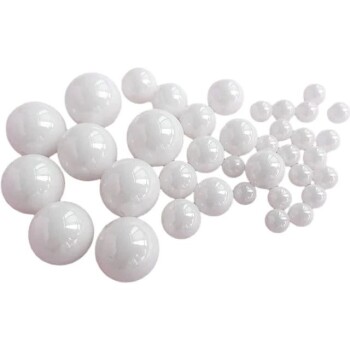
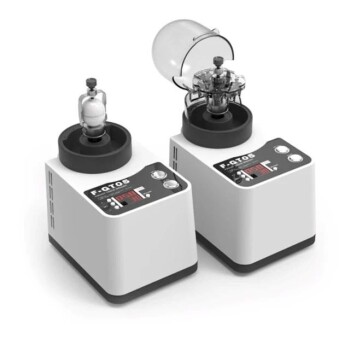
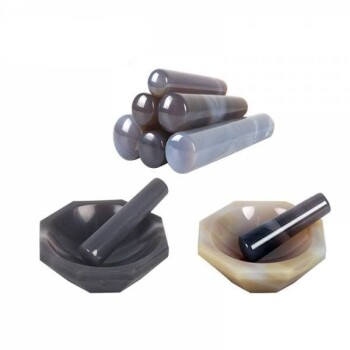
Zirconia grinding balls are the industry standard for this application primarily to guarantee material purity. They offer a critical combination of exceptional hardness and chemical inertness, allowing for the aggressive pulverization of LLZTO precursor powders without introducing detrimental metal ion contaminants that would compromise the final solid-state electrolyte.
Core Takeaway Processing LLZTO requires breaking down hard oxide materials without altering their chemical composition. Zirconia media is preferred because it delivers the high-impact force necessary for nanometer-level grinding while preventing the metallic contamination common with steel media, thereby ensuring the electrolyte maintains its intended electrochemical performance.
The Critical Need for Chemical Inertness
Preventing Cation Contamination
LLZTO (Lithium Lanthanum Zirconium Tantalum Oxide) is a solid-state electrolyte that is highly sensitive to impurities.
The introduction of foreign elements, particularly metal ions from grinding media, can act as unintended dopants. Zirconia is chemically inert, meaning it does not react with the precursor powders or release metallic contaminants during the milling process.
Superiority Over Stainless Steel
Common milling media, such as stainless steel, are unsuitable for this application due to abrasive wear.
Using steel balls introduces iron and other metal ions into the powder mixture. By using zirconia, you eliminate this contamination vector, preserving the high purity required for the material’s final electrochemical stability.
Mechanical Efficiency in Particle Refinement
Pulverizing Hard Oxides
The precursor materials for LLZTO—specifically Lanthanum Oxide ($La_2O_3$) and Zirconium Dioxide ($ZrO_2$)—are physically hard and difficult to break down.
Zirconia balls possess high hardness and wear resistance. This physical durability ensures they can effectively fracture these hard raw materials and mix them uniformly without degrading themselves.
Achieving Nanometer Fineness
High-performance solid-state electrolytes require an ultra-fine, uniform particle size to ensure reactivity.
Using small-diameter zirconia beads (e.g., 0.1 mm) creates high-frequency effective impact points. This capability enables the reduction of LLZTO powders to the nanometer level, which is essential for densification and ionic conductivity.
Durability During Extended Milling
The solid-state reaction method often requires long-term high-energy milling, sometimes extending to 12-hour cycles.
Zirconia’s high wear resistance ensures it maintains its structural integrity throughout these extended operations. This stability guarantees that the particle size distribution remains consistent from the beginning of the cycle to the end.
Understanding the Trade-offs
The Risk of Stoichiometric Shifts
While zirconia is preferred because it minimizes foreign contamination, it is not completely immune to wear.
If zirconia media does degrade, it introduces Zirconium Oxide ($ZrO_2$) into the mixture. Since Zirconium is already a component of LLZTO, this is far less damaging than iron contamination, but excessive wear can still slightly alter the intended stoichiometry of the final compound.
Cost vs. Performance
Zirconia media is generally more expensive than standard stainless steel options.
However, in the context of advanced battery materials, this cost is a necessary investment. The expense of the media is outweighed by the value of preventing batch failure due to conductivity-killing impurities.
Making the Right Choice for Your Goal
To optimize your LLZTO synthesis, select your grinding media based on your specific processing requirements:
- If your primary focus is Electrochemical Purity: Prioritize high-quality, stabilized zirconia balls to completely eliminate the risk of metallic ion doping from wear debris.
- If your primary focus is Particle Size Reduction: Utilize small-diameter (0.1 mm) zirconia beads to maximize impact frequency and achieve ultra-fine, nanometer-level powder.
Use zirconia media to ensure the aggressive mechanical energy required for milling results in a pure, reactive precursor rather than a contaminated waste product.
Summary Table:
| Feature | Zirconia Grinding Balls | Stainless Steel Media |
|---|---|---|
| Primary Benefit | Ensures chemical purity | Low cost, high durability |
| Contamination Risk | Negligible (same-element Zr) | High (Iron & metal ions) |
| Hardness | Exceptional (suitable for hard oxides) | High |
| Chemical Inertness | Highly Inert | Subject to abrasive wear |
| Target Fineness | Nanometer-level | Micron-level |
| Best Application | Solid-state electrolytes (LLZTO) | General industrial milling |
Elevate Your Battery Research with KINTEK
Don't let metallic contamination compromise your solid-state electrolyte performance. KINTEK specializes in high-performance laboratory equipment and consumables designed for precision material science. From our ultra-wear-resistant zirconia grinding media to our advanced crushing and milling systems, we provide the tools necessary to achieve nanometer-level fineness while maintaining absolute chemical purity.
Our comprehensive portfolio also includes high-temperature furnaces, hydraulic presses, and battery research consumables tailored for the next generation of energy storage.
Ready to optimize your LLZTO synthesis? Contact KINTEK today for a customized solution!
Related Products
- Laboratory Jar Ball Mill with Alumina Zirconia Grinding Jar and Balls
- Precision Machined Zirconia Ceramic Ball for Engineering Advanced Fine Ceramics
- Laboratory Jar Mill with Agate Grinding Jar and Balls
- Laboratory Ball Mill Jar Mill with Metal Alloy Grinding Jar and Balls
- High Energy Planetary Ball Mill Milling Machine for Laboratory
People Also Ask
- What are the primary functions of using a ball mill for BZCY72 powder? Achieve High Purity and Enhanced Sintering
- In what way does a laboratory ball mill affect material properties when modifying PHBV/pulp fiber composites?
- Why is a laboratory ball mill required for ultra-fine fly ash? Unlock Nano-Scale Adsorption Power
- What is the function of a laboratory ball mill in the preparation of AMMCs? Optimize Dispersion & Grain Refinement
- What is the function of a laboratory ball mill in the pretreatment of waste tire char (WTC)? Optimize Material Reactivity