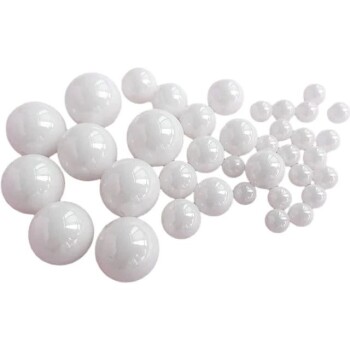
The primary advantages of utilizing zirconia grinding balls for wet milling sulfide electrolytes are their extreme chemical inertness and superior wear resistance. These properties allow for the effective pulverization of hard particles without introducing metallic impurities, which is critical for preventing side reactions and internal short circuits in solid-state batteries.
Core Takeaway The distinct value of zirconia lies in its ability to balance high-energy mechanical impact with chemical neutrality. Unlike stainless steel, zirconia media prevents conductive contamination, thereby preserving the high purity, ionic conductivity, and electrochemical stability essential for sensitive sulfide-based systems.
Preserving Electrochemical Purity
Elimination of Metallic Contaminants
Sulfide electrolytes are exceptionally sensitive to foreign materials, particularly metals. The primary benefit of zirconia is that it does not introduce metallic impurities, such as iron, into the mixture during the milling process.
Prevention of Internal Short Circuits
Metallic contaminants introduced during milling can act as conductive bridges within the electrolyte layer. By using electrically insulating zirconia, you eliminate a root cause of internal short circuits that can occur during battery cycling.
Chemical Stability and Inertness
Zirconia is chemically inert and does not react with the sulfur compounds in the electrolyte. This stability prevents unwanted side reactions that could degrade the electrolyte's composition or compromise its ionic conductivity.
Optimizing Mechanical Efficiency
High Impact for Amorphization
Zirconia balls possess high density and extreme hardness. This allows them to generate the intense impact energy required to promote amorphization, a structural change often necessary to achieve high ionic conductivity in sulfide electrolytes.
Superior Wear Resistance
Due to its high hardness, zirconia resists degradation even during prolonged, high-energy milling sessions. This durability ensures that the grinding media retains its shape and size, providing consistent energy transfer throughout the process.
Reducing Reaction Times
The combination of high hardness and density facilitates efficient mechanical energy transfer. This efficiency helps shorten the reaction times required to pulverize particles and synthesize the desired electrolyte phase.
Understanding the Trade-offs
Non-Zero Contamination
While zirconia minimizes contamination, it does not eliminate wear entirely. However, the trace amount of zirconia dust introduced is electrically insulating and chemically stable, making it benign compared to the fatal impact of conductive metal particles.
Density Considerations
Zirconia is denser than many ceramic alternatives but slightly less dense than steel. While this provides sufficient energy for most mechanochemical reactions, users transitioning from steel media may need to adjust milling duration or speed to achieve identical kinetic energy input.
Making the Right Choice for Your Goal
When selecting milling media for solid-state battery development, prioritize your specific performance metrics:
- If your primary focus is Electrochemical Stability: Select zirconia to strictly eliminate metallic iron contamination, which causes short circuits and degradation.
- If your primary focus is Ionic Conductivity: Rely on zirconia's high hardness to achieve the necessary amorphization and particle reduction without chemically altering the sulfide structure.
Zirconia represents the baseline standard for sulfide electrolyte processing, offering the only reliable path to high-purity, stable solid-state battery materials.
Summary Table:
| Feature | Advantage | Benefit for Sulfide Electrolytes |
|---|---|---|
| Chemical Inertness | No reaction with sulfur | Prevents electrolyte degradation |
| Electrical Insulation | Eliminates conductive debris | Prevents internal battery short circuits |
| High Hardness | Superior wear resistance | Ensures consistent energy and low contamination |
| High Density | Efficient energy transfer | Promotes amorphization and shorter milling times |
Elevate Your Solid-State Battery Research with KINTEK
Precision in material synthesis is the cornerstone of battery innovation. At KINTEK, we specialize in providing high-performance laboratory equipment and consumables tailored for sensitive electrochemical applications.
Our premium zirconia grinding media and advanced crushing and milling systems are engineered to prevent contamination and ensure the highest ionic conductivity for your sulfide electrolytes. Beyond milling, KINTEK offers a comprehensive range of solutions including:
- High-temperature furnaces & vacuum systems
- Hydraulic pellet presses & isostatic presses
- High-pressure reactors and autoclaves
- Electrolytic cells and battery research tools
Don't let metallic impurities compromise your battery's safety and performance. Partner with KINTEK for reliable, high-purity laboratory solutions that drive results.
Contact KINTEK Experts Today to find the perfect equipment for your specific research needs.
Related Products
- Laboratory Jar Ball Mill with Alumina Zirconia Grinding Jar and Balls
- Precision Machined Zirconia Ceramic Ball for Engineering Advanced Fine Ceramics
- Laboratory Jar Mill with Agate Grinding Jar and Balls
- Laboratory Ball Mill Jar Mill with Metal Alloy Grinding Jar and Balls
- High Energy Planetary Ball Mill Milling Machine for Laboratory
People Also Ask
- What are the primary functions of using a ball mill for BZCY72 powder? Achieve High Purity and Enhanced Sintering
- In what way does a laboratory ball mill affect material properties when modifying PHBV/pulp fiber composites?
- Why is a laboratory ball mill required for ultra-fine fly ash? Unlock Nano-Scale Adsorption Power
- What is the function of a laboratory ball mill in the preparation of AMMCs? Optimize Dispersion & Grain Refinement
- What is the function of a laboratory ball mill in the pretreatment of waste tire char (WTC)? Optimize Material Reactivity