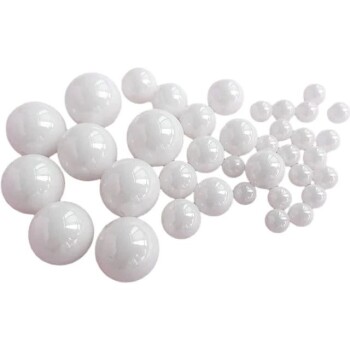
Zirconia grinding balls are the industry standard for phosphor preparation because they combine extreme mechanical force with unmatched chemical purity.
When milling hard ceramic raw materials like alumina, the grinding media must be harder than the material being processed to achieve effective particle size reduction. Zirconia (ZrO₂) is selected because its exceptional hardness and high density provide the necessary impact energy to refine powders to sub-micron levels. Crucially, its superior wear resistance ensures that virtually no foreign impurities are introduced into the mixture, preserving the critical optical and electrical properties of the final phosphor.
Core Takeaway: Zirconia grinding media provide the high-intensity impact energy required to crush hard ceramic oxides while maintaining a near-zero wear rate. This dual capability ensures efficient material refinement without compromising the chemical purity essential for high-performance phosphors.
The Mechanical Advantage: High-Energy Particle Refinement
High Density and Impact Energy
Zirconia is a high-density material, which translates directly into increased kinetic energy during the milling process. As the milling jar rotates, the weight of the zirconia balls generates the significant shear and impact forces required to break down hard alumina aggregates.
Exceptional Hardness and Toughness
Unlike softer media, zirconia possesses the structural integrity to withstand high-intensity milling without fracturing. Its high fracture toughness prevents the balls from chipping or cracking when they collide with each other or the hard raw materials.
Effective Particle Size Reduction
The combination of density and hardness allows for the consistent production of sub-micron level uniform powders. This fine particle size is vital for ensuring a thorough solid-state reaction during the subsequent synthesis of the ceramic composite.
The Purity Advantage: Protecting Optical and Electrical Integrity
Superior Wear Resistance
In phosphor production, even trace amounts of metallic impurities can "poison" the material, leading to a total loss of luminescence. Zirconia's extremely low wear rate means that the media does not shed material into the batch, even during prolonged milling cycles.
Chemical Inertness and Stability
Zirconia is chemically stable and does not react with the alumina or other precursors during the mixing process. This chemical neutrality ensures that the synthesized product maintains its intended stoichiometric balance and phase purity.
Avoiding Metallic Contamination
Using zirconia media eliminates the risk of introducing metal ions or foreign oxides that typically result from using steel or lower-grade ceramic balls. This is critical for maintaining the stable electrical performance and optical clarity required in high-performance applications.
Understanding the Trade-offs and Limitations
The Cost of Excellence
Zirconia grinding balls represent a significantly higher upfront investment compared to alumina or glass media. However, their long service life and the reduced risk of ruined batches often result in a lower total cost of ownership in high-precision manufacturing.
Equipment Compatibility and Wear
Because zirconia is so dense and hard, it can cause accelerated wear on milling jars that are not also lined with zirconia or high-quality polymers. To maintain purity, it is often necessary to match the media with a zirconia-lined vessel to prevent the jar itself from becoming a source of contamination.
Heat Generation
The high energy levels achieved with zirconia can lead to thermal buildup during dry milling. In many processes, a liquid medium like isopropyl alcohol is used to dissipate heat and facilitate a more efficient, cool milling environment.
How to Apply This to Your Project
When selecting grinding media for ceramic processing, your choice should align with the sensitivity of your final application.
- If your primary focus is optical or electrical purity: Always utilize high-purity zirconia balls and matching zirconia-lined jars to eliminate the risk of performance-degrading contaminants.
- If your primary focus is rapid particle size reduction: Leverage high-density zirconia to maximize impact energy, potentially reducing the total milling time required for hard oxides like alumina or SiC.
- If your primary focus is cost-sensitive bulk processing: Evaluate if the wear rate of lower-cost media (like high-alumina balls) is acceptable for your purity requirements before committing to the higher cost of zirconia.
Selecting the right zirconia media ensures that the fundamental chemistry of your material remains exactly as designed from the first minute of milling to the final synthesis.
Summary Table:
| Feature | Mechanical/Chemical Advantage | Impact on Phosphor Quality |
|---|---|---|
| High Density | Increased kinetic & impact energy | Efficient sub-micron particle refinement |
| Extreme Hardness | Resists fracturing and chipping | Consistent milling performance without debris |
| Low Wear Rate | Near-zero material shed | Preserves optical and electrical purity |
| Chemical Inertness | No reaction with precursors | Maintains stoichiometric balance and phase purity |
Elevate Your Material Synthesis with KINTEK Precision
Precision in phosphor preparation starts with the right consumables and equipment. At KINTEK, we specialize in providing high-performance laboratory solutions designed to meet the most stringent purity standards. Whether you need zirconia grinding media, milling jars, or advanced crushing and milling systems, our products ensure your materials remain free from contamination.
Beyond milling, KINTEK offers a comprehensive range of laboratory equipment to support your entire workflow, including:
- High-Temperature Furnaces: Muffle, tube, vacuum, and CVD systems for seamless synthesis.
- Processing Tools: Hydraulic pellet presses, sieving equipment, and high-pressure reactors.
- Lab Essentials: Alumina and zirconia ceramics, crucibles, and cooling solutions like ULT freezers.
Ready to optimize your ceramic processing? Contact our technical experts today to find the perfect grinding media and furnace solutions tailored to your research and production needs.
References
- Ju Hyun Oh, Seunghun Lee. Influence of Ga Substitution on the Local Structure and Luminescent Properties of Eu-Doped CaYAlO4 Phosphors. DOI: 10.3390/inorganics11080329
This article is also based on technical information from Kintek Solution Knowledge Base .
Related Products
- Laboratory Jar Ball Mill with Alumina Zirconia Grinding Jar and Balls
- Precision Machined Zirconia Ceramic Ball for Engineering Advanced Fine Ceramics
- Laboratory Jar Mill with Agate Grinding Jar and Balls
- Laboratory Ball Mill Jar Mill with Metal Alloy Grinding Jar and Balls
- Laboratory Micro Tissue Grinding Mill Grinder
People Also Ask
- What are the primary functions of using a ball mill for BZCY72 powder? Achieve High Purity and Enhanced Sintering
- In what way does a laboratory ball mill affect material properties when modifying PHBV/pulp fiber composites?
- Why is a laboratory ball mill required for ultra-fine fly ash? Unlock Nano-Scale Adsorption Power
- What is the function of a laboratory ball mill in the preparation of AMMCs? Optimize Dispersion & Grain Refinement
- What is the function of a laboratory ball mill in the pretreatment of waste tire char (WTC)? Optimize Material Reactivity