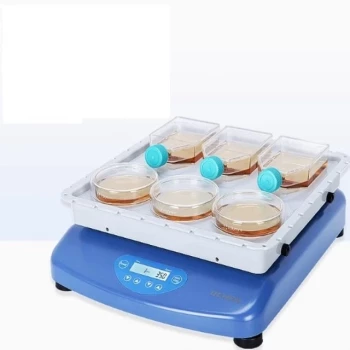
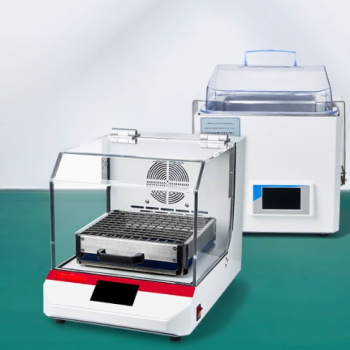
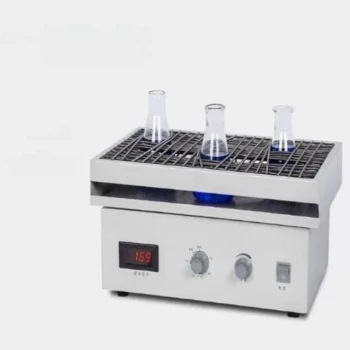
Achieving accurate results in magnetite-based adsorption requires precise control over fluid dynamics and thermal energy. In experiments involving Pb(II) removal, a reciprocating or constant temperature shaker is used to provide the continuous mechanical power necessary to keep magnetite particles fully suspended. This controlled environment eliminates physical barriers like liquid film diffusion resistance, ensuring that the interaction between the lead ions and the adsorbent is dictated by chemical affinity rather than physical transport limitations.
A shaker is critical for eliminating mass transfer resistance and maintaining thermal stability, allowing the system to reach kinetic equilibrium efficiently. Without this controlled motion, magnetite particles would settle, leading to inaccurate data and an incomplete understanding of the adsorption mechanism.
Overcoming Physical Barriers to Adsorption
Eliminating Liquid Film Diffusion Resistance
The primary role of a reciprocating shaker is to provide forced convection, which minimizes the stagnant liquid layer surrounding the magnetite particles. By maintaining a stable oscillation, the shaker ensures that Pb(II) ions can migrate rapidly from the bulk solution to the adsorbent surface. This process effectively removes liquid film diffusion resistance, which would otherwise slow down the reaction and mask the true kinetic behavior.
Ensuring Complete Adsorbent Suspension
Magnetite is a relatively dense mineral, and without active agitation, particles will naturally settle at the bottom of the reaction vessel. A shaker provides the continuous mechanical power required to keep these particles in a state of total suspension. This maximizes the available surface area for Pb(II) ions, ensuring that the entire mass of the adsorbent is participating in the reaction simultaneously.
Accelerating Mass Transfer to Internal Pores
While magnetite surface area is vital, some adsorbents possess internal microporous structures where ions must penetrate for complete removal. The mechanical energy from the shaker helps overcome mass transfer resistance at the liquid-solid interface. This promotes the efficient diffusion of Pb(II) into the internal structure of the material, allowing for a more uniform and rapid loading process.
Ensuring Data Integrity and Repeatability
Maintaining Precise Thermal Equilibrium
Adsorption is a temperature-sensitive process; even minor fluctuations can significantly alter the adsorption capacity and rate. A constant temperature incubator shaker provides a stable thermal environment, which is essential for calculating accurate thermodynamic parameters such as enthalpy and entropy. Precise temperature control ensures that the kinetic data collected is reproducible and reflects the true energy state of the system.
Accelerating the Path to Kinetic Equilibrium
In experimental research, reaching a steady state within a predictable timeframe is necessary for efficient data collection. By providing constant oscillation frequency (such as 150 or 180 rpm), the shaker ensures that the system reaches kinetic equilibrium as quickly as possible. This consistency allows researchers to accurately determine the maximum adsorption capacity and the time required for complete solute removal.
Eliminating Local Concentration Gradients
Static solutions often suffer from localized "dead zones" where the concentration of Pb(II) differs from the rest of the flask. The uniform motion of a shaker creates a homogeneous environment, eliminating these local concentration gradients. This homogeneity is what allows for the accurate determination of adsorption models and ensures that the final data is not skewed by sampling errors.
Understanding the Trade-offs
Mechanical Stress vs. Adsorption Efficiency
While high-speed shaking improves mass transfer, excessive mechanical force can lead to particle attrition or the breakdown of the adsorbent structure. If the magnetite particles are modified with sensitive organic coatings, overly aggressive shaking may strip the surface functional groups. Finding the optimal balance between high-speed contact and structural integrity is a key technical challenge.
Heat Generation from Mechanical Motion
Long-term experiments at high RPM can generate subtle amounts of heat through friction and the shaker's motor. In studies where precise temperature sensitivity is the primary variable, this internal heat gain must be compensated for by the incubator's cooling system. Failure to account for this can lead to a slight drift in data during extended kinetic runs.
Applying These Principles to Your Research
Maximizing the Precision of Your Adsorption Study
To ensure your magnetite Pb(II) experiments yield high-quality, publishable data, you should tailor the shaker settings to your specific research goals.
- If your primary focus is kinetic modeling: Utilize a consistent, high-rotation speed (typically 150-200 rpm) to ensure that film diffusion is completely eliminated as a rate-limiting step.
- If your primary focus is thermodynamic analysis: Prioritize the use of a high-precision constant temperature water bath or incubator shaker to maintain a deviation of less than ±0.5°C.
- If your primary focus is optimizing adsorbent dosage: Ensure the oscillation is sufficient to keep the highest concentration of adsorbent fully suspended without creating excessive splashing on the vessel walls.
By integrating controlled mechanical energy and thermal stability, you transform a simple mixture into a precise, measurable chemical system that reflects the true potential of your adsorbent.
Summary Table:
| Function | Benefit to Adsorption Experiment |
|---|---|
| Mechanical Oscillation | Eliminates liquid film diffusion resistance for faster ion migration. |
| Continuous Agitation | Keeps dense magnetite fully suspended to maximize available surface area. |
| Thermal Control | Maintains stable energy states for accurate enthalpy/entropy calculations. |
| Uniform Mixing | Eliminates local concentration gradients and "dead zones" in the vessel. |
| Controlled Frequency | Accelerates the path to kinetic equilibrium for efficient data collection. |
Elevate Your Adsorption Research with KINTEK Precision
Achieving repeatable and publishable results in heavy metal removal requires equipment that offers absolute control over environmental variables. KINTEK specializes in high-performance laboratory equipment designed to meet the rigorous demands of material science and chemical engineering.
From our precision incubator shakers and homogenizers—essential for overcoming mass transfer resistance in adsorption studies—to our advanced muffle and vacuum furnaces for adsorbent synthesis, we provide the tools you need for excellence. Our portfolio also includes crushing and milling systems for particle size optimization and high-temperature high-pressure reactors for advanced kinetic studies.
Don't let mechanical inconsistencies skew your data. Contact KINTEK today to discover how our comprehensive range of shakers, thermal solutions, and lab consumables can enhance the accuracy of your next experiment!
References
- Yuxin Li, Libing Liao. Improvement of magnetite adsorption performance for Pb (II) by introducing defects. DOI: 10.3389/fchem.2023.1137246
This article is also based on technical information from Kintek Solution Knowledge Base .
Related Products
- Laboratory Oscillating Orbital Shaker
- Laboratory Vibratory Sieve Shaker Machine Slap Vibrating Sieve
- Laboratory Wet Three-Dimensional Vibratory Sieve Shaker Machine
- Laboratory Vibratory Sieve Shaker Machine for Dry and Wet Three-Dimensional Sieving
- Shaking Incubators for Diverse Laboratory Applications
People Also Ask
- What is the role of a laboratory orbital shaker in activated carbon synthesis? Maximize Pore Depth & Surface Area
- What is the role of a laboratory orbital shaker in copper recovery? Optimize Industrial Waste Liquid Processing
- Why are high-precision shakers required for graphene oxide kinetic studies? Ensure Data Accuracy and Rapid Equilibrium
- What is the role of a laboratory shaker in silane sol preparation? Master Uniform Aramid Fabric Coating
- Why is a laboratory shaker required for continuous 24-hour catalyst treatment? Achieve Deep Uniform Impregnation