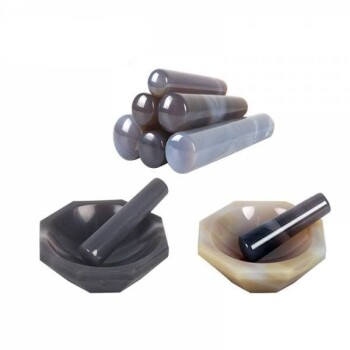
An agate mortar is the mandatory standard for preparing MOF-modified Carbon Paste Electrodes (CPE) because it guarantees the mixture remains free from external contaminants. Its extreme physical hardness and chemical inertness allow for the rigorous grinding required to blend graphite powder, Metal-Organic Framework (MOF) modifiers, and organic binders without shedding debris into the sample.
The selection of agate is not a preference but a technical requirement. It prevents the introduction of structural impurities during grinding, ensuring the resulting composite achieves the micron-level uniformity necessary for reliable conductivity and stable sensor performance.
The Critical Role of Material Inertness
Preventing Cross-Contamination
When preparing a Carbon Paste Electrode (CPE), the purity of the mixture is paramount. Agate is chemically inert and exceptionally hard.
This hardness prevents the mortar itself from degrading during the vigorous grinding process. Softer materials, such as porcelain or glass, would likely shed microscopic particles into the paste, effectively poisoning the electrode before it is even used.
Preserving Chemical Integrity
The introduction of impurities creates unwanted side reactions or physical barriers within the paste.
By using agate, you ensure that the only components reacting at the electrode surface are the graphite, the specific MOF modifier, and the binder. This isolation is crucial for attributing electrochemical signals correctly to the target analyte.
Achieving Optimal Composite Structure
Reaching Micron-Level Homogeneity
To function correctly, the graphite, MOF, and binder must form a seamless, cohesive paste. The components must be ground until they achieve a micron-level uniform mixture.
Thorough grinding in an agate mortar breaks down agglomerates effectively. This creates a consistent distribution of the MOF modifier throughout the carbon matrix, which is impossible to achieve if the grinding surface is uneven or degrades.
Ensuring Stable Conductivity
The uniformity of the paste directly dictates the conductivity of the final electrode.
If the mixture is heterogeneous due to poor grinding, the electrode will exhibit varying resistance. A uniform mixture ensures an optimal conductive path, resulting in distinct, sharp peaks and stable electrochemical responses.
Understanding the Trade-offs
The Risk of Alternative Materials
While agate mortars are more expensive than ceramic or glass alternatives, the trade-off is experimental validity.
Using a ceramic mortar introduces a high risk of "noise" in your electrochemical data due to silica abrasion. While you may save money on equipment, you lose time troubleshooting erratic baselines and non-reproducible results.
The Necessity of Manual Labor
The use of an agate mortar requires manual, thorough grinding.
This process is labor-intensive and difficult to automate while maintaining the specific texture required for CPEs. However, this manual control is currently the best method to judge the consistency and viscosity of the paste in real-time.
Making the Right Choice for Your Goal
To ensure your MOF-modified CPE functions as intended, apply the following guidelines:
- If your primary focus is high sensitivity: Use an agate mortar to eliminate background noise caused by impurities, ensuring the lowest possible detection limits.
- If your primary focus is reproducibility: Rely on the hardness of agate to provide a consistent grinding surface that does not change over time, allowing for identical electrode batches.
Mastering the preparation phase is the single most effective step to ensuring high-quality electrochemical data.
Summary Table:
| Feature | Agate Mortar Requirement | Benefit for MOF-CPE |
|---|---|---|
| Material Hardness | Extremely high Mohs hardness | Prevents debris shedding and sample contamination |
| Chemical Inertness | Non-reactive silica structure | Preserves the integrity of the MOF and graphite mixture |
| Grinding Precision | Micron-level homogeneity | Ensures stable conductivity and sharp electrochemical peaks |
| Surface Quality | Non-porous and smooth | Facilitates complete recovery of the synthesized paste |
Elevate Your Electrochemical Research with KINTEK
Precision in electrode preparation starts with the right tools. KINTEK specializes in providing high-performance laboratory equipment designed for the most demanding research applications. Whether you are developing MOF-modified Carbon Paste Electrodes or advancing battery research, our premium agate mortars, crushing and milling systems, and hydraulic presses ensure your materials achieve the purity and uniformity required for breakthrough results.
From high-temperature furnaces (muffle, vacuum, CVD) for material synthesis to electrolytic cells, electrodes, and ceramic consumables, KINTEK is your trusted partner for reliable laboratory solutions.
Ready to eliminate experimental noise and ensure reproducibility? Contact our technical experts today to find the perfect equipment for your lab's specific needs.
References
- Ricky Lalawmpuia, Diwakar Tiwari. Metal organic framework (MOF): Synthesis and fabrication for the application of electrochemical sensing. DOI: 10.4491/eer.2023.636
This article is also based on technical information from Kintek Solution Knowledge Base .
Related Products
- Nature Agate Mortar and Pestle for Grinding and Mixing
- Laboratory Jar Mill with Agate Grinding Jar and Balls
People Also Ask
- Why are agate mortars and pestles used for grinding iron oxide? Ensure Sample Purity for XRD Analysis
- What is the function of an agate mortar and pestle? Ensure Purity in Halide Solid-State Electrolyte Synthesis
- What is the primary function of an agate mortar and pestle? Optimize VO2+ CaZn2(PO4)2 Nanopowder Pre-Treatment
- Why is an agate mortar and pestle required for grinding Zr3(Al1-xSix)C2? Ensure Maximum Sample Purity
- Why is an agate mortar and pestle preferred for grinding MAX phase? Ensure Sample Purity & Zero Contamination