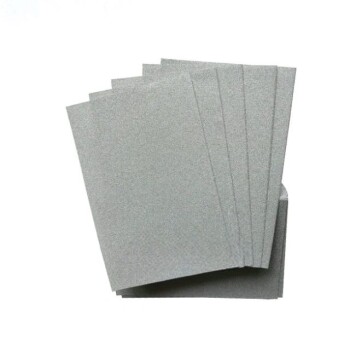
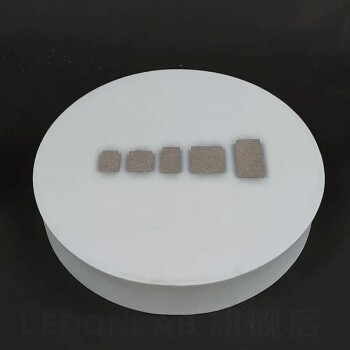
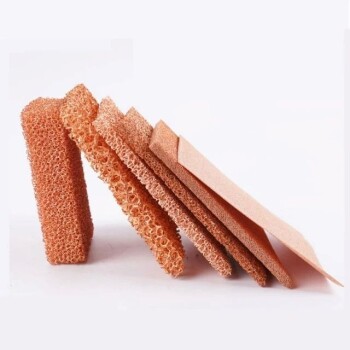
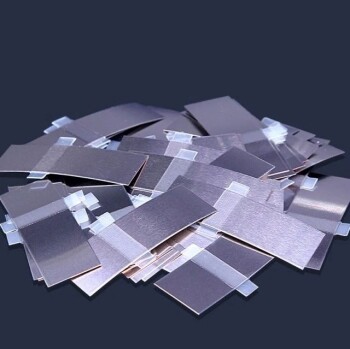
Nickel foam is the indispensable backbone for H-CoNiSe2/NC electrodes because it functions as a high-surface-area current collector that facilitates rapid electron and ion transport. It provides a highly interconnected 3D porous network that allows the electrolyte to fully penetrate the hollow polyhedral structure of the H-CoNiSe2/NC, significantly reducing internal resistance and enhancing rate performance during high-current operations.
Nickel Foam serves as a dual-purpose current collector and physical substrate, utilizing its interconnected 3D porosity to maximize electrolyte access while ensuring low-resistance electron transport across the active material layers.
The Architectural Advantage of 3D Porosity
Accommodating the Hollow Polyhedral Structure
The active material, H-CoNiSe2/NC, possesses a unique hollow polyhedral morphology that requires a compatible host. Nickel foam provides a large geometric surface area that allows these polyhedral structures to distribute uniformly without agglomeration.
Facilitating Electrolyte Penetration
The open-pore structure of nickel foam ensures that the electrolyte can flood the entire electrode volume. This free penetration is critical for minimizing ion diffusion resistance, allowing the interior of the H-CoNiSe2/NC particles to participate in electrochemical reactions.
Mechanical Support and Stability
Beyond conductivity, the foam acts as a self-supporting scaffold that maintains the structural integrity of the electrode. This rigidity is essential for preventing the active material from shedding during the mechanical stresses of rapid charge-discharge cycles.
Optimizing Electrochemical Kinetics
Minimizing Contact Resistance
By providing a massive effective contact area, nickel foam ensures a low-resistance interface between the active H-CoNiSe2/NC and the external circuit. This intimate contact is vital for achieving high-speed electron transfer, which directly translates to better power density.
Enhancing Rate Capability
The synergy between the foam’s conductivity and the material's hollow structure allows the electrode to handle high current densities. This combination prevents a massive drop in capacitance when the device is charged or discharged at extreme speeds.
Eliminating the Need for Binders
In many preparation methods, nickel foam allows for the direct growth of active materials on the substrate. This eliminates the need for non-conductive polymer binders, which often increase internal resistance and "dead mass" within the electrode.
Understanding Technical Trade-offs
Volumetric Energy Density Constraints
While the 3D porous structure is excellent for ion transport, it introduces significant void space into the electrode. This can lead to a lower volumetric energy density compared to more compact, film-based current collectors like aluminum or copper foil.
Chemical Stability Limitations
Nickel foam is highly stable in alkaline electrolytes, which are common for supercapacitors, but it may face corrosion in highly acidic environments. Engineers must ensure the electrolyte chemistry is compatible with the nickel metallic framework to prevent degradation.
Mass Loading Sensitivity
There is a critical limit to how much H-CoNiSe2/NC can be loaded onto the foam. Overloading the pores can clog the channels, negating the benefits of the 3D structure and increasing ion diffusion resistance.
How to Apply This to Your Project
Recommendations for Implementation
- If your primary focus is High Power Density: Prioritize nickel foam with the highest available porosity (PPI) to ensure maximum electrolyte flow and minimal resistance.
- If your primary focus is Maximum Cycle Life: Utilize binder-free growth methods (like hydrothermal synthesis) directly on the nickel foam to ensure the strongest mechanical adhesion.
- If your primary focus is Commercial Scalability: Ensure the nickel foam is pre-treated with a mild acid etch to remove surface oxides, guaranteeing the lowest possible contact resistance for large-scale batches.
By leveraging the structural and conductive properties of nickel foam, you can fully unlock the electrochemical potential of advanced materials like H-CoNiSe2/NC.
Summary Table:
| Key Feature of Nickel Foam | Benefit for H-CoNiSe2/NC | Electrochemical Impact |
|---|---|---|
| 3D Porous Network | Facilitates full electrolyte penetration | Reduced ion diffusion resistance |
| High Surface Area | Prevents active material agglomeration | Maximized reactive sites |
| High Conductivity | Low-resistance interface | Superior rate performance & power density |
| Mechanical Rigidity | Self-supporting scaffold | Enhanced structural integrity & cycle life |
| Binder-Free Potential | Enables direct material growth | Eliminated 'dead mass' & internal resistance |
Unlock High-Performance Energy Storage with KINTEK
Precision in material preparation is the key to breakthrough supercapacitor performance. KINTEK specializes in providing the high-quality battery research tools and consumables required to optimize your electrochemical projects.
From high-purity nickel foam and electrolytic cells to a comprehensive range of high-temperature furnaces (including CVD, atmosphere, and vacuum systems) for advanced material synthesis, we empower researchers to achieve maximum power density and cycle life. Our portfolio also features essential consumables like PTFE products, ceramics, and crucibles to ensure every stage of your workflow is supported by laboratory-grade reliability.
Ready to elevate your H-CoNiSe2/NC electrode research? Contact KINTEK today to find the perfect tools and technical support for your laboratory!
References
- P. Salehan, Behzad Rezaei. H-CoNiSe2/NC dodecahedral hollow structures for high-performance supercapacitors. DOI: 10.1038/s41598-023-29398-y
This article is also based on technical information from Kintek Solution Knowledge Base .
Related Products
- Nickel Foam for Industrial and Laboratory Applications
- Copper Nickel Foam Metal Sheet
- Copper Foam
- High Purity Zinc Foil for Battery Lab Applications
- Nickel Aluminum Tabs for Soft Pack Lithium Batteries
People Also Ask
- What procedures should be followed after using nickel or copper foam? A Guide to Reliable Reuse and Performance
- What is nickel foam used for? A Guide to Its Electrochemical Applications
- In which fields is nickel foam widely used? A Key Material for Advanced Engineering
- What procedures should be followed before using nickel or copper foam? Ensure Optimal Performance and Reliability
- What are the advantages of using high-porosity Nickel Foam or Nickel Mesh? Boost Your MEC Performance