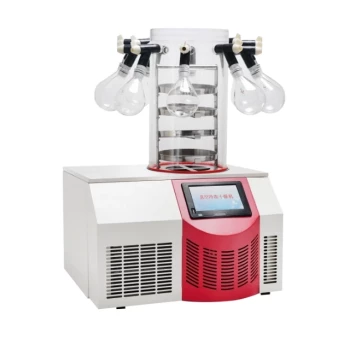
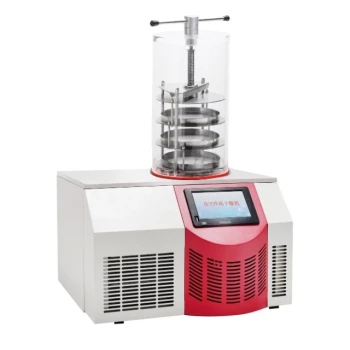
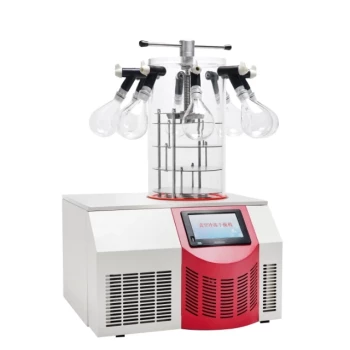
The structural integrity of porous carbon aerogels depends entirely on the phase transition used to remove moisture. A freeze dryer is mandatory because it utilizes sublimation—the direct transition of ice to vapor—under vacuum conditions. This process bypasses the liquid phase, eliminating the massive surface tension and capillary forces that occur during conventional oven drying, which would otherwise cause the fragile microscopic framework of delignified wood to collapse.
Core Takeaway: Freeze drying is the only method capable of preserving the ultra-low density and complex 3D architecture of delignified wood precursors. By avoiding the liquid-gas interface of traditional thermal drying, it prevents the structural shrinkage and pore collapse that destroy aerogel performance.
The Physics of Structural Preservation
Eliminating the Liquid-Gas Interface
In a blast drying oven, moisture evaporates from a liquid state to a gaseous state. This transition creates a liquid-gas interface within the narrow channels of the delignified wood.
The resulting surface tension exerts immense pressure on the cell walls of the cellulose scaffold. Because the delignified wood and MOF (Metal-Organic Framework) crystals form an incredibly delicate network, this pressure leads to a total mechanical failure of the pores.
The Role of Sublimation
A freeze dryer operates by first freezing the moisture into solid ice and then lowering the pressure in a vacuum chamber. This allows the ice to sublimate directly into water vapor.
Since the moisture never enters a liquid state, there is no surface tension to pull the pore walls together. This allows the material to retain its original morphology and ultra-high porosity throughout the dehydration process.
Maintaining Aerogel Performance
Preserving Microchannels and Porosity
Delignified wood serves as a high-surface-area template that requires an open, interconnected network for functionality. Freeze drying ensures these microchannels remain open and unobstructed.
This preservation is critical for the subsequent carbonization phase. If the pores collapse during drying, the final carbon aerogel will lack the "fluffy" architecture necessary for applications like ion storage or thermal insulation.
Preventing Component Agglomeration
In biomass-derived materials, conventional heat drying often causes agglomeration or the migration of active components, such as MOF crystals or activation agents.
Freeze drying locks these components in place within the frozen matrix. As the ice disappears via sublimation, the components remain uniformly distributed, preventing the "clumping" that reduces the effective surface area of the final product.
Understanding the Trade-offs
Process Complexity and Time
While freeze drying is technically superior for structural preservation, it is significantly more time-consuming than blast drying. A typical cycle can take 24 to 72 hours depending on the sample volume.
The equipment also requires precise control over vacuum levels and condenser temperatures (often reaching -60°C or lower). This makes the process more expensive and operationally complex than simple thermal evaporation.
Scaling and Energy Consumption
Freeze dryers consume substantially more energy than blast ovens because they must simultaneously maintain deep-freeze temperatures and a high vacuum.
For small-scale laboratory research, this is an acceptable cost for achieving high-performance materials. However, for industrial-scale production, the high energy demand represents a significant bottleneck that requires careful economic evaluation.
Applying This to Your Research Goals
Choosing the correct drying method is essential for ensuring the macroscopic and microscopic properties of your carbon aerogel align with your intended application.
- If your primary focus is maximizing specific surface area: Use a high-vacuum freeze dryer to ensure that even the finest nanopores do not collapse or adhere to one another during dehydration.
- If your primary focus is structural loading (e.g., MOFs or Graphene): Utilize freeze drying to maintain the 3D scaffold's openness, which provides ample space for the uniform distribution of secondary nanomaterials.
- If your primary focus is high-density carbon production: A blast drying oven may be used if structural porosity is not a requirement, though this will result in a significantly more compact and less "aerogel-like" material.
The preservation of the delignified wood's original three-dimensional framework through sublimation is the foundational step in producing high-performance, ultra-lightweight carbon aerogels.
Summary Table:
| Feature | Freeze Drying (Sublimation) | Blast Drying (Evaporation) |
|---|---|---|
| Phase Transition | Solid to Gas (Direct) | Liquid to Gas |
| Surface Tension | Virtually Zero | High Capillary Pressure |
| Structural Impact | Preserves 3D Micro-architecture | Causes Pore Collapse & Shrinkage |
| Component Distribution | Uniformly Locked in Matrix | Prone to Agglomeration/Migration |
| Final Product | Ultra-lightweight Aerogel | Dense, Compact Material |
Elevate Your Material Science with KINTEK Precision
Preserving the delicate architecture of delignified wood and MOF scaffolds requires more than just standard equipment—it requires precision. KINTEK specializes in high-performance laboratory solutions designed for advanced material synthesis. Whether you are producing ultra-lightweight carbon aerogels or conducting high-tech battery research, our equipment ensures consistent, repeatable results.
Our comprehensive portfolio includes:
- Advanced Cooling & Dehydration: High-vacuum freeze dryers, ULT freezers, and cold traps designed for structural preservation.
- Thermal Processing: A full range of high-temperature furnaces (Muffle, CVD, PECVD, Vacuum, and Atmosphere) for precise carbonization.
- Material Preparation: Crushing, milling, and high-pressure hydraulic presses (pellet, isostatic) for precursor development.
- Specialized Research Tools: Electrolytic cells, high-pressure reactors, and premium ceramic/PTFE consumables.
Ready to optimize your aerogel performance? Contact KINTEK today to discuss how our freeze drying and high-temperature furnace systems can streamline your research and development.
References
- Youngho Jeon, Jungmok You. Multiscale Porous Carbon Materials by In Situ Growth of Metal–Organic Framework in the Micro-Channel of Delignified Wood for High-Performance Water Purification. DOI: 10.3390/nano13192695
This article is also based on technical information from Kintek Solution Knowledge Base .
Related Products
- High Performance Laboratory Freeze Dryer
- High Performance Laboratory Freeze Dryer for Research and Development
- Benchtop Laboratory Freeze Dryer for Lab Use
- Benchtop Laboratory Vacuum Freeze Dryer
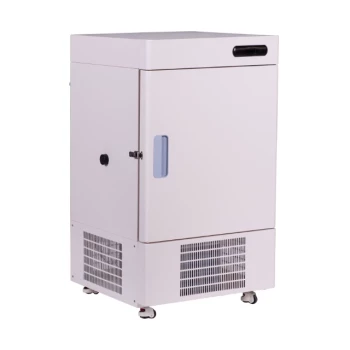
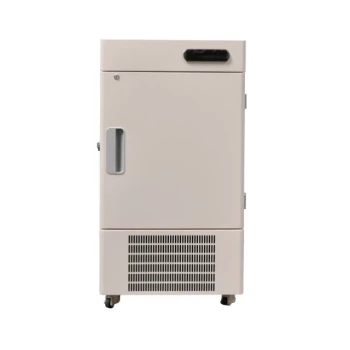
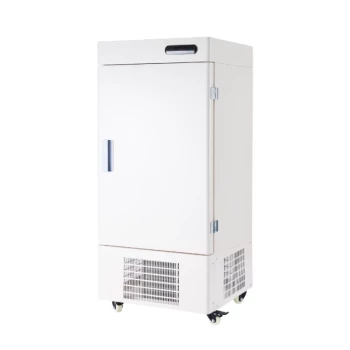
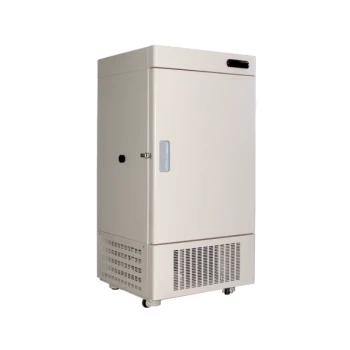
- 108L Vertical Ultra Low Temperature ULT Freezer
People Also Ask
- What role does a laboratory freeze dryer play in the synthesis of graphene-based electrocatalysts? Preserve 3D Structures
- What are the technical advantages of using a laboratory freeze dryer for porous carbon precursors? Preserve 3D Networks
- What types of liquid samples can be processed using a laboratory freeze dryer? Preserve Your Sensitive Materials
- How do laboratory freeze dryers support scientific research? Preserve Sample Integrity for Reproducible Results
- Why is a laboratory freeze dryer preferred over traditional heating? Preserve Biochar Structure & Maximize Porosity