
Coal Quality Analyzers
Dual Tube Sulfur Determinator High Temperature Combustion Sulfur Analyzer
Item Number : KT-TE11
Price varies based on specs and customizations
- Operating Temperature
- 1200°C (Short-term up to 1500°C)
- Constant Temperature Zone
- 80 mm (ΔT < 10°C)
- Heating Element
- Double-threaded SiC tube (Φ70/60×250/100/30 mm)

Shipping:
Contact us to get shipping details Enjoy On-time Dispatch Guarantee.
Why Choose Us
Easy ordering process, quality products, and dedicated support for your business success.
Product Overview

This high-temperature dual-tube combustion sulfur determination system provides rigorous, high-precision quantification of total sulfur content across coal, coke, steel, iron, ores, and various geological mineral matrices. Operating strictly in accordance with standardized high-temperature combustion neutralization methods such as GB/T 214, the apparatus utilizes high-purity oxygen flow within an elevated thermal zone to completely oxidize sample sulfur into sulfur dioxide. The evolved gases are subsequently converted into sulfuric acid through hydrogen peroxide absorption and quantitatively titrated to determine precise sulfur fractions with superior analytical fidelity.
Designed specifically for commercial inspection laboratories, power generation plants, metallurgical works, and academic geochemical facilities, this dual-channel analytical instrument significantly accelerates testing workflows. By incorporating parallel reaction tubes inside a single integrated thermal core, the system enables operators to conduct two independent determinations simultaneously without thermal interference or cross-contamination. This dual-stream capacity effectively doubles sample processing capacity while minimizing laboratory bench space and overall energy expenditure.
Built for continuous operation in demanding analytical settings, the equipment incorporates industrial-grade silicon carbide heating elements, robust corundum combustion chambers, and advanced silicon-controlled rectifier (SCR) temperature regulation. Its stable thermal distribution and resilient construction guarantee repeatable baselines, exceptional resistance to thermal shock, and extended service longevity under round-the-clock testing schedules.
Detail & Parts

Key Features
- Simultaneous Dual-Sample Testing: Integrated parallel corundum reaction chambers allow concurrent analysis of two discrete samples, effectively doubling laboratory throughput and minimizing analytical turn-around times.
- High-Temperature Capability: Sustains a consistent continuous operating temperature of 1200°C with short-duration capability reaching up to 1500°C, ensuring rapid and complete oxidative decomposition of volatile and refractory sulfur species alike.
- Extended Uniform Thermal Zone: An engineered 80 mm constant temperature zone maintains temperature uniformity within a tight tolerance of less than 10°C, eliminating cold spots and incomplete combustion.
- Rapid Thermal Ramp Rate: Advanced thermal engineering achieves heating rates between 20°C and 25°C per minute, bringing the combustion chamber from ambient up to the 1200°C operating baseline in under one hour.
- Precision SCR Temperature Regulation: Intelligent silicon-controlled rectifier temperature controller covers a wide 0°C to 1600°C monitoring span, providing smooth power regulation and tight thermal stability.
- Heavy-Duty Double-Spiral SiC Elements: Custom-configured double-threaded silicon carbide heating elements (Φ70/60×250/100/30 mm) provide exceptional radiant efficiency, uniform thermal output, and robust resistance against oxidative degradation.
- Corundum Reducing Reaction Tubes: Specialized high-purity corundum combustion tubes (Φ22/18×760 mm stepped down to Φ10/Φ6 mm) prevent gas leakage, minimize dead volume, and endure harsh acidic combustion environments.
- Integrated Gas Purification and Absorption Streamline: Complete analytical assembly includes dedicated gas scrubbing, flow regulation, and absorption vessels, ensuring spotless gas delivery and quantitative capture of evolved sulfur dioxide.
- Energy-Optimized Power Architecture: Operates with a moderate power consumption rating of approximately 4 kW, balancing rapid heat-up dynamics with long-term electrical efficiency on standard single-phase 220V power supplies.
Applications
| Application | Description | Key Benefit |
|---|---|---|
| Coal & Coke Quality Assurance | Quantification of total sulfur content in thermal coal, metallurgical coking coal, and petroleum coke per standard combustion protocols. | Prevents boiler corrosion, ensures regulatory environmental compliance, and optimizes combustion efficiency. |
| Blast Furnace & Steelmaking Metallurgy | Measurement of sulfur impurities in raw iron, scrap steel, ferroalloys, and metallurgical fluxes. | Controls sulfur-induced embrittlement in structural alloys and verifies melt chemistry prior to casting. |
| Geological & Mining Ore Assay | Rapid evaluation of sulfide minerals, pyrites, and sulfate fractions within mineral exploration cores and mine tailings. | Accelerates mineral grading, informs flotation recovery workflows, and aids environmental acid-rock drainage forecasting. |
| Cement & Building Materials Testing | Analysis of total sulfur in clinker, raw gypsum, limestone, and alternative fuels utilized in cement kilns. | Prevents ring formation in rotary kilns and ensures finalized structural binders satisfy international mechanical standards. |
| Environmental & Ash Residue Verification | Precise tracing of residual sulfur content in bottom ash, fly ash, and industrial flue scrub sludges. | Verifies desulfurization performance and validates waste byproduct safety for downstream reclamation. |
| Petrochemical Catalyst & Slag Analysis | Detection of bound sulfur species in spent catalysts, refinery solid residues, and synthetic carbonaceous additives. | Informs catalyst regeneration cycles and safeguards downstream chemical processing systems against poisoning. |
Technical Specifications
| Specification Parameter | Technical Detail / Value |
|---|---|
| Product Item Number | KT-TE11 |
| Analytical Standard Compliance | GB/T 214-2007 (High-Temperature Combustion Neutralization Method) |
| Furnace Operating Temperature | Continuous working: 1200°C; Short-term maximum: up to 1500°C |
| Constant Temperature Zone Length | 80 mm |
| Thermal Gradient within Constant Zone | ΔT < 10°C |
| Ramp-Up Heating Velocity | 20°C to 25°C / min (Reaches 1200°C within 60 minutes) |
| Heating Element Type & Geometry | Double-threaded silicon carbide tube (Φ70/60 × 250/100/30 mm) |
| Reaction Combustion Tube Material & Dimensions | High-purity corundum stepped/reducing tube (Φ22/18 × 760 mm / Φ10/Φ6 mm) |
| Operating Sample Capacity | Dual-tube configuration (2 simultaneous single-sample tests) |
| Temperature Controller Architecture | Silicon-Controlled Rectifier (SCR) proportional controller |
| Controller Measurement & Regulation Range | 0°C to 1600°C |
| Gas Circuit Assembly | Integrated gas purification, oxygen flow metering, and absorption system |
| Quantitative Detection Mechanism | Combustion oxidation to SO2, H2O2 oxidation to H2SO4, standard NaOH titration |
| Power Rating | Approximately 4.0 kW |
| Electrical Power Requirements | AC 220V ± 10%, 50 Hz |
Analytical Workflow and Chemical Mechanism
This apparatus employs an established high-temperature combustion neutralization technique that remains the primary reference benchmark for industrial sulfur verification. The analytical process comprises three distinct phases: combustion oxidation, chemical absorption, and stoichiometric titration.
During testing, a finely ground sample—typically weighed inside a combustion boat and mixed with a combustion additive or catalyst if required—is propelled into the hottest segment of the corundum reaction tube. High-purity oxygen flows continuously through the gas purification train into the furnace chamber. Under the elevated 1200°C environment, all organic and inorganic forms of sulfur (including pyritic, sulfate, and organic sulfur) undergo rapid oxidative breakdown:
$$\text{S} + \text{O}_2 \xrightarrow{1200^\circ\text{C}} \text{SO}_2$$ $$\text{FeS}_2 + \text{O}_2 \xrightarrow{1200^\circ\text{C}} \text{Fe}_2\text{O}_3 + \text{SO}_2$$ $$\text{MeSO}_4 \xrightarrow{1200^\circ\text{C}} \text{MeO} + \text{SO}_2 + \text{SO}_3$$
The evolved gaseous effluent passes out of the corundum reducing tube and directly enters an absorption vessel charged with dilute hydrogen peroxide solution. The hydrogen peroxide reacts selectively with sulfur oxides, oxidizing sulfur dioxide into sulfuric acid:
$$\text{SO}_2 + \text{H}_2\text{O}_2 \rightarrow \text{H}_2\text{SO}_4$$
Once combustion is finished and all gases have been absorbed, the collected sulfuric acid is titrated using standard sodium hydroxide solution in the presence of an indicator mixture:
$$\text{H}_2\text{SO}_4 + 2\text{NaOH} \rightarrow \text{Na}_2\text{SO}_4 + 2\text{H}_2\text{O}$$
Because the stoichiometry between titrated sodium hydroxide and initial sulfur content is direct and well-defined, analysts achieve definitive, absolute quantification without requiring complex empirical regression curves.
Component Engineering and Thermal Construction
Every structural subsystem in this furnace has been engineered for endurance under sustained high-temperature thermal cycling:
Silicon Carbide Heating Elements
The system employs a high-density, double-spiral silicon carbide tube characterized by low electrical resistivity at operating temperatures and exceptional mechanical stability. The double-threaded geometry ensures an even distribution of electrical currents, eliminating localized hotspots that prematurely degrade element lifespans. The hot zone is concentrated along the center of the heating core, matching the designated 80 mm constant temperature plateau.
Corundum Reducing Reaction Tubes
Standard straight quartz tubes tend to suffer from devitrification and deformation when exposed to temperatures exceeding 1150°C in sulfurous, alkali-rich atmospheres. To overcome this limitation, this analyzer incorporates high-purity corundum reducing tubes. Corundum demonstrates outstanding chemical inertness, resisting aggressive gaseous attack while maintaining full gas-tight integrity across sustained 1200°C runs. The stepped reducer structure (reducing down to Φ10/Φ6 mm) ensures a tight pneumatic coupling to the external absorption train, preventing gas condensation or loss.
Solid-State SCR Control Architecture
Precise temperature control is driven by an industrial-grade silicon-controlled rectifier module linked to a heavy-duty thermocouple. Unlike traditional on/off relay switches that cause severe thermal fluctuations and fatigue element spirals, the SCR controller provides smooth, step-less power throttling. This maintains thermal stability within ±10°C across the 80 mm hot zone and cushions elements against excessive startup inrush currents during fast ramps.
Operation and Best Practices
To achieve the highest analytical precision and maximize component life, operators should follow these procedural best practices:
- Oxygen Flow Calibration: Ensure oxygen carrier gas is purified through a solid desiccant and carbon dioxide scrubber before entering the furnace. Maintain a steady, calibrated flow rate between 750 mL/min and 1000 mL/min per tube to avoid sample spattering.
- Thermal Stabilization: Allow the system to reach the 1200°C target and hold for 15 minutes before inserting combustion boats. This ensures complete thermal saturation across the full 80 mm constant temperature zone.
- Sample Boat Loading: Insert sample boats gradually toward the center of the reaction tube using an indexing push rod to prevent thermal shock to the corundum walls.
- Absorption System Inspection: Regularly verify that glass ground joints and flexible connections between the reaction tube exit and absorption vessels are completely gas-tight to avoid sulfur gas escape.
- Titration Standardization: Re-standardize the sodium hydroxide titrant regularly against analytical-grade potassium hydrogen phthalate to preserve quantitative repeatability.
Why Choose This Product
- Doubled Analytical Productivity: The simultaneous dual-tube architecture enables high-volume testing facilities to process twice as many samples per shift compared to single-tube instruments, drastically reducing turnaround times.
- Robust High-Temperature Engineering: Engineered around heavy-duty double-spiral silicon carbide elements and high-purity corundum tubes, this system guarantees long operational life even when continuously operated at 1200°C.
- Strict Regulatory Conformance: Fully compliant with GB/T 214-2007 combustion neutralization protocols, delivering audit-ready data recognized by commercial inspection agencies and regulatory bodies.
- Precise Thermal Management: Featuring an 80 mm uniform constant temperature zone (ΔT < 10°C) and step-less SCR control, the furnace eliminates incomplete sample burnout and variability.
- Comprehensive Factory Support: Backed by dedicated technical specialists who provide expert application support, operational training, and rapid availability of replacement corundum consumables and heating elements.
Contact our technical sales team today to request a quotation or explore custom integration options for your laboratory's sulfur analysis requirements.
Trusted by Industry Leaders
REQUEST A QUOTE
Our professional team will reply to you within one business day. Please feel free to contact us!
Related Products

Hydrogen Determination Probe for Quickly Measuring Hydrogen Content with High Success Rate
Accurate hydrogen determination probe for molten steel, 0.5-14ppm range, ±0.15ppm accuracy, 96% success rate. Optimize steel quality now!

Multi Heating Zones CVD Tube Furnace Machine Chemical Vapor Deposition Chamber System Equipment
KT-CTF14 Multi Heating Zones CVD Furnace - Precise Temperature Control and Gas Flow for Advanced Applications. Max temp up to 1200℃, 4 channels MFC mass flow meter, and 7" TFT touch screen controller.

Vertical Laboratory Tube Furnace
Elevate your experiments with our Vertical Tube Furnace. Versatile design allows for operation under various environments and heat treatment applications. Order now for precise results!

Lab Electrochemical Workstation Potentiostat for Laboratory Use
Electrochemical workstations, also known as laboratory electrochemical analyzers, are sophisticated instruments designed for precise monitoring and control in various scientific and industrial processes.

Double-Layer Water Bath Electrolytic Electrochemical Cell
Discover the temperature-controllable electrolytic cell with a double-layer water bath, corrosion resistance, and customization options. Complete specifications included.

Multi-zone Laboratory Tube Furnace
Experience precise, efficient thermal testing with our Multi Zone Tube Furnace. Independent heating zones and temperature sensors allow for controlled high-temperature gradient heating fields. Order now for advanced thermal analysis!
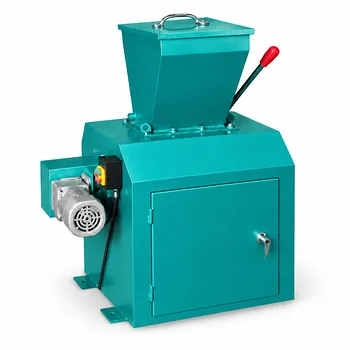
Electric Sample Divider for Laboratory Coal and Granular Material Sample Preparation
Engineered for precise sample preparation, this electric sample divider delivers continuous horizontal reciprocating cutting, an adjustable division ratio, robust dust containment, and representative splitting for coal, ores, and bulk granular materials up to thirteen millimeters.

Double Layer Five-Port Water Bath Electrolytic Electrochemical Cell
Experience optimal performance with our Water Bath Electrolytic Cell. Our double-layer, five-port design boasts corrosion resistance and longevity. Customizable to fit your specific needs. View specs now.
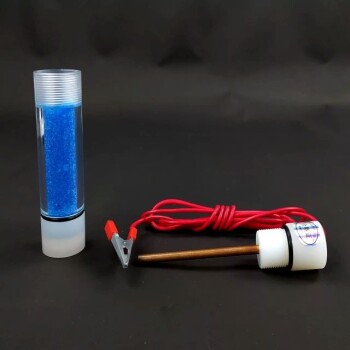
Copper Sulfate Reference Electrode for Laboratory Use
Looking for a Copper Sulfate Reference Electrode? Our complete models are made of high-quality materials, ensuring durability and safety. Customization options available.
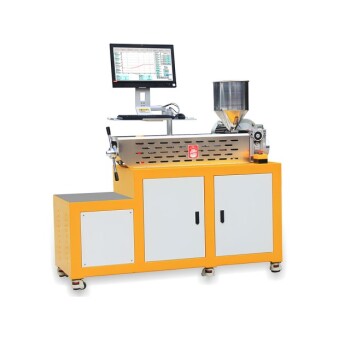
Filter Testing Machine FPV for Dispersion Properties of Polymers and Pigments
The filter testing machine (FPV) is suitable for testing the dispersion properties of polymers such as pigments, additives and masterbatches by extrusion and filtration.
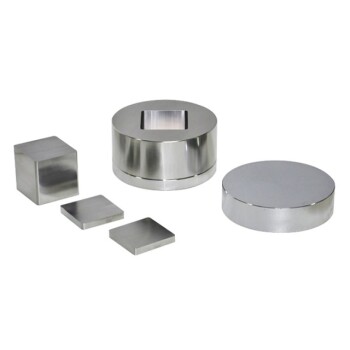
Square Lab Press Mold for Laboratory Applications
Create uniform samples easily with Square Lab Press Mold - available in various sizes. Ideal for battery, cement, ceramics, and more. Custom sizes available.

Reference Electrode Calomel Silver Chloride Mercury Sulfate for Laboratory Use
Find high-quality reference electrodes for electrochemical experiments with complete specifications. Our models offer resistance to acid and alkali, durability, and safety, with customization options available to meet your specific needs.
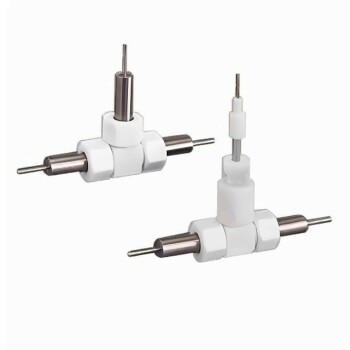
Customizable Swagelok Type Test Cells for Advanced Battery Research Electrochemical Analysis
The KINTEK Swagelok-type test cell is a modular, T-shaped device constructed from high-quality, chemically inert materials.

Cylindrical Press Mold with Scale for Lab
Discover precision with our Cylindrical Press Mold. Ideal for high-pressure applications, it molds various shapes and sizes, ensuring stability and uniformity. Perfect for lab use.

Laboratory Rapid Thermal Processing (RTP) Quartz Tube Furnace
Get lightning-fast heating with our RTP Rapid Heating Tube Furnace. Designed for precise, high-speed heating and cooling with convenient sliding rail and TFT touch screen controller. Order now for ideal thermal processing!
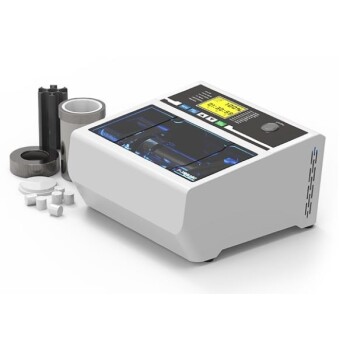
Laboratory Micro Horizontal Jar Mill for Precision Sample Preparation in Research and Analysis
Discover the Micro Horizontal Jar Mill for precise sample preparation in research and analysis. Ideal for XRD, geology, chemistry, and more.

Oxygen Probe to Measure Temperature and Active Oxygen Content in Molten Steel
Optimize steelmaking with our high-accuracy oxygen probe. Fast, reliable, and essential for precise oxygen and temperature control. Enhance quality and efficiency today.