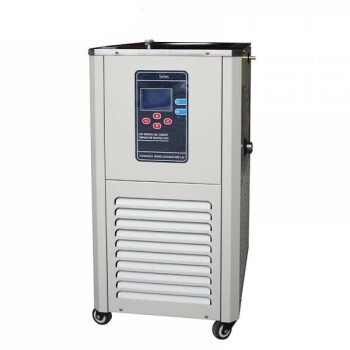
Precise thermal control acts as the architect of the hydrogel's internal network. A high-stability low-temperature freezer governs the physical cross-linking process during the synthesis phase, ensuring the environment remains at a constant ultra-low temperature. This specific thermal consistency induces the formation of microcrystalline nuclei within polymer chains—specifically in materials like polyvinyl alcohol (PVA)—which creates the robust, porous framework necessary for the composite's function.
The stability of the freezing environment dictates the hydrogel's internal architecture, specifically creating honeycomb-like micropores through controlled microcrystalline nucleation. This structural precision is the defining factor for critical properties like swelling capacity and reaction speed in smart actuators.
The Mechanism of Structural Formation
Controlling Physical Cross-Linking
The core function of the high-stability freezer is to regulate the physical cross-linking of the polymer solution.
Unlike chemical cross-linking, which relies on additives, this method uses the freezing phase itself to bond the material. The freezer ensures that this process occurs uniformly throughout the sample.
Inducing Microcrystalline Nuclei
The constant ultra-low temperature is not merely about solidification; it is about organization.
This environment induces the formation of microcrystalline nuclei within the polymer chains. In the case of PVA, these nuclei serve as the foundational "knots" that hold the network together.
Constructing a Honeycomb Framework
The arrangement of these nuclei results in a specific geometric structure.
The process constructs a framework characterized by honeycomb-like micropores and macropores. This porous architecture is not accidental but is a direct result of the controlled thermal environment provided by the freezer.
Impact on Material Performance
Defining Swelling and Deswelling Rates
The physical structure established during freezing dictates how the hydrogel interacts with water.
The honeycomb-like pores determine the material's swelling capacity and its deswelling rate. For applications requiring rapid shape changes, this pore structure acts as the plumbing system for water movement.
Setting the Phase Transition Temperature
The synthesis conditions influence the thermal sensitivity of the final composite.
The freezing process determines the Volume Phase Transition Temperature (VPTT). This is the precise temperature at which the hydrogel undergoes a radical change in volume, a critical property for smart light-driven actuators.
Understanding the Operational Dependencies
The Necessity of Thermal Constancy
The term "high-stability" is the operative variable in this process.
If the temperature fluctuates during the freezing phase, the formation of microcrystalline nuclei becomes inconsistent. This leads to irregular pore structures, which compromises the mechanical integrity and responsiveness of the hydrogel.
Equipment Limitations
Standard refrigeration units often lack the precision required for this specific synthesis.
To achieve the "honeycomb" micropore structure required for high-performance actuators, the equipment must provide a constant ultra-low temperature without the thermal cycling found in conventional freezers.
Making the Right Choice for Your Goal
To optimize your bilayer hydrogel nanocomposites, you must align your freezing parameters with your desired performance outcome.
- If your primary focus is Rapid Actuation: Prioritize thermal stability to ensure uniform honeycomb micropores, which maximize the deswelling rate and response speed.
- If your primary focus is Thermal Sensitivity: Focus on the consistency of the freezing phase to precisely calibrate the Volume Phase Transition Temperature (VPTT) for accurate triggering.
The structural integrity of your hydrogel is not defined by the chemistry alone, but by the stability of the cold that shapes it.
Summary Table:
| Feature | Impact on Hydrogel Nanocomposites |
|---|---|
| Thermal Stability | Ensures uniform physical cross-linking and consistent microcrystalline nuclei formation. |
| Pore Architecture | Creates a honeycomb-like network of micropores/macropores for water transport. |
| Mechanical Performance | Defines swelling capacity and rapid deswelling rates for smart actuators. |
| Thermal Sensitivity | Precisely calibrates the Volume Phase Transition Temperature (VPTT). |
| Internal Network | Determines structural integrity and response speed for bilayer composites. |
Elevate Your Material Research with KINTEK Precision
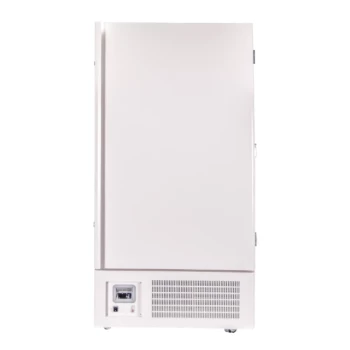
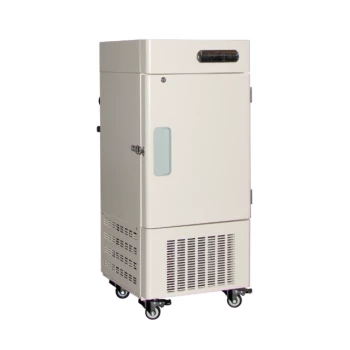
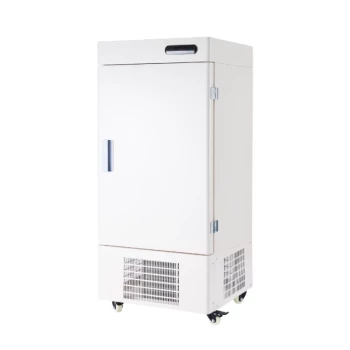
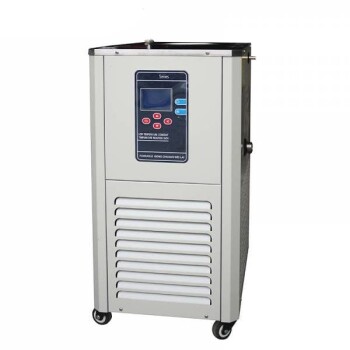
Achieving the perfect honeycomb structure in bilayer hydrogels requires more than just cold—it requires absolute thermal constancy. KINTEK specializes in advanced laboratory solutions, offering high-performance ULT freezers and cooling systems specifically designed to maintain the stable ultra-low temperatures essential for microcrystalline nucleation and precise polymer cross-linking.
From high-temperature furnaces to specialized freeze dryers and cooling solutions, KINTEK provides the tools researchers need for sophisticated material synthesis. Whether you are developing smart actuators or high-response nanocomposites, our equipment ensures your results are consistent and reproducible.
Ready to optimize your hydrogel synthesis? Contact our laboratory equipment experts today to find the ideal cooling solution for your research goals!
References
- Damian Komar, V. A. Antonov. Spectrometric gamma radiation detection units based on high-resolution crystals SrI 2(Eu) and LaBr3(Ce). DOI: 10.21175/rad.abstr.book.2023.32.15
This article is also based on technical information from Kintek Solution Knowledge Base .
Related Products
- 308L Precision Ultra Low Temperature Freezer for Laboratory Applications
- 208L Advanced Precision Laboratory Ultra Low Temperature Freezer for Cold Storage
- 108L Vertical Ultra Low Temperature ULT Freezer
- 408L Advanced Vertical Laboratory Ultra Low Temperature Freezer for Critical Research Material Preservation
- 58L Precision Laboratory Ultra Low Temperature Upright Freezer for Critical Sample Storage
People Also Ask
- How does evaporation occur in Ultra Freezers? The Core Process for Deep Freezing
- How are ultra low temperature freezers used in pharmaceutical storage? Protect Your High-Value Biologics & Vaccines
- What is the price range for ultra low temperature freezers? Protect Your Samples with the Right Investment
- How are Ultra Freezers designed for easy movement in laboratories? Unlock Lab Flexibility with Swivel Castors
- How is temperature controlled in ultra low temperature freezers? A Guide to Stable -80°C Storage