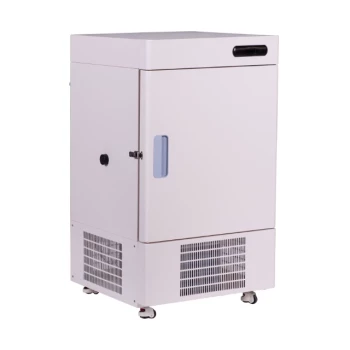
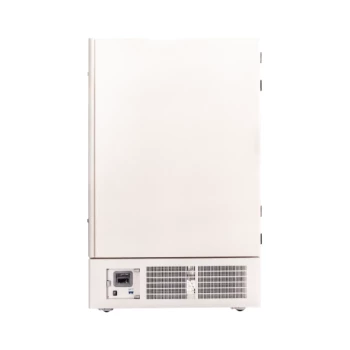
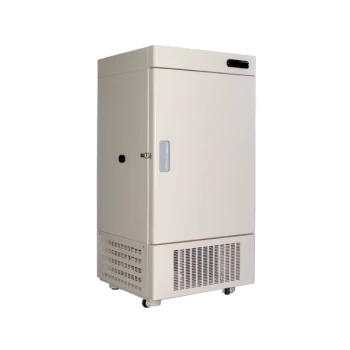
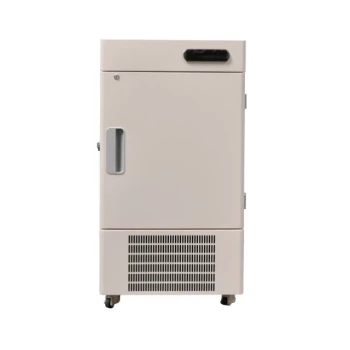
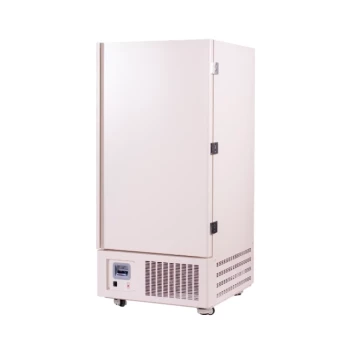
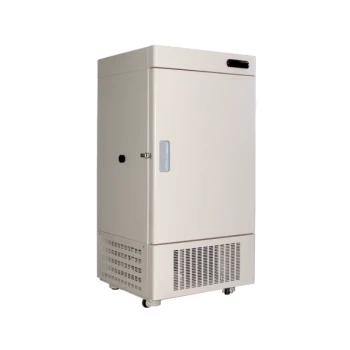
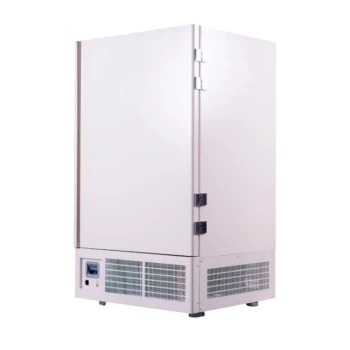
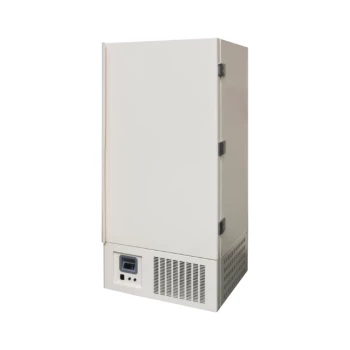
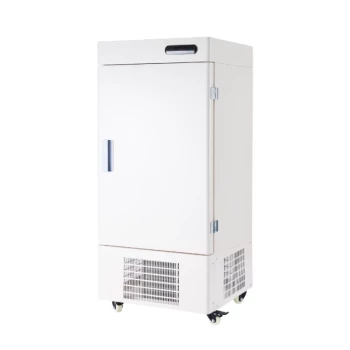
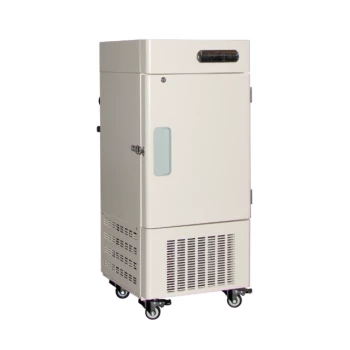
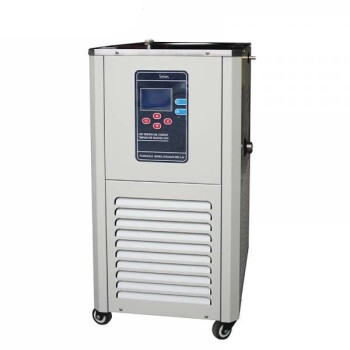
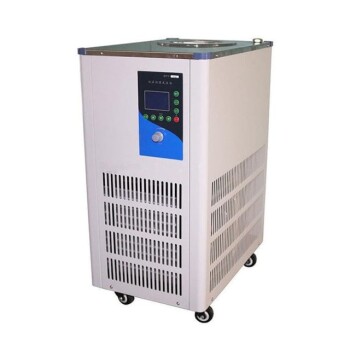
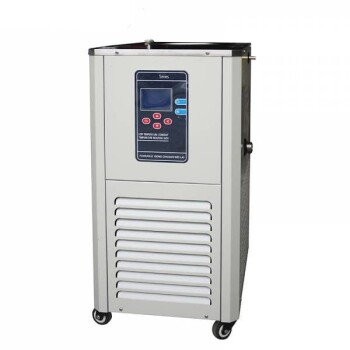
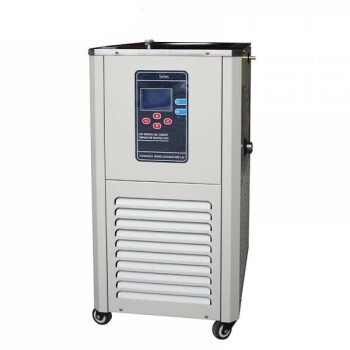
The primary function of an ultra-low temperature (ULT) freezer in this context is to induce physical cross-linking within polymer chains, specifically Polyvinyl Alcohol (PVA), without the need for chemical agents. By maintaining a stable, extreme low-temperature environment, the freezer drives the formation of ice crystals that compress polymer chains into high-density crystalline networks, establishing the fundamental architecture of the hydrogel.
The ULT freezer acts as a structural architect, using ice crystals as temporary templates to construct a honeycomb-like microporous network. This precise structural control is the defining factor that gives the hydrogel its mechanical strength and rapid response to photothermal stimulation.
The Mechanism of Physical Cross-Linking
Utilizing the Exclusion Effect
The freeze-thaw process relies on a phenomenon known as the exclusion effect. As the ULT freezer rapidly lowers the temperature, water within the solution begins to crystallize into ice.
These growing ice crystals repel the polymer chains (such as PVA), forcing them to aggregate into highly concentrated regions. This proximity allows the chains to interact and bond physically.
Eliminating Chemical Agents
Unlike traditional synthesis methods, this approach requires no chemical cross-linking agents. The high-density regions formed during freezing remain intact upon thawing, creating a stable network.
This absence of chemicals is crucial for preserving the biocompatibility of the material, making it safer for biological applications.
Structuring the Hydrogel Matrix
Creating a Honeycomb Microporous Architecture
The most critical structural outcome of using a ULT freezer is the formation of a honeycomb-like microporous or macroporous structure.
The ice crystals formed during the freezing phase act as placeholders. When the material acts as a template and is subsequently thawed, these crystals melt away, leaving behind an ordered, porous framework.
Supporting Nanoparticle Integration
This porous architecture provides a stable spatial arrangement for embedded nanocomposites, such as gold (Au) nanoparticles.
The honeycomb structure ensures these particles are uniformly loaded within the matrix, which is essential for consistent photothermal heating across the actuator.
Understanding the Trade-offs
The Necessity of Cycle Precision
While the ULT freezer eliminates the need for chemicals, the process is highly sensitive to the specific parameters of the freeze-thaw cycles.
The freezing rate and temperature stability must be precisely controlled. Inconsistent cooling can lead to irregular pore sizes, which directly degrades the mechanical strength and responsiveness of the final material.
Balancing Porosity and Strength
The formation of the honeycomb structure is a balance between creating void space for water movement and maintaining structural integrity.
If the "walls" of the honeycomb (the polymer aggregates) are not sufficiently dense—achieved through proper freezing intensity—the hydrogel may lack the mechanical robustness required for repeated actuation.
Enhancing Photothermal Performance
Optimizing Response Kinetics
The microporous structure created by the ULT freezer dramatically improves the swelling and shrinkage kinetics of the hydrogel.
Because the structure is open and interconnected, water can enter and exit the matrix rapidly. This allows the actuator to change shape quickly when the internal temperature is raised by photothermal stimulation.
Defining Actuation Characteristics
The controlled freezing process ultimately determines the volume phase transition temperature (VPTT) and the deswelling rate.
These factors dictate how "smart" the actuator is—specifically, how sensitive it is to light and how forcefully it can move.
Making the Right Choice for Your Goal
To maximize the effectiveness of the freeze-thaw synthesis for your specific application, consider these priorities:
- If your primary focus is Rapid Actuation: Ensure your freeze-thaw protocol maximizes the honeycomb micropore distribution to facilitate the fastest possible water transport.
- If your primary focus is Biocompatibility: Leverage the ULT freezer's ability to create robust networks purely through physical cross-linking, strictly avoiding chemical additives.
- If your primary focus is Mechanical Durability: Prioritize the stability of the low-temperature environment to ensure the formation of highly ordered, dense microcrystalline regions.
Success in synthesizing photo-actuating hydrogels lies not just in freezing the material, but in using the ULT freezer to precisely engineer the empty space within it.
Summary Table:
| Feature | Role of ULT Freezer in Synthesis |
|---|---|
| Mechanism | Induces physical cross-linking via ice crystal formation (exclusion effect) |
| Structural Output | Creates a honeycomb-like microporous architecture for rapid water transport |
| Cross-Linking Type | 100% Physical; eliminates the need for potentially toxic chemical agents |
| Thermal Control | Ensures uniform nanoparticle distribution for consistent photothermal response |
| Material Benefit | Increases mechanical strength and biocompatibility for medical applications |
Elevate Your Material Research with KINTEK Precision
Unlock the full potential of your hydrogel and nanocomposite synthesis with KINTEK’s advanced cooling solutions. Our high-performance ULT freezers and freeze dryers provide the thermal stability and precision required to engineer perfect microporous architectures without chemical additives.
Whether you are developing photo-actuating actuators, biocompatible scaffolds, or smart battery components, KINTEK offers a comprehensive range of laboratory equipment including high-temperature furnaces, crushing systems, and hydraulic presses to support every stage of your workflow.
Ready to optimize your synthesis process? Contact our laboratory specialists today to find the ideal equipment for your target research applications.
References
- A.D. Pogrebnjak, Iryna Savitskaya. Characterization, Mechanical and Biomedical Properties of Titanium Oxynitride Coating. DOI: 10.21175/rad.abstr.book.2023.3.1
This article is also based on technical information from Kintek Solution Knowledge Base .
Related Products
- 108L Vertical Ultra Low Temperature ULT Freezer
- 938L Vertical Ultra Low Temperature Freezer for Advanced Laboratory Storage
- 208L Advanced Precision Laboratory Ultra Low Temperature Freezer for Cold Storage
- 58L Precision Laboratory Ultra Low Temperature Upright Freezer for Critical Sample Storage
- 408L Advanced Vertical Laboratory Ultra Low Temperature Freezer for Critical Research Material Preservation
People Also Ask
- What are the common applications of ultra-low temperature freezers? Preserve Your Most Valuable Samples
- What are the different types of ultra-low temperature freezers available? Choose the Right ULT Freezer for Your Lab
- What are some key features of ultra-low temperature freezers? Essential Guide to Reliable Sample Storage
- Have other labs successfully stored samples at -70°C? Proven Long-Term Preservation for Biological Materials
- What features should be considered when choosing an ultra low temperature freezer? Secure Your Samples with Precision