
In short, yes. Induction heating is an exceptionally effective method for modern forging. As a high-capacity electric heating system, it allows for the rapid, precise, and repeatable heating of metal, enabling the material deformation required to create complex parts with outstanding control.
The core advantage of induction heating is that it generates heat directly within the metal itself, unlike a traditional forge which heats the metal from the outside. This fundamental difference provides unparalleled speed, precision, and energy efficiency, transforming the forging process from a bulk heating operation into a highly controlled manufacturing step.
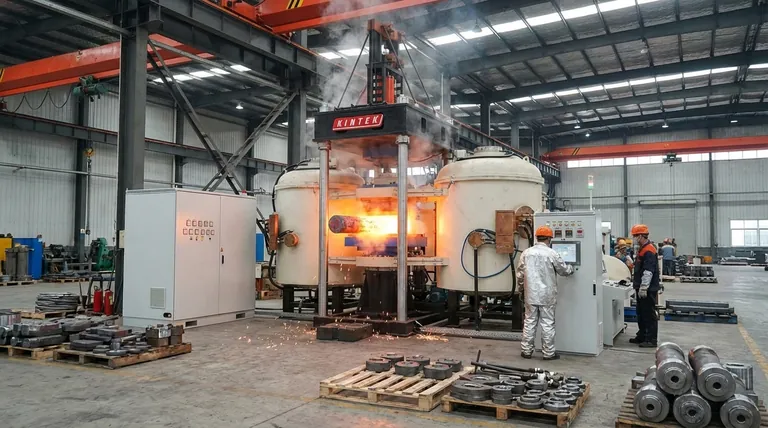
How Induction Heating Transforms the Forging Process
Traditional forging involves soaking a workpiece in the flames of a gas or coal forge. Induction heating completely redefines this approach by using electromagnetism to deliver targeted energy exactly where it's needed.
The Principle of Targeted Heat
Induction heating systems use a high-frequency alternating current that flows through a copper coil. This creates a powerful, rapidly changing magnetic field around the coil.
When a metal workpiece is placed within this field, the magnetic field induces electrical currents (known as eddy currents) inside the part. The material's natural resistance to these currents generates intense, localized heat from the inside out.
Unmatched Speed and Efficiency
Because heat is generated within the part itself, the process is incredibly fast, often bringing a steel bar to forging temperature in seconds or minutes.
This speed also drives efficiency. Almost no energy is wasted heating the surrounding air or furnace walls, focusing the power directly on the workpiece. This translates to lower energy consumption per part compared to a continuously running fuel-fired forge.
Precision and Repeatability
The heating process is highly controllable. You can precisely manage the location of the heat, the final temperature, and the heating duration.
This level of control is critical for automation and producing consistent, high-quality parts, which is essential for forging the complex geometries required in modern manufacturing.
A Cleaner, Safer Work Environment
Induction heating eliminates the open flames, loud noise, smoke, and waste heat associated with traditional forges. This creates a safer, cleaner, and more comfortable environment for operators.
Understanding the Trade-offs and Limitations
While powerful, induction heating is not a universal solution. Its benefits come with specific considerations that make it ideal for some applications but less suited for others.
Significant Initial Investment
The primary drawback is cost. An induction heating power supply, custom-engineered coils, and the necessary cooling systems represent a much higher upfront capital investment than a simple gas or coal forge.
The Importance of Coil Design
The efficiency of the process depends entirely on the design of the induction coil. The coil must be carefully shaped to match the part being heated for optimal performance.
This means that forging a wide variety of part shapes and sizes may require an inventory of different coils, adding complexity and cost to the operation.
Challenges with Decarburization and Scale
While the speed of induction heating dramatically reduces scale formation (oxidation), it does not eliminate it. Improper setup can still lead to surface decarburization, where carbon is lost from the steel's surface, potentially affecting its final properties.
Making the Right Choice for Your Forging Operation
The decision to use induction heating depends entirely on the goals of your operation. It is less a question of "good or bad" and more a question of "right for the task."
- If your primary focus is high-volume production and repeatability: Induction heating is the superior choice for its speed, consistency, and potential for full automation.
- If your primary focus is cost-sensitive, low-volume, or artistic work: A traditional fuel-fired forge offers greater flexibility for one-off shapes with a significantly lower initial investment.
- If your primary focus is achieving precise metallurgical properties: The unmatched temperature control of an induction system provides the accuracy needed for specialized alloys and demanding applications.
Ultimately, choosing induction heating is an investment in precision, speed, and control for the modern forging process.
Summary Table:
| Feature | Induction Heating | Traditional Forge |
|---|---|---|
| Heating Speed | Seconds to minutes | Minutes to hours |
| Energy Efficiency | High (direct internal heating) | Lower (heat loss to surroundings) |
| Temperature Control | Precise and repeatable | Less consistent |
| Work Environment | Clean, safe, no open flames | Hot, smoky, noisy |
| Initial Cost | Higher investment | Lower investment |
| Ideal For | High-volume, automated production | Low-volume, flexible, artistic work |
Ready to Transform Your Forging Process with Precision Induction Heating?
Upgrade your operation with KINTEK's advanced lab equipment and consumables. Our induction heating solutions are designed for laboratories and manufacturing facilities that demand superior control, repeatability, and efficiency. Whether you're working with specialized alloys or high-volume production, KINTEK provides the reliable equipment you need to achieve consistent, high-quality results.
Contact us today to discuss how our induction heating systems can enhance your forging capabilities and drive your success.
Visual Guide

Related Products
- 600T Vacuum Induction Hot Press Furnace for Heat Treat and Sintering
- Vacuum Arc Induction Melting Furnace
- Non Consumable Vacuum Arc Induction Melting Furnace
- Lab-Scale Vacuum Induction Melting Furnace
People Also Ask
- What role does an induction vacuum hot pressing furnace play in sintering? Achieve 98% Density in Carbide Blocks
- What advantages does a vacuum hot press furnace provide for LSLBO ceramic electrolytes? Achieve 94% Relative Density
- What role does a Vacuum Hot Press (VHP) furnace play in the densification of austenitic stainless steel 316 composites?
- What role does mechanical pressure play during the vacuum diffusion bonding of tungsten and copper? Keys to Solid Bonding
- What are the advantages of a vacuum hot press furnace for W-50%Cu? Achieve 99.6% Density at Lower Temperatures



