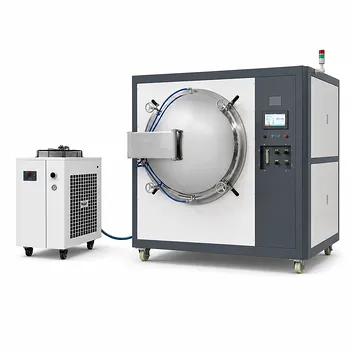
The induction vacuum hot pressing furnace acts as a mechanism for forced densification, specifically tailored to overcome the sintering resistance of complex materials like (W0.4Al0.6)C0.65–Co cemented carbide. By integrating rapid induction heating (up to 150°C/min) with a mechanical pressure of 40 MPa in a controlled vacuum (80 Pa), this equipment achieves relative densities exceeding 98% while maintaining fine microstructures.
The core advantage of this technology is the substitution of thermal energy with mechanical energy. By applying external pressure, the furnace increases the sintering driving force, allowing for complete pore elimination at lower temperatures and shorter times than conventional methods.
The Mechanics of Pressure-Assisted Sintering
Increasing the Driving Force
In conventional sintering, densification relies largely on thermal energy and surface tension. An induction vacuum hot press introduces external mechanical force, applying axial pressure (typically 40 MPa for this alloy) directly to the powder compact.
Forcing Particle Rearrangement
This mechanical pressure physically forces powder particles to rearrange and flow plastically. It accelerates the movement of materials into voids, overcoming the friction that typically hinders densification in difficult-to-sinter powders.
Enhancing Liquid Phase Infiltration
The applied pressure promotes the infiltration of the liquid cobalt (Co) phase into the pores between the hard ceramic particles. This ensures that the binding phase is evenly distributed, which is essential for structural integrity.
The Critical Role of the Vacuum Environment
Degassing and Purification
The furnace maintains a vacuum environment (specifically around 80 Pa) throughout the process. This low-pressure atmosphere actively extracts adsorbed gases and volatile impurities from the surface of the powder particles before they are trapped inside the block.
Preventing Oxidation
Complex carbides are sensitive to oxidation at high temperatures. The vacuum shields the (W0.4Al0.6)C0.65 powder from oxygen, preventing surface oxides that would otherwise inhibit sintering and weaken the final product.
Improving Wettability
By cleaning the particle surfaces of contaminants and oxides, the vacuum significantly enhances the wettability of the liquid cobalt on the tungsten carbide-based particles. Better wetting leads to stronger bonding and improved fracture toughness.
Thermal Control and Microstructure
Rapid Heating Rates
The furnace utilizes induction heating to achieve rapid temperature increases, capable of rates up to 150°C/min. This minimizes the material's exposure to intermediate temperatures where unwanted phases might form.
The Role of Graphite Molds
High-strength graphite molds act as both the container for the powder and the heating element (susceptor) in the induction field. Graphite's high thermal conductivity ensures the heat is transferred uniformly to the alloy, preventing thermal gradients that could cause cracking.
Inhibiting Grain Growth
Because the combination of pressure and vacuum allows for full densification at lower temperatures and shorter holding times (10–15 minutes), the process effectively inhibits abnormal grain growth. This preserves a fine microstructure, directly contributing to high hardness (up to 20.57 GPa).
Understanding the Trade-offs
Mold Dependency
The process is heavily dependent on the quality of the graphite molds. These molds must withstand extreme pressures (40 MPa) and temperatures (1400°C–1500°C) without deforming or reacting chemically with the alloy.
Throughput Limitations
Unlike continuous sintering furnaces, vacuum hot pressing is inherently a batch process. The requirement to heat, press, and cool the mold assembly cycles limits the volume of parts that can be produced per hour compared to pressureless sintering.
Making the Right Choice for Your Goal
When processing (W0.4Al0.6)C0.65–Co cemented carbides, align your process parameters with your specific mechanical requirements:
- If your primary focus is Maximum Density: Prioritize the application of 40 MPa mechanical pressure to physically force pore closure and achieve >98% relative density.
- If your primary focus is Hardness and Strength: Focus on the rapid heating rate (150°C/min) and short holding times to prevent grain coarsening, ensuring the final alloy retains superior mechanical properties.
Ultimately, the induction vacuum hot press transforms the sintering process from a thermal diffusion reliance to a mechanically driven consolidation, ensuring defect-free, high-performance carbide blocks.
Summary Table:
| Feature | Parameter/Function | Benefit to Carbide Sintering |
|---|---|---|
| Heating Method | Induction (up to 150°C/min) | Inhibits grain growth; preserves fine microstructure |
| Mechanical Pressure | 40 MPa (Axial) | Forces particle rearrangement; achieves >98% density |
| Atmosphere | Vacuum (~80 Pa) | Prevents oxidation; improves liquid phase wettability |
| Sintering Time | 10–15 Minutes | Minimizes thermal exposure; prevents unwanted phases |
| Mold Type | High-strength Graphite | Ensures uniform heat distribution and structural integrity |
Elevate Your Material Performance with KINTEK
Precision sintering of complex alloys like cemented carbides requires more than just heat—it demands the perfect synergy of pressure and atmosphere control. KINTEK specializes in advanced laboratory equipment, offering high-performance induction vacuum hot pressing furnaces, muffle and vacuum furnaces, and hydraulic presses designed for superior material densification.
Whether you are conducting battery research, developing ceramic composites, or refining crushing and milling systems, our comprehensive portfolio—from high-temperature reactors to PTFE consumables—is engineered to meet the most rigorous research standards.
Ready to achieve 98%+ relative density and superior hardness? Contact our technical experts today to find the ideal solution for your laboratory needs.
Related Products
- 600T Vacuum Induction Hot Press Furnace for Heat Treat and Sintering
- Vacuum Hot Press Furnace Heated Vacuum Press Machine Tube Furnace
- Vacuum Hot Press Furnace Machine Heated Vacuum Press
- Vacuum Hot Press Furnace Machine for Lamination and Heating
- Lab-Scale Vacuum Induction Melting Furnace
People Also Ask
- What advantages does a vacuum hot press furnace provide for LSLBO ceramic electrolytes? Achieve 94% Relative Density
- What role does a Vacuum Hot Press (VHP) furnace play in the densification of austenitic stainless steel 316 composites?
- What are the advantages of a vacuum hot press furnace for W-50%Cu? Achieve 99.6% Density at Lower Temperatures
- What role does mechanical pressure play during the vacuum diffusion bonding of tungsten and copper? Keys to Solid Bonding
- What is the application value of a vacuum hot press furnace? Unlock High-Density Complex Carbide Ceramics