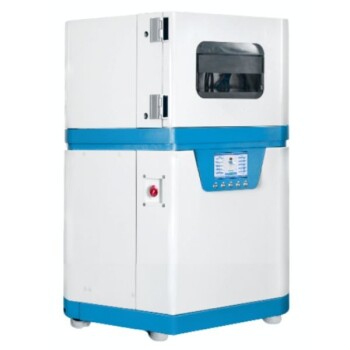
A Vacuum Hot Press (VHP) furnace serves as the critical consolidation mechanism for converting austenitic stainless steel 316 composite powders into solid, high-density materials. By simultaneously subjecting the powder to high heat (typically 1100°C) and significant uniaxial pressure (around 35 MPa), the furnace forces particle bonding and creates a solid structure without reaching the alloy's melting point.
Core Takeaway: VHP technology solves the problem of porosity in metal composites by combining mechanical force with thermal energy in a gas-free environment. It achieves full material density and uniform reinforcement distribution while preventing the structural weaknesses associated with oxidation and excessive grain growth.
The Mechanism of Densification
Simultaneous Heat and Pressure
The defining characteristic of VHP is the application of mechanical pressure alongside thermal energy. While traditional sintering relies primarily on heat to bond particles, VHP utilizes hydraulic rams to apply uniaxial pressure (e.g., 35–70 MPa).
Reaching Full Density Below Melting Points
This mechanical force enables the stainless steel composite to reach maximum density at temperatures below its melting point. By physically forcing the softened powder particles together, the process eliminates voids that heat alone might not resolve.
Promoting Diffusion and Bonding
The combination of heat and pressure accelerates atomic diffusion at particle boundaries. This promotes strong inter-particle bonding and plastic deformation, ensuring the material consolidates into a coherent bulk mass.
The Role of the Vacuum Environment
Elimination of Porosity
Operating under high vacuum (typically around 1.5 x 10^-2 Pa) is essential for removing gases trapped within the powder bulk. As the material heats up, the vacuum extracts these gases before the pores seal off, allowing the material to achieve relative densities exceeding 96%.
Prevention of Oxidation
Austenitic stainless steel 316 contains elements like chromium which are susceptible to oxidation. The vacuum environment lowers oxygen partial pressure, preventing the formation of oxide films that would otherwise inhibit particle bonding and weaken the final composite.
Microstructural Control and Quality
Inhibiting Grain Growth
Because VHP achieves densification rapidly and at temperatures lower than melting, it significantly restricts grain growth. This is vital for maintaining the mechanical strength and hardness of the stainless steel composite.
Uniform Distribution of Reinforcements
In composite materials, maintaining the placement of reinforcing elements (such as oxides) is critical. The VHP process locks these reinforcements in place, ensuring a uniform distribution throughout the steel matrix rather than allowing them to segregate or float as they might in a liquid melt.
Understanding the Trade-offs
Geometry Limitations
Unlike Hot Isostatic Pressing (HIP), which applies pressure from all directions using gas, VHP applies pressure uniaxially (from one direction). This generally limits the process to producing simple shapes, such as plates or cylinders, which are defined by the graphite molds used.
Directionality of Properties
Because the pressure is applied in only one direction, the resulting material properties may exhibit slight anisotropy. This means the mechanical strength might vary slightly depending on whether it is measured parallel or perpendicular to the pressing direction.
Making the Right Choice for Your Goal
When evaluating VHP for stainless steel 316 composites, consider the following specific requirements:
- If your primary focus is maximum density: VHP is highly effective, capable of exceeding 96% relative density by mechanically eliminating pores.
- If your primary focus is microstructural integrity: VHP is ideal as it prevents excessive grain growth and oxidation, preserving the material's theoretical strength.
- If your primary focus is part complexity: Be aware that VHP is best suited for simple geometries (discs, pucks, tiles) and may require post-processing for complex final shapes.
By leveraging simultaneous pressure and vacuum, VHP transforms loose powder into a high-performance steel composite with superior internal soundness.
Summary Table:
| Feature | VHP Impact on 316 SS Composites |
|---|---|
| Densification Goal | Achieve >96% relative density below melting point |
| Pressure Mode | Uniaxial (35-70 MPa) for void elimination |
| Atmosphere | High Vacuum (1.5 x 10^-2 Pa) to prevent oxidation |
| Microstructure | Inhibits grain growth and ensures uniform reinforcement |
| Common Shapes | Simple geometries (discs, plates, cylinders) |
Maximize Your Material Density with KINTEK Precision
Unlock the full potential of your advanced materials with KINTEK’s high-performance Vacuum Hot Press (VHP) furnaces. Whether you are working with austenitic stainless steel 316 composites or specialized ceramics, our systems provide the precise uniaxial pressure and high-vacuum environment necessary to eliminate porosity and prevent oxidation.
Why partner with KINTEK?
- Comprehensive Range: From VHP and Spark Plasma Sintering to CVD, PECVD, and high-pressure reactors.
- Quality Assurance: Advanced cooling solutions, hydraulic presses, and essential consumables like crucibles and ceramics.
- Expert Support: We help laboratory researchers and industrial manufacturers achieve superior microstructural integrity and mechanical strength.
Ready to elevate your research or production quality? Contact KINTEK today to discuss your project requirements!
Related Products
- Vacuum Hot Press Furnace Heated Vacuum Press Machine Tube Furnace
- 600T Vacuum Induction Hot Press Furnace for Heat Treat and Sintering
- Vacuum Hot Press Furnace Machine Heated Vacuum Press
- Vacuum Hot Press Furnace Machine for Lamination and Heating
- Vacuum Heat Treat and Pressure Sintering Furnace for High Temperature Applications
People Also Ask
- What advantages does a vacuum hot press furnace provide for LSLBO ceramic electrolytes? Achieve 94% Relative Density
- What are the advantages of using a vacuum hot pressing furnace? Superior Densification for 2024Al/Gr/SiC Composites
- What are the advantages of a vacuum hot press furnace for LTPO solid electrolytes? Boost Density and Conductivity
- What core processing conditions does a vacuum hot press furnace provide? Achieve High-Density Cu-SiC/Diamond Composites
- How does a vacuum hot press furnace achieve the densification of ZrB2–SiC–TaC? Unlock Ultra-High Ceramic Density