At their core, carbon nanotubes (CNTs) possess a unique and powerful combination of physical properties that set them apart from virtually all other materials. They exhibit extraordinary mechanical strength far exceeding that of steel, electrical conductivity that can surpass copper, and exceptional thermal stability, all derived from their unique, nanometer-scale cylindrical structure.
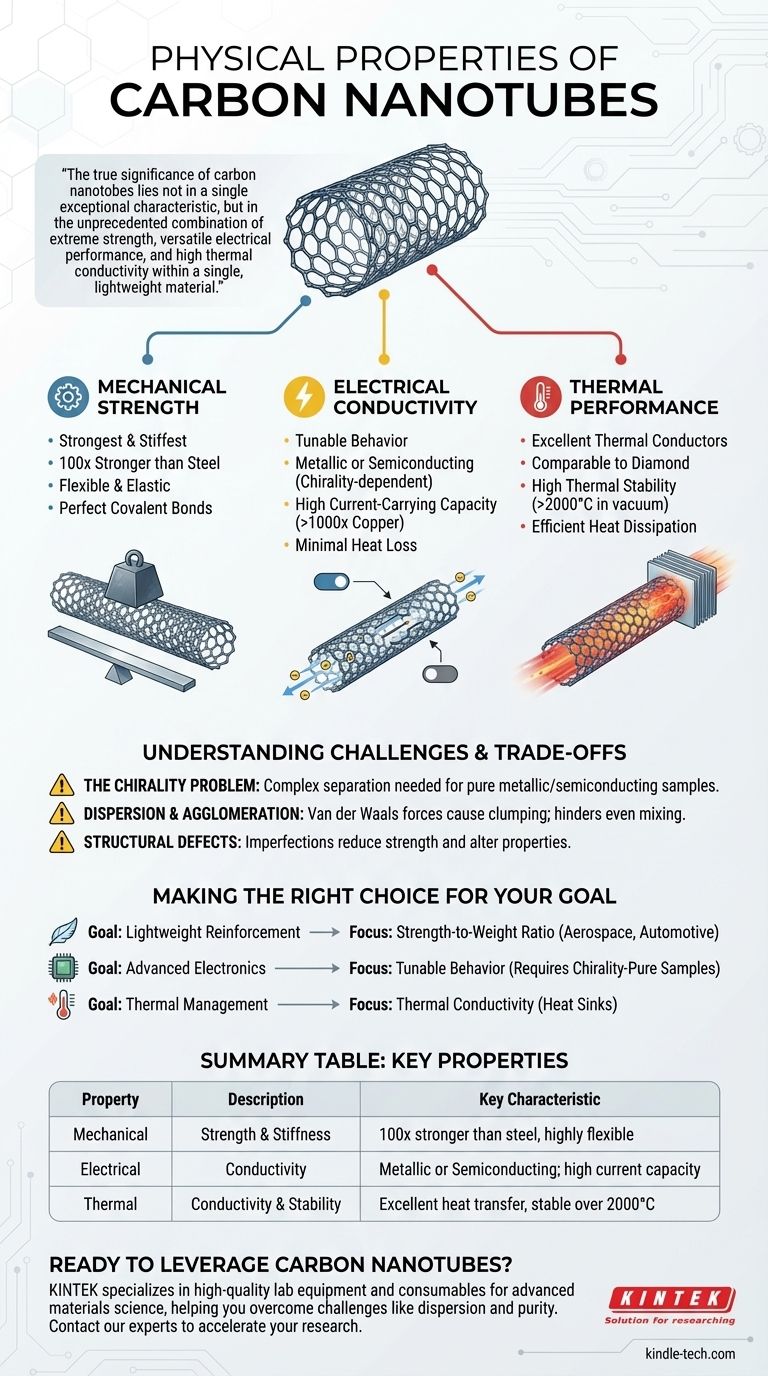
The true significance of carbon nanotubes lies not in a single exceptional characteristic, but in the unprecedented combination of extreme strength, versatile electrical performance, and high thermal conductivity within a single, lightweight material.
The Three Pillars of CNT Properties
The remarkable capabilities of CNTs can be understood by examining three fundamental areas: mechanical, electrical, and thermal. These properties originate from their structure—a seamless, rolled-up sheet of graphene, which is a single layer of carbon atoms arranged in a hexagonal lattice.
Unprecedented Mechanical Strength
Carbon nanotubes are the strongest and stiffest materials yet discovered in terms of tensile strength (the ability to resist being pulled apart) and elastic modulus (stiffness).
The covalent bonds between the carbon atoms are incredibly strong. This atomic perfection gives CNTs a tensile strength estimated to be 100 times greater than that of steel, at only a fraction of the weight.
Beyond sheer strength, they are also highly flexible and elastic. They can be bent to extreme angles and return to their original shape without damage, a property known as resilience.
Versatile Electrical Conductivity
One of the most fascinating properties of CNTs is their variable electrical behavior, which is entirely dependent on their atomic structure.
A CNT's electrical nature is determined by its chirality, which refers to the angle at which the graphene sheet is "rolled" to form the tube. Depending on this angle, a CNT can behave either as a metallic conductor or a semiconductor.
Metallic CNTs have an extremely high current-carrying capacity (ampacity), estimated to be over 1,000 times that of copper, making them highly efficient conductors with minimal heat loss.
Exceptional Thermal Performance
Carbon nanotubes are excellent thermal conductors, efficiently transferring heat along their length.
This high thermal conductivity is comparable to that of diamond, one of the best bulk thermal conductors known. This allows CNTs to be highly effective at dissipating heat from a source.
Furthermore, they possess high thermal stability. They can withstand very high temperatures (over 2000°C in a vacuum) without degrading, making them suitable for high-temperature applications.
Understanding the Challenges and Trade-offs
While their theoretical properties are astounding, achieving them in practical applications presents significant challenges. Understanding these limitations is critical for any real-world implementation.
The Chirality Problem
Synthesizing CNTs typically results in a mixture of metallic and semiconducting types. For most electronic applications, a pure sample of one type is required.
Separating CNTs by chirality is a complex and costly process, which remains a major hurdle for their widespread adoption in advanced electronics like computer chips.
Dispersion and Agglomeration
Due to powerful attractive forces known as van der Waals forces, individual nanotubes have a strong tendency to clump together into bundles.
This agglomeration prevents them from being evenly dispersed in other materials (like polymers or metals), which can negate their reinforcing effects and create points of weakness.
Structural Defects
The ideal properties of CNTs are dependent on their perfect hexagonal lattice structure.
Defects, impurities, or breaks in the nanotube wall, which can occur during synthesis or processing, can dramatically reduce their mechanical strength and alter their electrical properties.
Making the Right Choice for Your Goal
Harnessing the power of carbon nanotubes requires aligning their specific properties with the primary objective of your application.
- If your primary focus is lightweight structural reinforcement: The unmatched strength-to-weight ratio is the key property to leverage, making CNT composites ideal for aerospace, automotive, and high-performance sporting goods.
- If your primary focus is advanced electronics: The tunable metallic or semiconducting behavior is critical, but success depends on overcoming the challenge of achieving chirality-pure samples.
- If your primary focus is thermal management: Their exceptional thermal conductivity makes them a prime candidate for creating next-generation heat sinks and thermal interface materials in electronics.
Understanding these fundamental properties and their associated challenges is the first step toward unlocking the transformative potential of this remarkable material.
Summary Table:
| Property | Description | Key Characteristic |
|---|---|---|
| Mechanical | Strength & Stiffness | 100x stronger than steel, highly flexible |
| Electrical | Conductivity | Can be metallic or semiconducting; high current capacity |
| Thermal | Conductivity & Stability | Excellent heat transfer, stable over 2000°C |
Ready to leverage the power of carbon nanotubes in your research or product development?
KINTEK specializes in providing high-quality lab equipment and consumables tailored for advanced materials science. Whether you are synthesizing, testing, or applying CNTs, our solutions are designed to help you overcome challenges like dispersion and purity to achieve reliable results.
Contact our experts today to discuss how we can support your laboratory's specific needs and accelerate your innovation with carbon nanotubes.
Visual Guide
Related Products
- Carbon Graphite Boat -Laboratory Tube Furnace with Cover
- Boron Nitride (BN) Ceramic Tube
- Hexagonal Boron Nitride HBN Thermocouple Protection Tube
People Also Ask
- What metals can you melt in a graphite crucible? A Guide to Safe & Efficient Melting
- Does a graphite crucible need to be seasoned? The Critical First-Use Safety Guide
- Why is graphite used in furnaces? For Extreme Heat, Purity, and Efficiency
- Why is a graphite crucible containing molten bismuth used in LiF–NaF–KF purification? Enhance Melt Purity Efficiently
- What is the use of graphite tube? Essential for Extreme Heat & Corrosive Environments