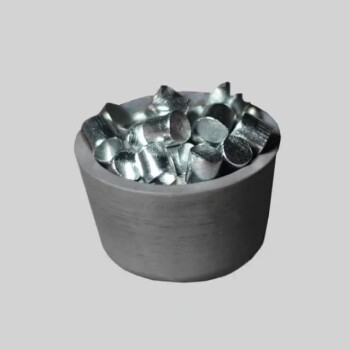
In the electrolytic purification of LiF–NaF–KF melts, the graphite crucible containing molten bismuth acts as the cathode system. The molten bismuth functions as a liquid electrode that captures precipitated potassium metal during electrolysis, forming a stable alloy. This configuration is essential for preventing active alkali metals from reacting back with the melt, thereby allowing the efficient removal of oxygen impurities at the anode.
The molten bismuth serves as a "trap" for reactive metals, alloying with them to prevent side reactions. This stability ensures the electrochemical process remains focused on its primary goal: the anodic oxidation and removal of oxygen impurities.
The Mechanics of the Liquid Cathode
The Role of Molten Bismuth
The core function of the bismuth in this assembly is to act as a liquid cathode.
Unlike a solid metal electrode, the molten bismuth provides a dynamic surface for the electrochemical reaction.
It specifically receives potassium metal that precipitates out of the LiF–NaF–KF melt during the application of current.
Alloy Formation and Sequestration
When potassium is reduced at the cathode, it does not remain as a free element.
Instead, the potassium immediately dissolves into the molten bismuth to form an alloy.
This physical sequestration stabilizes the potassium, preventing it from floating away or reacting chemically with the surrounding fluoride salts.
The Role of the Graphite Container
The graphite crucible itself serves as the conductive container for the liquid bismuth.
It provides the necessary electrical connection to the power source while physically containing the heavy liquid metal at the bottom of the cell.
Graphite is chosen for its ability to withstand the thermal environment and its electrical conductivity.
Ensuring Purification Efficiency
Preventing Re-oxidation
A major challenge in purifying alkali fluoride melts is the high reactivity of the alkali metals (Lithium, Sodium, Potassium).
If potassium were allowed to precipitate on a solid cathode without protection, it could easily redissolve or react with impurities, reversing the purification work.
The bismuth "trap" effectively removes the potassium from the reaction zone, ensuring the separation is permanent during the process.
Enabling Anodic Oxygen Removal
The ultimate goal of this electrolysis is to remove oxygen ions from the melt.
While the cathode manages the metal ions, the anode (often glassy carbon) converts oxygen ions into carbon dioxide or carbon monoxide.
The stable cathode reaction provided by the bismuth is what allows this anodic oxidation to proceed continuously without interference from unstable metal species.
Understanding the Trade-offs
Complexity of Liquid Systems
Using a liquid cathode introduces mechanical complexity to the cell design.
Operators must ensure the molten bismuth remains distinct from the electrolyte melt and does not become agitated enough to mix mechanically.
This requires precise temperature control and careful cell geometry.
Material Compatibility
While graphite is conductive and heat-resistant, it must remain chemically inert relative to the bismuth alloy.
If the graphite were to degrade, it could introduce carbon particulate into the bismuth or the fluoride melt.
Furthermore, the recovery of the potassium from the bismuth alloy after purification requires secondary processing steps, adding to the total operational effort.
Making the Right Choice for Your Goal
To determine if this cathode configuration is appropriate for your specific purification needs, consider the following principles:
- If your primary focus is high-purity oxygen removal: The bismuth cathode is essential because it prevents alkali metal side reactions that would compete with oxygen removal.
- If your primary focus is process simplicity: You must weigh the benefits of high purity against the added complexity of managing a dual-liquid system (molten salt plus molten bismuth).
By utilizing a graphite crucible to hold molten bismuth, you transform a volatile electrochemical environment into a stable system capable of achieving deep purification.
Summary Table:
| Component | Material | Primary Function in Electrolysis |
|---|---|---|
| Cathode Material | Molten Bismuth | Acts as a liquid trap to alloy and stabilize precipitated potassium. |
| Containment | Graphite Crucible | Provides electrical conductivity and thermal stability for the bismuth. |
| Reaction Goal | Electrolytic Purification | Enables removal of oxygen impurities at the anode by preventing side reactions. |
| Anode Type | Glassy Carbon | Converts oxygen ions into CO/CO2 to purify the fluoride melt. |
Optimize Your Molten Salt Research with KINTEK
Achieving high-purity melts requires precision-engineered components. KINTEK specializes in advanced laboratory solutions, offering high-performance graphite crucibles, high-temperature furnaces (muffle, vacuum, and atmosphere), and specialized ceramics tailored for complex electrolytic processes. Whether you are conducting battery research or developing nuclear salt purification techniques, our comprehensive range of high-temperature high-pressure reactors and consumables ensures consistent, reliable results.
Ready to elevate your laboratory's capabilities? Contact us today to discuss your specific equipment needs and see how KINTEK’s expertise can streamline your purification workflows.
References
- Anna A. Maslennikova, Wei‐Qun Shi. Determination of the Oxygen Content in the LiF–NaF–KF Melt. DOI: 10.3390/ma16114197
This article is also based on technical information from Kintek Solution Knowledge Base .
Related Products
- High Purity Pure Graphite Crucible for Evaporation
- High Purity Pure Graphite Crucible for Electron Beam Evaporation
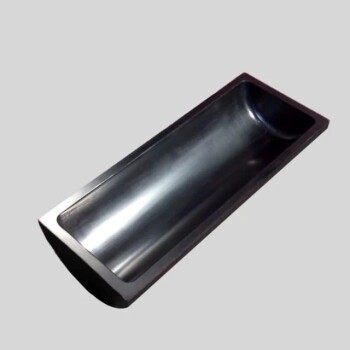
- Carbon Graphite Boat -Laboratory Tube Furnace with Cover
- Arc-Shaped Alumina Ceramic Crucible High Temperature Resistant for Engineering Advanced Fine Ceramics
- Engineering Advanced Fine Ceramics Alumina Al2O3 Crucible With Lid Cylindrical Laboratory Crucible
People Also Ask
- Why are high-purity graphite crucibles preferred for sulfide solid electrolytes? Achieve Superior Material Purity
- Why is a high-purity graphite crucible required for Chromel-TaC composites? Ensure Peak Purity at 1400°C
- What role do high-purity graphite crucibles play in molten salt corrosion research? Ensure Reactor-Grade Precision
- Why are high-purity graphite crucibles used for magnesium distillation? Ensure 3N8 Purity & Thermal Stability
- Why is a high-purity graphite crucible ideal for nitrogen-doped graphene at 1500 °C? Maximize Purity and Stability