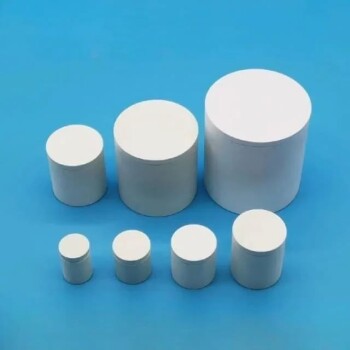
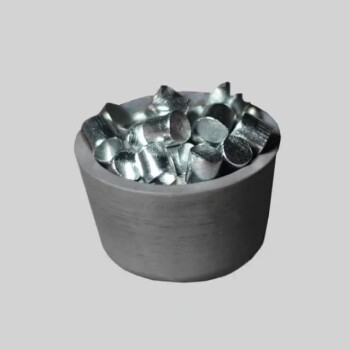
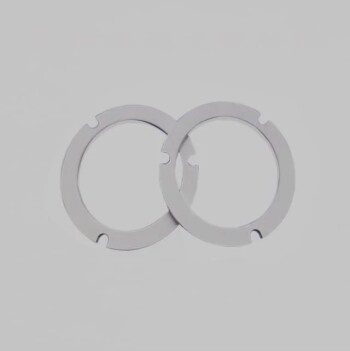
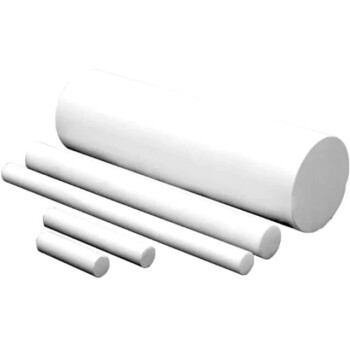
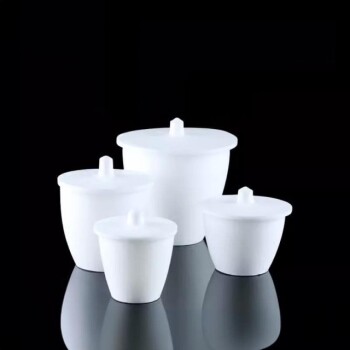
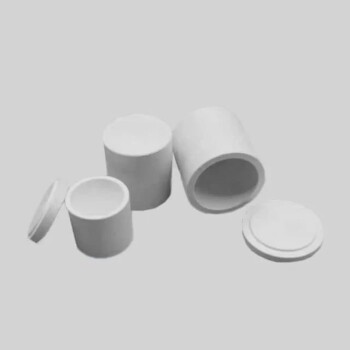
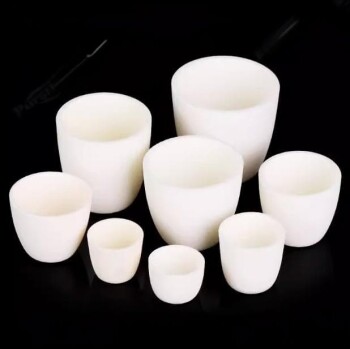
Boron Nitride (BN) and Alumina are the preferred crucible materials for the Sodium-flux growth of Gallium Nitride because they offer an essential combination of thermal stability and chemical inertness. Specifically, they can withstand the required 800-900°C operating temperatures while resisting the highly corrosive nature of molten sodium and gallium mixtures.
Core Takeaway Success in Na-flux growth relies on controlling where the crystal forms. BN and Alumina are critical because their low wettability and high purity prevent the melt from reacting with the vessel walls, thereby suppressing unwanted stray crystals (parasitic nucleation) and ensuring growth is focused entirely on the seed crystal.
The Challenge of the Reaction Environment
Withstanding Thermal Stress
The Sodium-flux method operates at significant temperatures, typically between 800-900°C. The reaction vessel must maintain structural integrity without softening or deforming in this heat range.
Resisting Chemical Attack
Molten sodium and gallium are chemically aggressive. BN and Alumina are chosen specifically because they resist chemical attack from this mixture. Unlike other potential materials, they do not degrade or dissolve when in contact with these corrosive fluxes.
Controlling Crystal Nucleation
The Role of Low Wettability
A critical factor in this process is low wettability. The molten mixture does not easily spread over or adhere to the surface of BN or Alumina.
Suppressing Parasitic Nucleation
Because the melt does not "wet" the crucible walls, crystal formation on the container surface is minimized. This suppression of parasitic nucleation is vital. It prevents random crystals from growing on the walls, which would otherwise compete with the intended seed crystal for resources.
Focusing Growth on the Seed
By eliminating competition from the crucible walls, the system ensures that the supersaturated nutrients contribute solely to the growth of large-sized seed crystals. This results in a more efficient process and larger final crystals.
Ensuring Material Purity
Preventing Contamination
High-quality semiconductor growth requires an contaminant-free environment. BN and Alumina crucibles are available in high purity grades.
Eliminating Impurities
Because these materials resist chemical attack, they do not leach substances into the melt. This prevents the introduction of impurities that could degrade the electronic or optical properties of the Gallium Nitride crystal.
Risks of Improper Material Selection
The Cost of Wettability
If a crucible material has high wettability, the melt will adhere to the walls. This almost guarantees the formation of polycrystals on the vessel surface, reducing the yield of the single crystal.
Chemical Instability
Using materials unable to withstand the corrosive Na-flux leads to container failure or melt contamination. Even minor degradation of the crucible introduces foreign atoms, ruining the high-quality nature required for these crystals.
Making the Right Choice for Your Goal
To maximize the effectiveness of your Na-flux growth process, consider these priorities:
- If your primary focus is Crystal Quality: Select high-purity BN or Alumina to eliminate chemical leaching and prevent impurity introduction into the melt.
- If your primary focus is Yield and Size: Rely on the low wettability of these materials to suppress parasitic nucleation, forcing all growth onto your large seed crystal.
The selection of the crucible is not just about containment; it is an active control mechanism for crystal purity and nucleation dynamics.
Summary Table:
| Feature | Boron Nitride (BN) | Alumina (Al₂O₃) | Impact on Na-flux Growth |
|---|---|---|---|
| Temperature Limit | Up to 900°C+ (Inert) | Up to 1700°C | Maintains integrity at 800-900°C growth range |
| Wettability | Very Low | Low | Suppresses parasitic nucleation on walls |
| Chemical Resistance | Excellent (Molten Na/Ga) | High (Corrosion resistant) | Prevents melt contamination and leaching |
| Purity Levels | Ultra-high available | High | Ensures high electronic/optical GaN quality |
Elevate Your Crystal Growth Precision with KINTEK
Maximize your semiconductor yield and eliminate parasitic nucleation with high-purity BN and Alumina crucibles from KINTEK. As experts in high-temperature laboratory solutions, we provide the specialized consumables and equipment necessary for demanding processes like Sodium-flux GaN growth and high-pressure reactions.
From advanced high-temperature furnaces (muffle, vacuum, and CVD) to precision isostatic presses and corrosion-resistant ceramics, KINTEK is dedicated to empowering researchers and industrial manufacturers with reliable, contamination-free tools.
Ready to optimize your lab's performance? Contact KINTEK today for a customized quote!
References
- Nathan Stoddard, Siddha Pimputkar. Prospective view of nitride material synthesis. DOI: 10.1002/ces2.10184
This article is also based on technical information from Kintek Solution Knowledge Base .
Related Products
- Boron Nitride (BN) Crucible for Phosphorous Powder Sintered
- Electron Beam Evaporation Coating Conductive Boron Nitride Crucible BN Crucible
- Hexagonal Boron Nitride HBN Ceramic Ring
- Boron Nitride (BN) Ceramic Rod for High Temperature Applications
- Boron Nitride (BN) Ceramic Plate
People Also Ask
- Why use Boron Nitride (BN) crucibles in metal infiltration? Ensure sample purity and non-wetting performance.
- What is the necessity of using a ceramic crucible as a carrier during BN synthesis? Ensure High-Purity Results
- How much heat can a ceramic crucible take? Find the Right Crucible for Your High-Temp Process
- What is the necessity of using ceramic crucibles in TGA for TClPhMA? Ensure Accurate Thermal Data Integrity
- What protective role do ceramic crucibles play? Ensure Equipment Longevity and Catalyst Purity in Synthesis