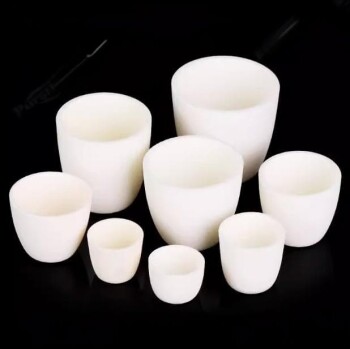
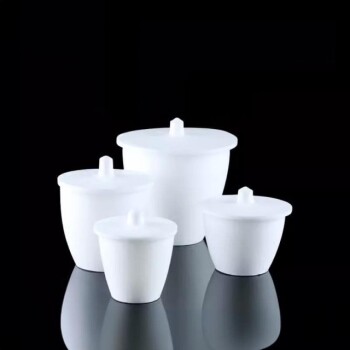
The use of an alumina crucible with a lid serves a dual purpose: it provides a vessel capable of resisting the corrosive attack of molten salts while creating a contained environment to stabilize the chemical reaction. Specifically, the alumina withstands the aggressive nature of molten Magnesium Chloride (MgCl2), while the lid prevents the evaporation of these volatile salts to maintain the precise chemical ratios required for high-purity Titanium Diboride (TiB2) synthesis.
Core Takeaway The combination of an alumina vessel and a fitted lid is essential for maintaining stoichiometry and purity. By resisting corrosion and preventing the volatile loss of reaction media, this setup ensures the TiB2 nanopowders are synthesized without degradation or contamination.
Why Alumina is the Material of Choice
Withstanding Chemical Aggression
The primary reason for selecting alumina is its exceptional high-temperature chemical stability.
In the synthesis of TiB2, the process involves molten Magnesium Chloride (MgCl2) salts. These salts are chemically aggressive and would degrade lesser materials, leading to vessel failure or product contamination.
Superior Corrosion Resistance
Alumina serves as a robust barrier against the corrosive nature of the molten medium.
It remains inert during the heat treatment process. This ensures that the crucible itself does not react with the mixture, preserving the integrity of the synthesis.
The Critical Role of the Lid
Preventing Volatile Loss
At high temperatures, molten salts like MgCl2 are prone to becoming volatile and evaporating.
The lid acts as a physical containment barrier. It effectively prevents the volatile loss of the molten salt, keeping the reaction medium within the crucible.
Maintaining Stoichiometry
For a chemical reaction to yield the correct product, the ratio of reactants (stoichiometry) must remain constant.
If the molten salt were to evaporate, the chemical balance of the system would shift. The lid preserves this balance, ensuring the reaction proceeds exactly as calculated.
Shielding from Contamination
High-purity nanopowders require a pristine synthesis environment.
The lid shields the reaction from external contaminants. By blocking airborne particulates or atmospheric impurities, it ensures the final TiB2 powder retains high purity.
Understanding the Operational Constraints
Thermal Shock Sensitivity
While alumina is chemically stable, it is a ceramic material prone to thermal shock.
Rapid heating or cooling of the crucible, especially when loaded with molten salts, can cause cracking. Users must manage temperature ramps carefully to avoid fracturing the vessel.
The Limits of Containment
A standard crucible lid prevents bulk volatility but does not create a hermetic pressure seal.
It effectively manages standard evaporation rates. However, it is not designed to contain extreme pressures if the reaction generates significant gas volume rapidly.
Optimizing Your Synthesis Setup
Selecting the right equipment configuration is the first step toward reproducible results in nanomaterial synthesis.
- If your primary focus is Chemical Purity: Ensure the lid is fitted properly to act as a shield against external environmental contaminants throughout the heating cycle.
- If your primary focus is Reaction Consistency: Prioritize the use of the lid to prevent salt evaporation, thereby strictly maintaining the stoichiometry of the system.
By securing the reaction environment against volatility and corrosion, you guarantee the production of high-quality Titanium Diboride nanopowders.
Summary Table:
| Feature | Benefit for TiB2 Synthesis | Impact on Final Product |
|---|---|---|
| Alumina Material | Resists corrosion from molten MgCl2 salts | Prevents crucible degradation and contamination |
| Fitted Lid | Prevents evaporation of volatile salts | Maintains stoichiometry and chemical balance |
| Chemical Inertness | High-temperature stability | Ensures high purity of synthesized nanopowders |
| Containment | Physical barrier against external particles | Protects the reaction from atmospheric impurities |
Elevate Your Nanomaterial Synthesis with KINTEK
Precision in heat treatment requires the right containment. KINTEK provides high-performance laboratory solutions, including high-purity alumina crucibles, dental and muffle furnaces, and advanced crushing systems designed to withstand aggressive chemical environments.
Whether you are synthesizing Titanium Diboride (TiB2) nanopowders or conducting complex battery research, our comprehensive range of high-temperature furnaces, autoclaves, and specialized consumables ensures your results are consistent, pure, and reproducible.
Ready to optimize your lab’s efficiency and chemical integrity?
Contact KINTEK Today for Expert Guidance
References
- Liaqat Ali Shah. Molten salt synthesis of TiB2 nanopowder by reduction of TiO2 with MgB2. DOI: 10.2298/pac2101040s
This article is also based on technical information from Kintek Solution Knowledge Base .
Related Products
- Alumina Al2O3 Ceramic Crucible Semicircle Boat with Lid for Engineering Advanced Fine Ceramics
- Engineering Advanced Fine Ceramics Alumina Al2O3 Crucible With Lid Cylindrical Laboratory Crucible
- Arc-Shaped Alumina Ceramic Crucible High Temperature Resistant for Engineering Advanced Fine Ceramics
- Engineering Advanced Fine Ceramics Alumina Crucibles (Al2O3) for Thermal Analysis TGA DTA
- Engineering Advanced Fine Alumina Al2O3 Ceramic Crucible for Laboratory Muffle Furnace
People Also Ask
- Why are alumina crucibles and mother powder essential for LATP sintering? Optimize Your Solid Electrolyte Performance
- Why are high-purity alumina crucibles used for liquid lead corrosion experiments? Ensure Data Accuracy at 550°C
- Why Use Alumina Crucibles & Powder Burial for NaSICON? Ensure Phase Purity and Prevent Elemental Volatilization
- What is the primary purpose of using alumina crucibles for LLTO ceramics? Optimize Your High-Temperature Sintering
- Primary considerations for choosing alumina crucibles and quartz tubes in indium intercalation: Ensure Material Purity