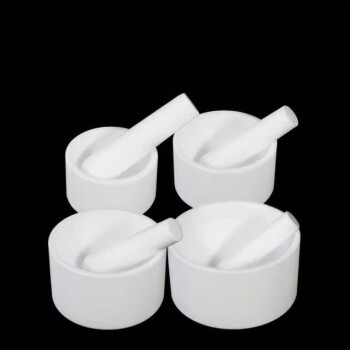
The primary technical advantage of tungsten carbide (WC) grinding jars is their exceptional hardness and wear resistance, which are critical for maintaining the chemical integrity of ceramic powders. In high-energy planetary ball milling, these jars prevent the physical degradation of the container wall, thereby eliminating the introduction of metallic impurities into the sample.
The definitive value of tungsten carbide in ceramic processing is contamination control. By resisting the high-impact forces of planetary milling, it ensures raw materials maintain chemical purity levels exceeding 99.95%, a necessity for sensitive research applications.
Preserving Chemical Purity
Eliminating Cross-Contamination
The most significant risk in grinding ceramic powders is the introduction of foreign elements from the grinding equipment itself. Tungsten carbide offers superior wear resistance compared to standard materials.
This resistance effectively prevents the physical wear of the grinding media that typically occurs during operation. Consequently, it stops metallic impurities from leaching into the powder and altering its composition.
Meeting High-Purity Standards
For advanced applications, such as the preparation of Cerium Oxide ceramics, maintaining the original stoichiometry is non-negotiable.
Using tungsten carbide ensures that the powder maintains a chemical purity level of over 99.95%. This level of purity is essential when impurities would otherwise interfere with precise scientific inquiries, such as studies on radiation damage mechanisms.
Withstanding High-Energy Mechanics
Handling Multi-Dimensional Impact
Planetary ball mills utilize a complex, multi-dimensional motion to generate high collision energy. This process involves high-speed rotation that creates significant impact and shear forces to achieve fine particle sizes quickly.
While this mechanism is efficient for grinding, it places immense stress on the jar materials. Tungsten carbide is hard enough to withstand these combined forces without degrading, ensuring the jar remains intact during high-speed collisions.
Durability in Long-Term Operation
Achieving the desired fineness in ceramic powders often requires long-term milling sessions.
Tungsten carbide jars are specifically engineered to endure these extended durations of high-speed operation. Their hardness ensures that the grinding efficiency attributed to the mill's structure is not compromised by equipment failure or excessive wear over time.
Common Pitfalls to Avoid
The Risk of Softer Materials
While planetary ball mills are compatible with various jar materials like stainless steel or agate, choosing a material softer than the ceramic powder being ground is a critical error.
If the grinding jar is less durable than the sample or the impact force, wear debris will contaminate the mixture. In high-precision studies, this renders the sample useless for analyzing intrinsic material properties, as the observed effects may be caused by the impurities rather than the ceramic itself.
Making the Right Choice for Your Goal
To determine if tungsten carbide is the correct material for your specific milling requirements, consider your scientific objectives:
- If your primary focus is High-Purity Research: Choose tungsten carbide to guarantee purity levels above 99.95% and prevent metallic contamination from skewing sensitive data.
- If your primary focus is Grinding Efficiency: Rely on tungsten carbide to withstand the high shear and impact forces generated by the mill's multi-dimensional motion without degrading over long cycles.
Select your grinding media not just for its ability to break down particles, but for its ability to preserve the fundamental chemistry of your sample.
Summary Table:
| Feature | Technical Advantage | Research Benefit |
|---|---|---|
| Material Hardness | Exceptional wear resistance | Eliminates metallic impurities and cross-contamination |
| Chemical Purity | Maintains >99.95% purity levels | Preserves stoichiometry for advanced ceramic applications |
| Energy Resistance | Withstands multi-dimensional impact | Prevents jar degradation during high-speed collisions |
| Durability | High-speed, long-term operation | Consistent grinding efficiency without equipment failure |
Elevate Your Research with KINTEK’s Precision Engineering
Don't let equipment wear compromise your scientific integrity. KINTEK specializes in high-performance laboratory solutions designed for the most demanding applications. Whether you are processing advanced ceramics or conducting sensitive battery research, our tungsten carbide grinding jars, crushing and milling systems, and high-purity consumables ensure your samples remain uncontaminated.
From planetary ball mills and hydraulic presses to high-temperature furnaces and vacuum systems, we provide the tools needed for precision material synthesis.
Ready to achieve 99.95%+ purity in your next project? Contact our technical experts today to find the perfect milling solution for your laboratory.
References
- Аrtem L. Kozlovskiy, Maxim V. Zdorovets. Study of the Influence of Doping Efficiency of CeO2 Ceramics with a Stabilizing Additive Y2O3 on Changes in the Strength and Thermophysical Parameters of Ceramics under High-Temperature Irradiation with Heavy Ions. DOI: 10.3390/cryst14040320
This article is also based on technical information from Kintek Solution Knowledge Base .
Related Products
- Laboratory Ball Mill Jar Mill with Metal Alloy Grinding Jar and Balls
- Laboratory Jar Mill with Agate Grinding Jar and Balls
- Laboratory Jar Ball Mill with Alumina Zirconia Grinding Jar and Balls
- Custom PTFE Teflon Parts Manufacturer Grinding Bowl
People Also Ask
- What is the function of a laboratory ball mill in the preparation of AMMCs? Optimize Dispersion & Grain Refinement
- What is the primary function of a laboratory ball mill in the modification of sulfide-based solid electrolytes with LiPO2F2?
- What is the function of a laboratory ball mill in the pretreatment of waste tire char (WTC)? Optimize Material Reactivity
- What is the primary function of a laboratory ball mill in Rice Husk Ash (RHA) modification? Achieve Peak Densification
- How do laboratory ball mills facilitate the mechanochemical synthesis of ZIF-8? Solvent-Free Synthesis Explained