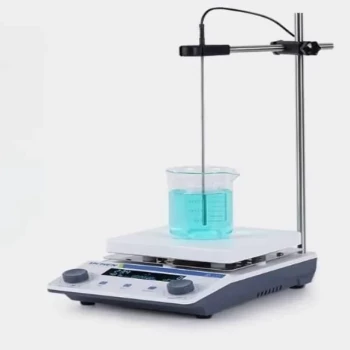
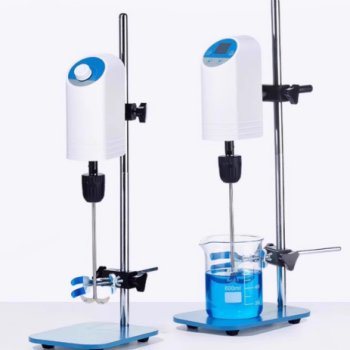
The primary role of these devices is to eliminate mass transfer limitations. By providing continuous fluid dynamics, a precision magnetic stirrer or constant temperature shaker ensures that adsorbent particles remain fully suspended and in constant contact with the methylene blue solution. This mechanical energy reduces the diffusion resistance of the liquid-phase boundary layer, allowing dye molecules to migrate efficiently into the adsorbent pores for accurate kinetic and thermodynamic measurement.
To obtain scientifically valid data, researchers must ensure that the adsorption rate is governed by the material's properties rather than the speed of the liquid. These devices provide the necessary kinetic energy to overcome physical barriers, ensuring that experimental results reflect the true maximum adsorption capacity and equilibrium time.
Overcoming Physical Diffusion Barriers
Eliminating Liquid Film Resistance
In a static solution, a "liquid film" or boundary layer forms around adsorbent particles, acting as a barrier that slows down the movement of methylene blue molecules. Continuous agitation or oscillation breaks down this resistance, allowing the solute to reach the surface of the adsorbent more rapidly. This is a prerequisite for ensuring that the experiment measures the actual adsorption rate rather than the speed of external diffusion.
Accelerating Solute Migration into Micropores
Once the methylene blue molecules reach the surface, they must penetrate the internal structure of the material, such as the pores of biochar or activated carbon. The fluid dynamics generated by the stirrer or shaker provide the kinetic energy needed to drive these molecules into internal active sites. This process significantly shortens the time required to reach adsorption equilibrium.
Ensuring Experimental Accuracy and Reproducibility
Maintaining Uniform Particle Suspension
For the adsorption reaction to be consistent, the adsorbent particles must not be allowed to settle at the bottom of the vessel. A constant rotation or oscillation speed ensures that the particles are uniformly distributed, maximizing the available surface area for the dye molecules to collide with. This uniformity is essential for fitting mathematical models like the Langmuir isotherm or pseudo-second-order kinetics.
Stabilizing the Thermal Environment
Adsorption is a temperature-sensitive process that involves specific thermodynamic changes. A constant temperature shaker eliminates thermal fluctuations that could otherwise shift the adsorption equilibrium or alter the reaction kinetics. By maintaining a stable environment (e.g., 25°C or 30°C), researchers can accurately determine the material's maximum adsorption capacity and heat of adsorption.
Understanding the Trade-offs and Constraints
Shear Stress and Particle Degradation
While high stirring speeds reduce diffusion resistance, excessive mechanical force can lead to the physical breakdown of fragile adsorbent particles, such as certain biomass charcoals. This degradation increases the surface area artificially, leading to inflated adsorption results that do not reflect the material's original state.
Heat Generation from Magnetic Stirrers
Standard magnetic stirrers can generate significant internal heat during long experiments, which may transfer to the sample through the base plate. If the experiment requires precise temperature control, a water-jacketed vessel or a dedicated constant temperature shaker is preferred to prevent unintended temperature rises that could skew the data.
Optimizing Your Experimental Parameters
To achieve the most reliable results in methylene blue adsorption studies, consider the specific requirements of your material and pollutant.
- If your primary focus is kinetic modeling: Use a constant rotation speed (typically 150–200 rpm) to ensure that external mass transfer resistance is fully eliminated.
- If your primary focus is thermodynamic parameters: Prioritize a constant temperature shaker or water bath to maintain a precision of ±1°C throughout the duration of the experiment.
- If your primary focus is fragile biochar materials: Opt for orbital shaking rather than magnetic stirring to provide a gentler mechanical environment that prevents particle attrition.
By precisely controlling the fluid dynamics and thermal environment, you ensure that your findings are a true reflection of the material's chemical performance.
Summary Table:
| Function | Action on Experiment | Key Benefit |
|---|---|---|
| Eliminate Film Resistance | Breaks down the liquid boundary layer | Faster solute migration from solution to surface |
| Ensure Suspension | Maintains uniform distribution of particles | Maximizes active site availability for molecules |
| Internal Diffusion | Provides kinetic energy for pore penetration | Shortens time to reach adsorption equilibrium |
| Thermal Regulation | Stabilizes environment (constant temp) | Ensures valid thermodynamic and kinetic data |
| Shear Control | Optimizes rotation/oscillation speed | Prevents mechanical degradation of fragile adsorbents |
Elevate Your Adsorption Research with KINTEK Precision Instruments
To achieve scientifically valid data in your methylene blue adsorption experiments, precision is non-negotiable. KINTEK specializes in high-performance laboratory equipment designed to eliminate experimental variables and maximize efficiency. From precision magnetic stirrers and constant temperature shakers that ensure perfect mass transfer to water-jacketed vessels for stabilization, we provide the tools researchers need for reproducible results.
Our extensive portfolio supports your entire workflow, including:
- Thermal Processing: Muffle, tube, and vacuum furnaces for adsorbent synthesis.
- Sample Preparation: Crushing, milling systems, and hydraulic presses (pellet, hot, isostatic).
- Advanced Synthesis: CVD, PECVD, and high-pressure reactors/autoclaves.
- Lab Essentials: Electrolytic cells, cooling solutions (ULT freezers), and high-quality ceramic crucibles.
Ready to optimize your lab’s workflow? Contact our experts today to find the perfect equipment tailored to your specific research needs and experience the KINTEK difference in quality and support.
References
- Min Hou, Can Liu. Preparation of Biomass Biochar with Components of Similar Proportions and Its Methylene Blue Adsorption. DOI: 10.3390/molecules28176261
This article is also based on technical information from Kintek Solution Knowledge Base .
Related Products
- Laboratory Small Constant Temperature Heated Magnetic Stirrer Heater and Stirrer
- Custom PTFE Teflon Parts Manufacturer for Magnetic Stirring Bar
- High Performance Laboratory Stirrers for Diverse Applications
- Three-dimensional electromagnetic sieving instrument
- Custom PTFE Teflon Parts Manufacturer for PTFE Stirring Bar Recovery Rod
People Also Ask
- What role does a magnetic stirrer with heating play in ZnO nanoparticle synthesis? Precision Control for Quality Results
- What role does a constant temperature heating magnetic stirrer play in MFC-HAp synthesis? Achieve Material Homogeneity
- What is the function of a laboratory magnetic stirrer in Ni–Cr–P electrodeposition? Optimize Ion Transport & Coating
- Why is a laboratory magnetic stirrer required for benzoic acid esters? Boost Reaction Speed & Yield with High RPM
- What role does a laboratory magnetic stirrer play in TiO2 and TiO2-Ag sol preparation? Master Chemical Kinetics