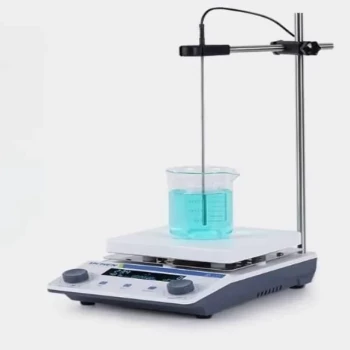
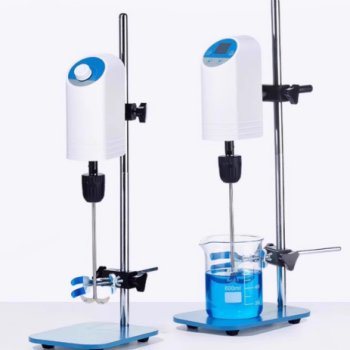
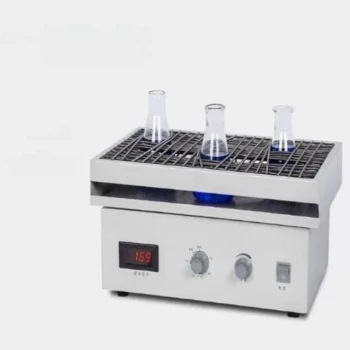
A laboratory magnetic stirrer acts as the primary driver for electrolyte homogeneity and mass transfer control. During the Ni–Cr–P electrodeposition process, it maintains a constant rotation speed (e.g., 200 rpm) to force fluid flow, ensuring that metal ions reach the cathode efficiently while simultaneously scouring the surface of contaminants.
Core Takeaway The magnetic stirrer does more than simply mix the solution; it actively manages the chemical environment at the electrode interface. By accelerating the transport of Nickel and Chromium ions and physically detaching hydrogen bubbles, it ensures the coating has a consistent chemical composition and a defect-free surface structure.
Facilitating Ion Transport and Distribution
The fundamental role of the magnetic stirrer is to overcome the natural limitations of diffusion. Without active agitation, the concentration of reactive species near the electrode would drop rapidly, compromising the plating process.
Accelerating Ion Migration
The stirrer forces the electrolyte to flow continuously. This movement accelerates the migration of critical metal ions—specifically $Ni^{2+}$ (Nickel) and $Cr^{3+}$ (Chromium)—as well as hypophosphites toward the cathode surface.
Reducing the Diffusion Layer
By creating forced convection, the stirrer thins the diffusion layer adjacent to the cathode. This ensures that the supply of fresh ions is replenished faster than they are consumed, allowing the electrodeposition to proceed at a steady, efficient rate.
Ensuring Electrolyte Homogeneity
The rotation guarantees the uniform distribution of all electrolyte components throughout the bath. This prevents localized "dead zones" where ion concentration might be too low, ensuring that the entire surface of the workpiece receives the same chemical treatment.
Enhancing Surface Quality
Beyond moving ions, the physical force of the moving liquid plays a critical role in the mechanical quality of the deposited layer.
Detaching Hydrogen Bubbles
Electrodeposition often generates hydrogen gas as a side reaction. If these bubbles remain attached to the electrode, they block the surface, causing pits or pores in the coating.
The flow generated by the magnetic stirrer mechanically sweeps these potentially attached hydrogen bubbles away from the electrode surface, preventing surface defects.
Removing Reaction By-products
The reduction process creates by-products that can interfere with further deposition if allowed to accumulate. The stirrer continuously washes these by-products away from the active reaction sites, maintaining a clean surface for continuous plating.
Understanding the Trade-offs
While magnetic stirring is essential, the parameters must be carefully controlled to avoid negative outcomes.
The Importance of Constant Speed
The primary reference highlights the need for a constant rotation speed (e.g., 200 rpm).
If the speed fluctuates, the rate of mass transfer changes. This can lead to variations in the elemental composition of the Ni–Cr–P alloy layer, resulting in a coating with inconsistent physical properties across its thickness.
Balancing Flow Intensity
Ideally, the flow should be vigorous enough to replenish ions and remove bubbles, but not so turbulent that it disrupts the uniform formation of the layer. The goal is consistent, laminar-like flow across the cathode surface, rather than chaotic turbulence.
Making the Right Choice for Your Goal
To maximize the effectiveness of your Ni–Cr–P electrodeposition setup, consider the following operational priorities:
- If your primary focus is Compositional Consistency: Ensure your magnetic stirrer is calibrated to maintain a strictly constant RPM, as fluctuations directly alter the ratio of Nickel, Chromium, and Phosphorus in the final alloy.
- If your primary focus is Surface Finish: Verify that the rotation speed is sufficient to generate enough shear force to immediately detach hydrogen bubbles, preventing pitting and porosity.
Ultimately, the magnetic stirrer is the stabilizing force that translates chemical potential into a uniform, high-quality metal coating.
Summary Table:
| Feature | Function in Ni–Cr–P Electrodeposition | Benefit to Final Coating |
|---|---|---|
| Ion Transport | Accelerates $Ni^{2+}$, $Cr^{3+}$, and hypophosphite migration | Prevents depletion of reactive species at the cathode |
| Diffusion Layer | Thins the layer through forced convection | Maintains a steady and efficient deposition rate |
| Bubble Removal | Mechanically detaches hydrogen gas bubbles | Prevents surface pitting, pores, and defects |
| Homogeneity | Eliminates localized concentration "dead zones" | Ensures uniform chemical composition of the alloy |
| Speed Control | Maintains constant rotation (e.g., 200 rpm) | Guarantees consistent physical properties throughout the layer |
Elevate Your Electrochemistry Research with KINTEK
Precision is the heartbeat of successful electrodeposition. At KINTEK, we specialize in providing high-performance laboratory equipment designed to meet the rigorous demands of material science. From magnetic stirrers and shakers that ensure perfect electrolyte homogeneity to advanced electrolytic cells, electrodes, and high-temperature reactors, our solutions empower your lab to achieve defect-free, consistent results.
Whether you are refining Ni–Cr–P alloy coatings or exploring next-generation battery research, our comprehensive portfolio—including crushing systems, hydraulic presses, and specialized ceramics—is built for excellence.
Ready to optimize your deposition process? Contact us today to find the perfect equipment for your lab!
References
- Uttam Kumar Chanda, Soobhankar Pati. Effect of Cr content on the corrosion resistance of Ni–Cr–P coatings for PEMFC metallic bipolar plates. DOI: 10.1007/s40243-019-0158-8
This article is also based on technical information from Kintek Solution Knowledge Base .
Related Products
- Laboratory Small Constant Temperature Heated Magnetic Stirrer Heater and Stirrer
- High Performance Laboratory Stirrers for Diverse Applications
- Custom PTFE Teflon Parts Manufacturer for Magnetic Stirring Bar
- Laboratory Vortex Mixer Orbital Shaker Multifunctional Rotation Oscillation Mixer
- Laboratory Multifunctional Small Speed-Adjustable Horizontal Mechanical Shaker for Lab
People Also Ask
- What role does a magnetic stirrer with heating play in ZnO nanoparticle synthesis? Precision Control for Quality Results
- What role does a constant temperature heating magnetic stirrer play in MFC-HAp synthesis? Achieve Material Homogeneity
- Why is a laboratory magnetic stirrer required for benzoic acid esters? Boost Reaction Speed & Yield with High RPM
- What role does a laboratory magnetic stirrer play in TiO2 and TiO2-Ag sol preparation? Master Chemical Kinetics
- What role does a laboratory magnetic stirrer play in the acidification pretreatment of aluminum sludge? Speed Recovery