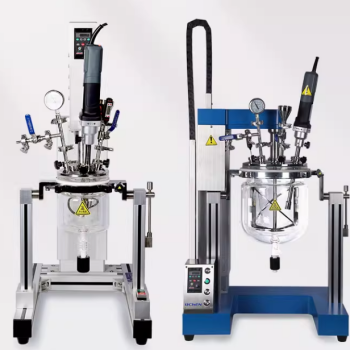
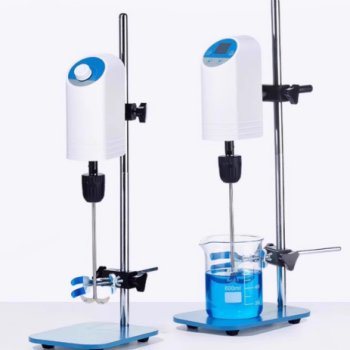
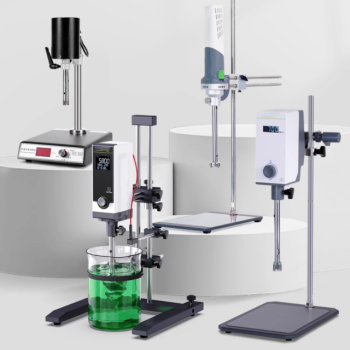
High-energy laboratory stirring or homogenization equipment serves as the critical control mechanism for achieving uniformity in C-S-H synthesis. By applying consistent shear force to the mixture of sodium silicate and calcium salt solutions, this equipment ensures optimal reactant contact. This mechanical intervention is the defining factor in transitioning from a simple mixture to a phase-pure, scientifically viable precipitate.
Core Takeaway
In the wet chemical synthesis of Calcium Silicate Hydrate (C-S-H), high-energy mixing is not merely about blending; it is about defining the material's fundamental architecture. It provides the necessary shear to control stoichiometry and nanostructure, ensuring the resulting material is phase-pure and suitable for rigorous structural and mechanical testing.
The Mechanics of Synthesis
To understand the role of this equipment, one must look at the physical dynamics of the reaction environment. The synthesis involves bringing together distinct aqueous solutions, typically sodium silicate and calcium salts.
Delivering Uniform Shear Force
The primary function of high-energy equipment is the application of uniform shear force. Unlike standard stirring, which may leave dead zones, high-energy homogenization ensures the entire volume experiences the same mixing intensity. This prevents localized areas of high or low concentration, which is essential for phase purity.
Ensuring Reactant Contact
For the reaction to proceed correctly, the reactants must maintain sufficient contact within the aqueous phase. High-energy homogenization forces these reactants together at a microscopic level. This maximizes the efficiency of the chemical interaction and ensures the reaction reaches completion.
Controlling Chemical and Physical Properties
The ultimate goal of using high-energy equipment is to dictate the final properties of the C-S-H precipitate. The equipment acts as a tuning knob for the material's characteristics.
Precision in Stoichiometry
The specific chemical makeup of C-S-H is defined largely by its calcium-to-silicon (C/S) ratio. High-energy mixing is critical for controlling this chemical stoichiometry. By ensuring a homogeneous reaction environment, the equipment allows researchers to achieve the precise C/S ratio intended by the experimental design.
Consistent Nanostructures
Beyond chemistry, the physical structure of the precipitate matters. This process produces near-amorphous precipitates. The intense mixing ensures that the nanostructures and particle sizes formed are consistent across the entire batch, rather than varying due to uneven reaction conditions.
The Impact on Downstream Analysis
Using high-energy equipment is often a prerequisite for valid research data. The quality of the synthesis directly correlates to the reliability of subsequent testing.
The Foundation for Validity
The C-S-H produced via this method serves as the foundation for structural analysis and mechanical testing. If the synthesis is flawed, all downstream data is compromised.
Avoiding Analytical Noise
Phase purity is the priority. Without the uniform mixing intensity provided by this equipment, the sample may contain impurities or structural variances. This inconsistency introduces "noise" into mechanical tests, making it impossible to attribute results accurately to the specific C-S-H phase being studied.
Ensuring Reliability in Your Research
When designing your synthesis protocol, the choice of mixing equipment dictates the quality of your output.
- If your primary focus is Chemical Stoichiometry: Ensure your equipment can deliver sustained, high-shear mixing to lock in a precise C/S ratio.
- If your primary focus is Structural Analysis: Prioritize homogenization intensity to guarantee consistent particle sizes and near-amorphous nanostructures.
By standardizing the mixing energy, you transform a variable chemical reaction into a controlled process, guaranteeing the phase purity required for high-quality scientific inquiry.
Summary Table:
| Feature | Impact on C-S-H Synthesis | Scientific Benefit |
|---|---|---|
| Uniform Shear Force | Eliminates localized concentration gradients | Ensures phase purity and prevents impurities |
| Microscopic Contact | Maximizes reactant interaction in aqueous phase | Efficient reaction completion and high yield |
| Stoichiometric Control | Precision tuning of Calcium-to-Silicon (C/S) ratio | Accurate chemical makeup for structural testing |
| Nanostructure Regulation | Consistent particle size and amorphous formation | Reliable data for mechanical analysis |
Elevate Your Synthesis Precision with KINTEK
Don't let inconsistent mixing compromise your research data. At KINTEK, we specialize in high-performance laboratory equipment designed to meet the rigorous demands of material science. Our advanced homogenizers and high-energy stirring systems provide the uniform shear force necessary to produce phase-pure C-S-H and other complex precipitates.
From crushing and milling systems to high-temperature furnaces and isostatic presses, KINTEK offers a comprehensive range of solutions for researchers who demand stoichiometry precision and structural consistency.
Ready to optimize your lab's output? Contact our experts today to find the perfect equipment for your specific synthesis protocols and ensure the reliability of your downstream analysis.
References
- Laïla Raki, Taijiro Sato. Cement and Concrete Nanoscience and Nanotechnology. DOI: 10.3390/ma3020918
This article is also based on technical information from Kintek Solution Knowledge Base .
Related Products
- High Performance Lab Homogenizer for Pharma Cosmetics and Food R&D
- High Performance Laboratory Stirrers for Diverse Applications
- High Shear Homogenizer for Pharmaceutical and Cosmetic Applications
- Laboratory Disc Rotary Mixer for Efficient Sample Mixing and Homogenization
- High-Energy Omnidirectional Planetary Ball Mill Milling Machine for Laboratory
People Also Ask
- Why is a high-performance homogenizer essential for Fe3O4@C9 anode slurries? Boost Battery Performance & Stability.
- What is the primary function of high-performance homogenizers for SAPO-34 MMMs? Ensure Superior Gas Separation Efficiency
- How do lab stirrers & homogenizers ensure uniform distribution? Optimize Your Complex Multiphase Chemical Mixing
- What role does a laboratory homogenizer play in radioactive cesium detection? Ensure Accuracy in Wildlife Sampling
- How does a laboratory automatic masticator or homogenizer facilitate the processing of biofilm samples? Optimize Accuracy